Solbiati Marco, Ierace Tiziana, Muglia Riccardo, Pedicini Vittorio, Iezzi Roberto, Passera Katia M, Rotilio Alessandro C, Goldberg S Nahum, Solbiati Luigi A
R&D Unit, R.A.W. Srl, 20127 Milano, Italy.
Department of Radiology, IRCCS Humanitas Research Hospital, Rozzano, 20089 Milan, Italy.
Cancers (Basel). 2022 Mar 3;14(5):1312. doi: 10.3390/cancers14051312.
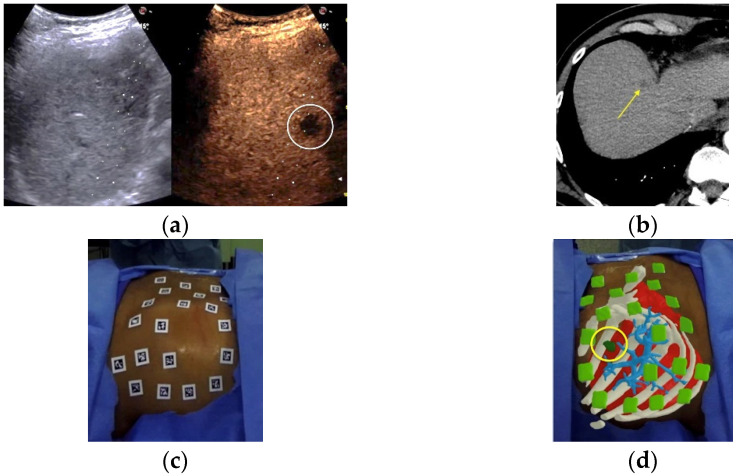
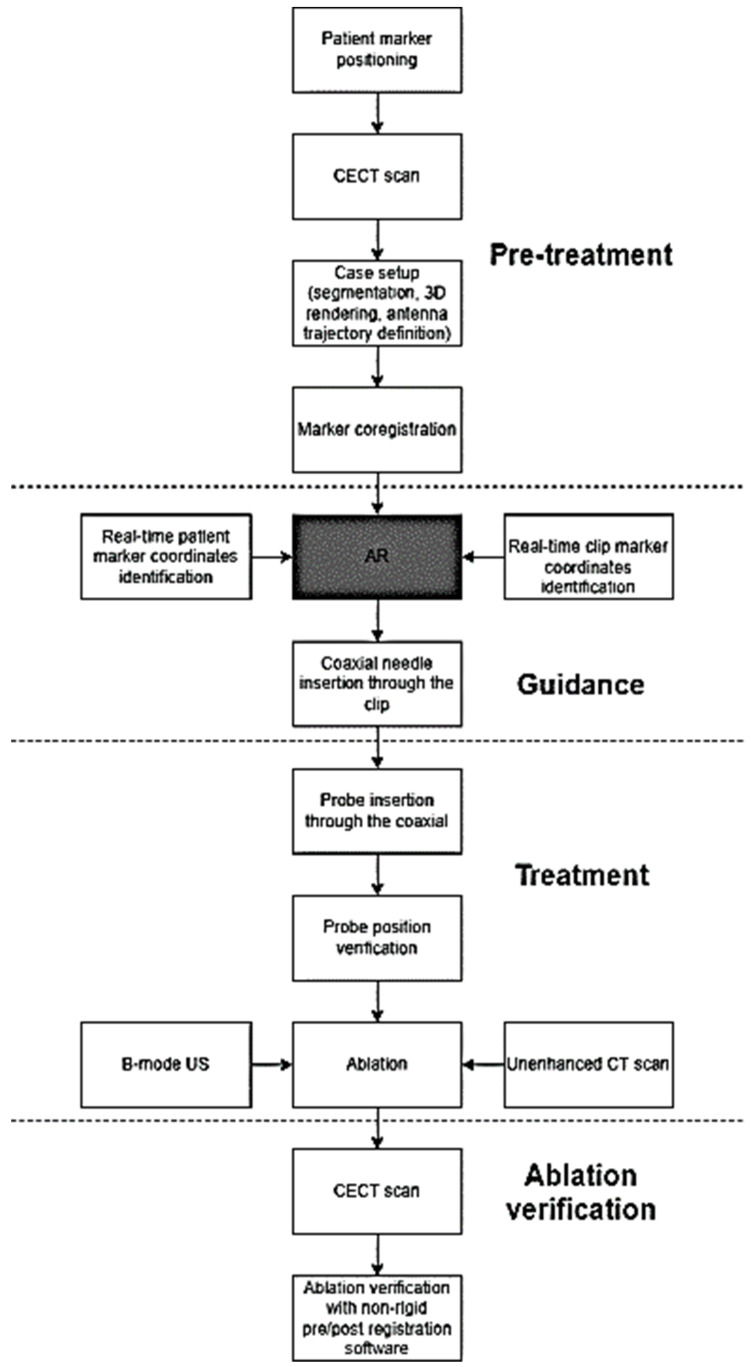
Background: Over the last two decades, augmented reality (AR) has been used as a visualization tool in many medical fields in order to increase precision, limit the radiation dose, and decrease the variability among operators. Here, we report the first in vivo study of a novel AR system for the guidance of percutaneous interventional oncology procedures. Methods: Eight patients with 15 liver tumors (0.7−3.0 cm, mean 1.56 + 0.55) underwent percutaneous thermal ablations using AR guidance (i.e., the Endosight system). Prior to the intervention, the patients were evaluated with US and CT. The targeted nodules were segmented and three-dimensionally (3D) reconstructed from CT images, and the probe trajectory to the target was defined. The procedures were guided solely by AR, with the position of the probe tip was subsequently confirmed by conventional imaging. The primary endpoints were the targeting accuracy, the system setup time, and targeting time (i.e., from the target visualization to the correct needle insertion). The technical success was also evaluated and validated by co-registration software. Upon completion, the operators were assessed for cybersickness or other symptoms related to the use of AR. Results: Rapid system setup and procedural targeting times were noted (mean 14.3 min; 12.0−17.2 min; 4.3 min, 3.2−5.7 min, mean, respectively). The high targeting accuracy (3.4 mm; 2.6−4.2 mm, mean) was accompanied by technical success in all 15 lesions (i.e., the complete ablation of the tumor and 13/15 lesions with a >90% 5-mm periablational margin). No intra/periprocedural complications or operator cybersickness were observed. Conclusions: AR guidance is highly accurate, and allows for the confident performance of percutaneous thermal ablations.
在过去二十年中,增强现实(AR)已在许多医学领域用作可视化工具,以提高精准度、限制辐射剂量并减少操作者之间的差异。在此,我们报告了一项关于新型AR系统用于经皮介入肿瘤手术引导的首例体内研究。方法:8例患有15个肝肿瘤(直径0.7 - 3.0 cm,平均1.56 + 0.55)的患者接受了使用AR引导(即Endosight系统)的经皮热消融术。在干预前,对患者进行了超声和CT检查。从CT图像中分割出目标结节并进行三维(3D)重建,确定了探头至目标的轨迹。手术仅由AR引导,随后通过传统成像确认探头尖端的位置。主要终点是靶向准确性、系统设置时间和靶向时间(即从目标可视化到正确进针)。技术成功率也通过配准软件进行评估和验证。完成后,评估操作者是否有晕动症或与使用AR相关的其他症状。结果:记录到快速的系统设置和手术靶向时间(平均分别为14.3分钟;12.0 - 17.2分钟;4.3分钟,3.2 - 5.7分钟)。高靶向准确性(平均3.4毫米;2.6 - 4.2毫米)伴随着所有15个病灶的技术成功(即肿瘤完全消融,13/15个病灶的消融边缘>90%为5毫米)。未观察到术中/术后并发症或操作者晕动症。结论:AR引导高度准确,能够自信地进行经皮热消融术。