Reita Damien, Pabst Lucile, Pencreach Erwan, Guérin Eric, Dano Laurent, Rimelen Valérie, Voegeli Anne-Claire, Vallat Laurent, Mascaux Céline, Beau-Faller Michèle
Department of Biochemistry and Molecular Biology, Strasbourg University Hospital, CEDEX, 67098 Strasbourg, France.
Bio-Imagery and Pathology (LBP), UMR CNRS 7021, Strasbourg University, 67400 Illkirch-Graffenstaden, France.
Cancers (Basel). 2022 Mar 4;14(5):1321. doi: 10.3390/cancers14051321.
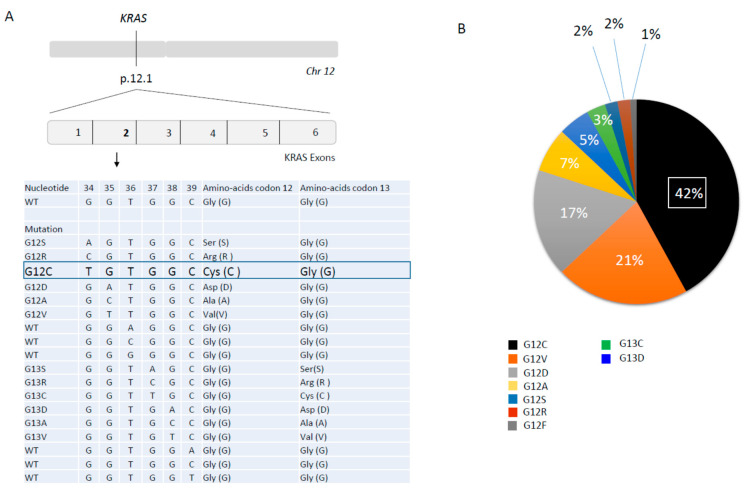
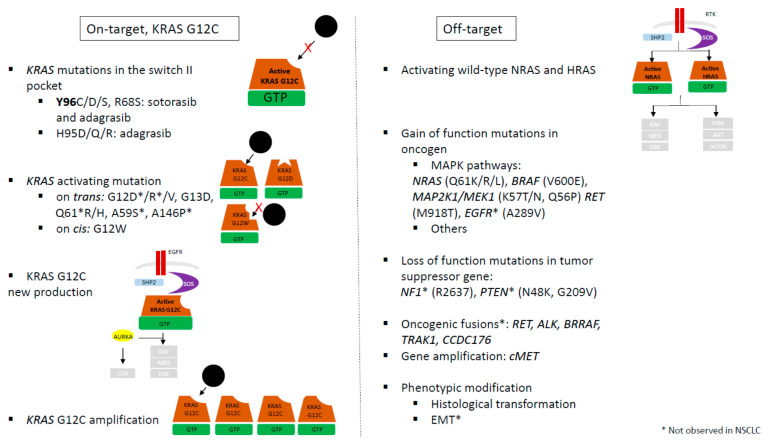
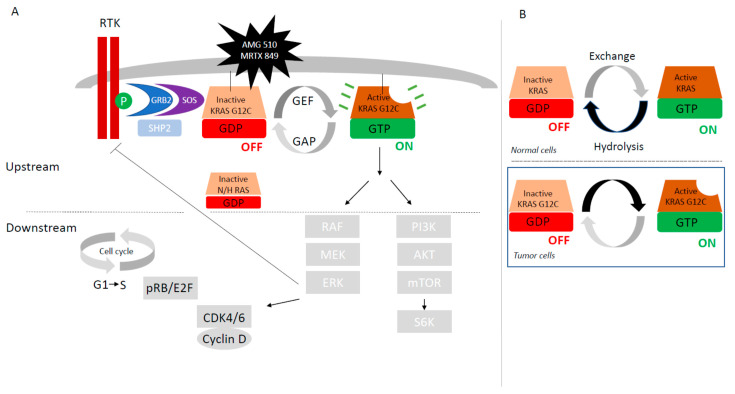
KRAS is the most frequently mutated oncogene in non-small cell lung cancers (NSCLC), with a frequency of around 30%, and encoding a GTPAse that cycles between active form (GTP-bound) to inactive form (GDP-bound). The mutations favor the active form with inhibition of GTPAse activity. mutations are often with poor response of EGFR targeted therapies. mutations are good predictive factor for immunotherapy. The lack of success with direct targeting of KRAS proteins, downstream inhibition of KRAS effector pathways, and other strategies contributed to a focus on developing mutation-specific KRAS inhibitors. p.G12C mutation is one of the most frequent KRAS mutation in NSCLC, especially in current and former smokers (over 40%), which occurs among approximately 12-14% of NSCLC tumors. The mutated cysteine resides next to a pocket (P2) of the switch II region, and P2 is present only in the inactive GDP-bound KRAS. Small molecules such as sotorasib are now the first targeted drugs for G12C mutation, preventing conversion of the mutant protein to GTP-bound active state. Little is known about primary or acquired resistance. Acquired resistance does occur and may be due to genetic alterations in the nucleotide exchange function or adaptative mechanisms in either downstream pathways or in newly expressed G12C mutation.
KRAS是非小细胞肺癌(NSCLC)中最常发生突变的致癌基因,突变频率约为30%,它编码一种GTP酶,该酶在活性形式(结合GTP)和非活性形式(结合GDP)之间循环。这些突变有利于活性形式,同时抑制GTP酶活性。这些突变通常对EGFR靶向治疗反应不佳。这些突变是免疫治疗的良好预测指标。直接靶向KRAS蛋白、KRAS效应途径的下游抑制以及其他策略均未取得成功,这促使人们将重点放在开发针对特定突变的KRAS抑制剂上。p.G12C突变是NSCLC中最常见的KRAS突变之一,尤其是在当前和既往吸烟者中(超过40%),在大约12-14%的NSCLC肿瘤中出现。突变的半胱氨酸位于开关II区域的一个口袋(P2)旁边,而P2仅存在于非活性的结合GDP的KRAS中。索托拉西布等小分子现在是针对G12C突变的首批靶向药物,可防止突变蛋白转化为结合GTP的活性状态。关于原发性或获得性耐药知之甚少。确实会出现获得性耐药,这可能是由于核苷酸交换功能的基因改变或下游途径或新表达的G12C突变中的适应性机制所致。