Kwon Jae Hyun, Lee Jung-Woo, Lee Jong Woo, Lee Young Joo
Department of Surgery, Hallym University Sacred Heart Hospital, Hallym University College of Medicine, Anyang-si 14068, Gyeonggi-do, Korea.
Division of Hepato-Biliary-Pancreatic Surgery, Department of Surgery, Asan Medical Center, University of Ulsan College of Medicine, Seoul 05535, Korea.
J Clin Med. 2022 Mar 2;11(5):1369. doi: 10.3390/jcm11051369.
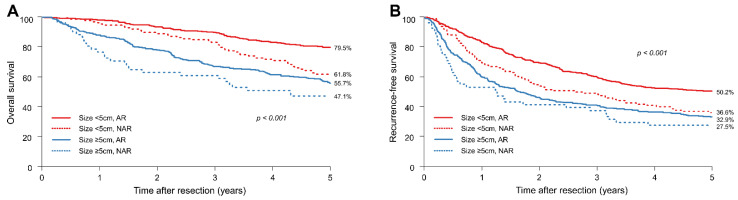
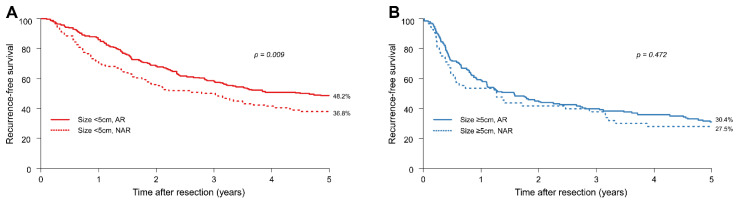
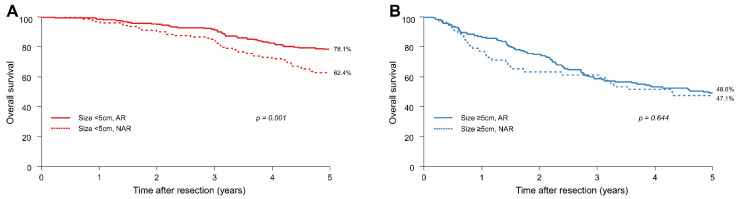
Background: The relative benefit of anatomical resection (AR) versus non-anatomical resection (NAR) in hepatocellular carcinoma (HCC) remains controversial. This study compared the survival outcomes and recurrence rates of HCCs analysed according to tumour size and the extent of resection. Methods: Consecutive patients with HCC who underwent curative resection at Asan Medical Center between January 1999 and December 2009 were included in this study. We performed propensity score matching (PSM) according to tumour size to compare the survival outcomes between AR and NAR. A total of 986 patients were analysed; 812 and 174 patients underwent AR and NAR, respectively. Results: Before PSM, regardless of tumour size, the AR group demonstrated significantly better 5-year overall survival (OS) and recurrence-free survival (RFS) than the NAR group (p < 0.001). After PSM, the AR group demonstrated better OS and RFS rates than the NAR group when tumour size was less than 5 cm, but there was no significant difference in the OS and RFS rates between the two groups when tumour size was equal to or greater than 5 cm. In tumours less than 5 cm in size, AR was the most significant factor associated with OS and RFS. However, this prognostic effect of AR was not demonstrated in tumours with sizes equal to or greater than 5 cm. Conclusion: In patients with HCCs smaller than 5 cm, AR reduced the risk of tumour recurrence and improved OS. In HCCs larger than 5 cm, AR and NAR showed comparable survival outcomes.
在肝细胞癌(HCC)中,解剖性切除(AR)与非解剖性切除(NAR)的相对获益仍存在争议。本研究比较了根据肿瘤大小和切除范围分析的HCC患者的生存结局和复发率。方法:纳入1999年1月至2009年12月在峨山医学中心接受根治性切除的连续HCC患者。我们根据肿瘤大小进行倾向评分匹配(PSM),以比较AR和NAR之间的生存结局。共分析了986例患者;分别有812例和174例患者接受了AR和NAR。结果:在PSM之前,无论肿瘤大小,AR组的5年总生存期(OS)和无复发生存期(RFS)均显著优于NAR组(p < 0.001)。PSM后,当肿瘤大小小于5 cm时,AR组的OS和RFS率优于NAR组,但当肿瘤大小等于或大于5 cm时,两组的OS和RFS率无显著差异。在肿瘤大小小于5 cm的患者中,AR是与OS和RFS相关的最显著因素。然而,AR的这种预后作用在肿瘤大小等于或大于5 cm的患者中未得到证实。结论:在肿瘤大小小于5 cm的HCC患者中,AR降低了肿瘤复发风险并改善了OS。在肿瘤大小大于5 cm的HCC患者中,AR和NAR的生存结局相当。