Division of Transplantation and Vascular Surgery.
Division of Hepatobiliary Surgery, Department of Surgery, Dongsan Medical Center, Keimyung University School of Medicine, Daegu, Korea.
Int J Surg. 2023 Sep 1;109(9):2784-2793. doi: 10.1097/JS9.0000000000000503.
Despite retrospective studies comparing anatomical liver resection (AR) and non-anatomical liver resection (NAR), the efficacy and benefits of AR for hepatocellular carcinoma remain unclear.
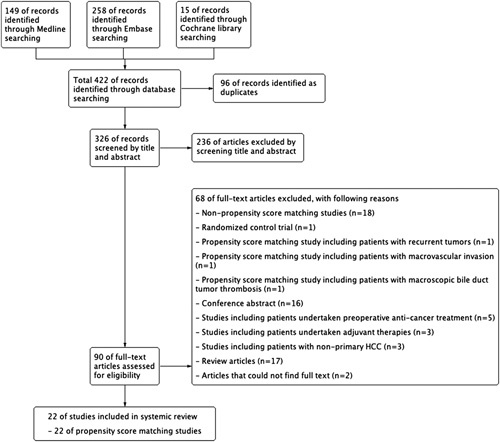
The authors systemically reviewed MEDLINE, Embase, and Cochrane Library for propensity score matched cohort studies that compared AR and NAR for hepatocellular carcinoma. Primary outcomes were overall survival (OS) and recurrence-free survival (RFS). Secondary outcomes were recurrence patterns and perioperative outcomes.
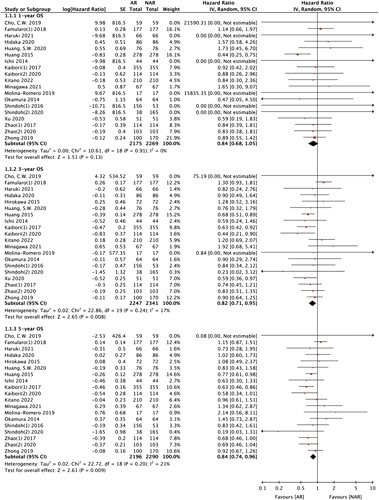
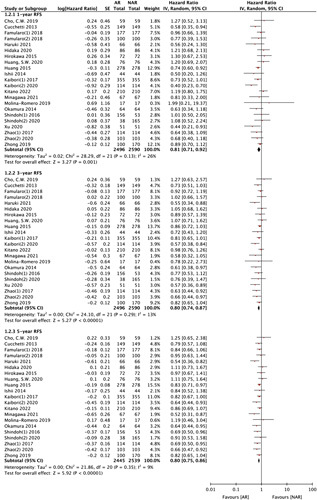
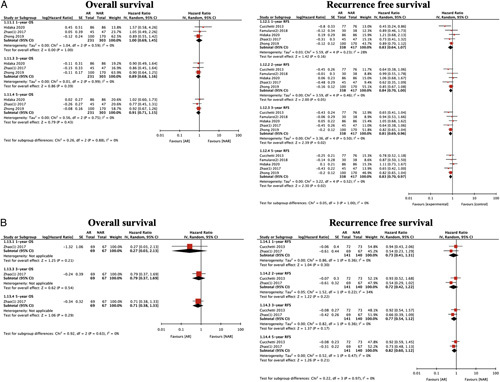
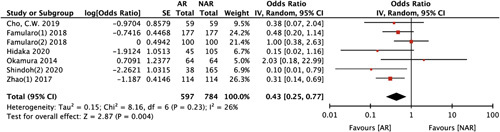
Overall, 22 propensity score matched studies (AR, n =2,496; NAR, n =2590) were included. AR including systemic segmentectomy was superior to NAR regarding the 3-year and 5-year OS. AR showed significantly better 1-year, 3-year, and 5-year RFS than NAR, with low local and multiple intrahepatic recurrence rates. In the subgroup analyses of tumour diameter less than or equal to 5 cm and tumours with microscopic spread, the RFS in the AR group was significantly better than that in the NAR group. Patients with cirrhotic liver in the AR group showed comparable 3-year and 5-year RFS with the NAR group. Postoperative overall complications were comparable between AR and NAR.
This meta-analysis demonstrated that AR showed better OS and RFS with a low local and multiple intra-hepatic recurrence rate than NAR, especially in patients with tumour diameter less than or equal to 5 cm and non-cirrhotic liver.
尽管有回顾性研究比较了解剖性肝切除术(AR)和非解剖性肝切除术(NAR),但 AR 治疗肝细胞癌的疗效和益处仍不清楚。
作者系统地检索了 MEDLINE、Embase 和 Cochrane Library 中的倾向评分匹配队列研究,比较了 AR 和 NAR 治疗肝细胞癌的效果。主要结局指标是总生存期(OS)和无复发生存期(RFS)。次要结局指标是复发模式和围手术期结局。
共纳入 22 项倾向评分匹配研究(AR 组 n =2496,NAR 组 n =2590)。包括系统性节段切除术在内的 AR 在 3 年和 5 年 OS 方面优于 NAR。AR 在 1 年、3 年和 5 年 RFS 方面明显优于 NAR,局部和多发肝内复发率较低。在肿瘤直径≤5 cm 和有显微镜下扩散的肿瘤亚组分析中,AR 组的 RFS 明显优于 NAR 组。AR 组肝硬化患者的 3 年和 5 年 RFS 与 NAR 组相当。AR 和 NAR 两组术后总并发症发生率相当。
这项荟萃分析表明,AR 与 NAR 相比,具有更好的 OS 和 RFS,且局部和多发肝内复发率较低,尤其是在肿瘤直径≤5 cm 和非肝硬化肝脏的患者中。