Center for Nuclear Energy in Agriculture, University of Sao Paulo, Piracicaba 13416-000, Brazil.
Molecules. 2022 Feb 26;27(5):1563. doi: 10.3390/molecules27051563.
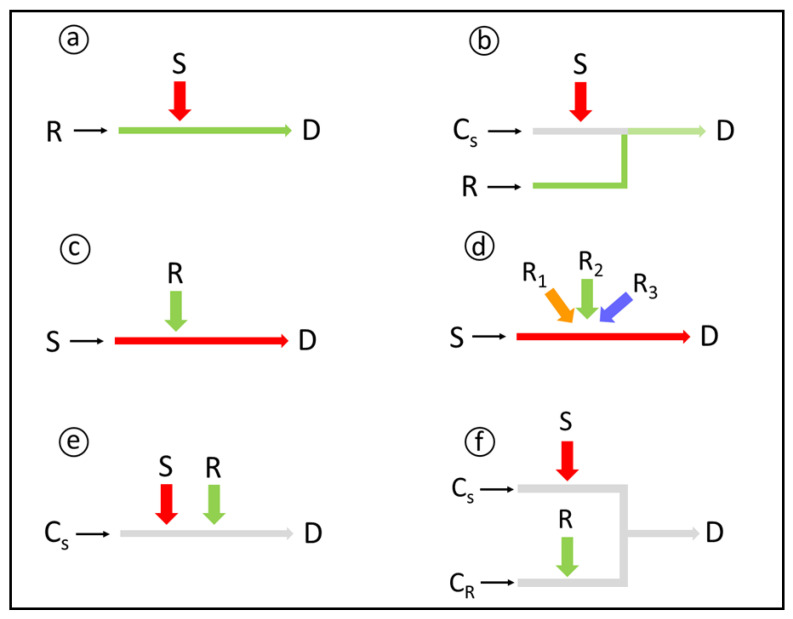
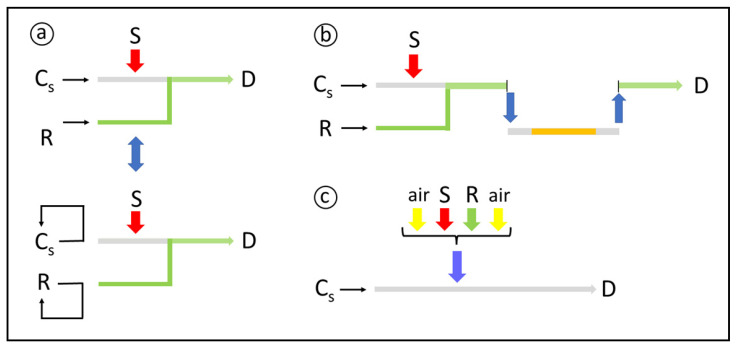
Chemical derivatization for improving selectivity and/or sensitivity is a common practice in analytical chemistry. It is particularly attractive in flow analysis in view of its highly reproducible reagent addition(s) and controlled timing. Then, measurements without attaining the steady state, kinetic discrimination, exploitation of unstable reagents and/or products, as well as strategies compliant with Green Analytical Chemistry, have been efficiently exploited. Flow-based chemical derivatization has been accomplished by different approaches, most involving flow and manifold programming. Solid-phase reagents, novel strategies for sample insertion and reagent addition, as well as to increase sample residence time have been also exploited. However, the required alterations in flow rates and/or manifold geometry may lead to spurious signals (e.g., Schlieren effect) resulting in distorted peaks and a noisy/drifty baseline. These anomalies can be circumvented by a proper flow system design. In this review, these aspects are critically discussed mostly in relation to spectrophotometric and luminometric detection.
化学衍生化是提高分析选择性和/或灵敏度的常用方法,在流动分析中尤其具有吸引力,因为它可以高度重现地添加试剂并控制时间。因此,在未达到稳定状态的情况下进行测量、动力学分辨、利用不稳定试剂和/或产物,以及符合绿色分析化学的策略都得到了有效利用。基于流动的化学衍生化可以通过不同的方法来实现,大多数涉及到流动和流路编程。还可以利用固相试剂、新型样品插入和试剂添加策略以及增加样品停留时间。然而,流速和/或流路几何形状的变化可能会导致虚假信号(例如,纹影效应),从而导致峰形扭曲和基线噪声/漂移。这些异常可以通过适当的流路系统设计来避免。在本文中,主要从分光光度法和发光光度法检测的角度对这些方面进行了批判性讨论。