Department of Gynecological Endocrinology, Poznan University of Medical Sciences, 60-535 Poznan, Poland.
Department of Gynecological Endocrinology, Medical University of Warsaw, 00-315 Warsaw, Poland.
Int J Environ Res Public Health. 2022 Mar 6;19(5):3089. doi: 10.3390/ijerph19053089.
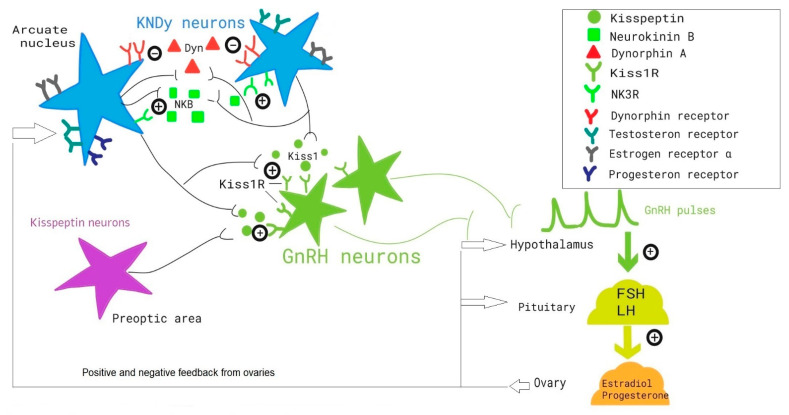
Polycystic ovary syndrome (PCOS) is the most common endocrine disorder in women and a major cause of anovulatory infertility. A diagnosis of PCOS is established based the presence of two out of three clinical symptoms, which are criteria accepted by the ESHRE/ASRM (European Society of Human Reproduction and Embryology/American Society for Reproductive Medicine). Gonadotropin-releasing hormone (GnRH) is responsible for the release of luteinizing hormone, and follicle stimulating hormone from the pituitary and contributes a leading role in controlling reproductive function in humans. The goal of this review is to present the current knowledge on neuroendocrine determinations of PCOS. The role of such neurohormones as GnRH, and neuropeptides kisspeptin, neurokinin B, phoenixin-14, and galanin is discussed in this aspect. Additionally, different neurotransmitters (gamma-aminobutyric acid (GABA), glutamate, serotonin, dopamine, and acetylcholine) can also be involved in neuroendocrine etiopathogenesis of PCOS. Studies have shown a persistent rapid GnRH pulse frequency in women with PCOS present during the whole ovulatory cycle. Other studies have proved that patients with PCOS are characterized by higher serum kisspeptin levels. The observations of elevated serum kisspeptin levels in PCOS correspond with the hypothesis that overactivity in the kisspeptin system is responsible for hypothalamic-pituitary-gonadal axis overactivity. In turn, this causes menstrual disorders, hyperandrogenemia and hyperandrogenism. Moreover, abnormal regulation of Neurokinin B (NKB) is also suspected of contributing to PCOS development, while NKB antagonists are used in the treatment of PCOS leading to reduction in Luteinizing hormone (LH) concentration and total testosterone concentration. GnRH secretion is regulated not only by kisspeptin and neurokinin B, but also by other neurohormones, such as phoenixin-14, galanin, and Glucagon-like peptide-1 (GLP-1), that have favorable effects in counteracting the progress of PCOS. A similar process is associated with the neurotransmitters such as GABA, glutamate, serotonin, dopamine, and acetylcholine, as well as the opioid system, which may interfere with secretion of GnRH, and therefore, influence the development and severity of symptoms in PCOS patients. Additional studies are required to explain entire, real mechanisms responsible for PCOS neuroendocrine background.
多囊卵巢综合征(PCOS)是女性最常见的内分泌疾病之一,也是无排卵性不孕的主要原因。PCOS 的诊断基于三个临床症状中的两个,这是 ESHRE/ASRM(欧洲人类生殖与胚胎学会/美国生殖医学学会)认可的标准。促性腺激素释放激素(GnRH)负责从垂体释放黄体生成素和卵泡刺激素,并在控制人类生殖功能方面发挥主导作用。本综述的目的是介绍目前关于 PCOS 的神经内分泌测定的知识。在这方面,讨论了 GnRH 等神经激素以及神经肽 kisspeptin、神经激肽 B、凤凰素-14 和甘丙肽的作用。此外,不同的神经递质(γ-氨基丁酸(GABA)、谷氨酸、血清素、多巴胺和乙酰胆碱)也可能参与 PCOS 的神经内分泌发病机制。研究表明,在整个排卵周期中,患有 PCOS 的女性持续存在快速 GnRH 脉冲频率。其他研究已经证明,患有 PCOS 的患者的血清 kisspeptin 水平较高。在 PCOS 中观察到的血清 kisspeptin 水平升高与 kisspeptin 系统过度活跃导致下丘脑-垂体-性腺轴过度活跃的假设相符。反过来,这会导致月经紊乱、高雄激素血症和高雄激素症。此外,神经激肽 B(NKB)的异常调节也被怀疑有助于 PCOS 的发展,而 NKB 拮抗剂被用于治疗 PCOS,导致黄体生成素(LH)浓度和总睾酮浓度降低。GnRH 的分泌不仅受到 kisspeptin 和神经激肽 B 的调节,还受到其他神经激素的调节,如凤凰素-14、甘丙肽和胰高血糖素样肽-1(GLP-1),它们对对抗 PCOS 的进展有积极作用。类似的过程与神经递质如 GABA、谷氨酸、血清素、多巴胺和乙酰胆碱以及阿片样物质系统有关,这些物质可能干扰 GnRH 的分泌,从而影响 PCOS 患者的病情发展和严重程度。需要进一步的研究来解释导致 PCOS 神经内分泌背景的全部真实机制。