Olszewska Alicja M, Gaca Maciej, Herman Aleksandra M, Jednoróg Katarzyna, Marchewka Artur
Laboratory of Brain Imaging, Nencki Institute of Experimental Biology of the Polish Academy of Sciences, Warsaw, Poland.
Laboratory of Language Neurobiology, Nencki Institute of Experimental Biology of the Polish Academy of Sciences, Warsaw, Poland.
Front Neurosci. 2021 Mar 10;15:630829. doi: 10.3389/fnins.2021.630829. eCollection 2021.
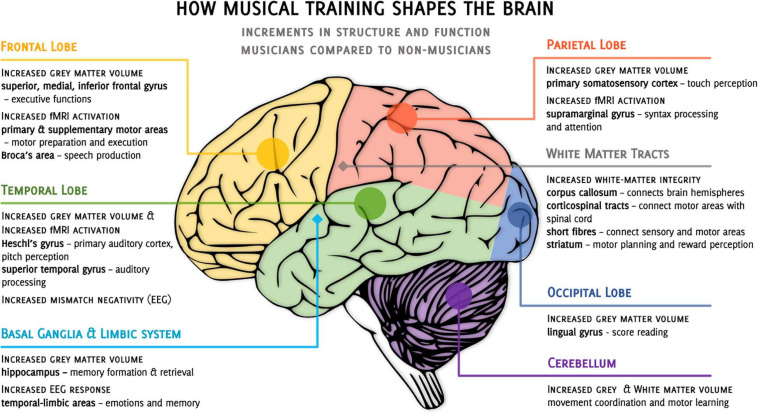
Learning to play a musical instrument is a complex task that integrates multiple sensory modalities and higher-order cognitive functions. Therefore, musical training is considered a useful framework for the research on training-induced neuroplasticity. However, the classical nature-or-nurture question remains, whether the differences observed between musicians and non-musicians are due to predispositions or result from the training itself. Here we present a review of recent publications with strong focus on experimental designs to better understand both brain reorganization and the neuronal markers of predispositions when learning to play a musical instrument. Cross-sectional studies identified structural and functional differences between the brains of musicians and non-musicians, especially in regions related to motor control and auditory processing. A few longitudinal studies showed functional changes related to training while listening to and producing music, in the motor network and its connectivity with the auditory system, in line with the outcomes of cross-sectional studies. Parallel changes within the motor system and between the motor and auditory systems were revealed for structural connectivity. In addition, potential predictors of musical learning success were found including increased brain activation in the auditory and motor systems during listening, the microstructure of the arcuate fasciculus, and the functional connectivity between the auditory and the motor systems. We show that "the musical brain" is a product of both the natural human neurodiversity and the training practice.
学习演奏乐器是一项复杂的任务,它整合了多种感觉模态和高阶认知功能。因此,音乐训练被认为是研究训练诱导的神经可塑性的一个有用框架。然而,经典的先天与后天问题仍然存在,即音乐家和非音乐家之间观察到的差异是由于先天倾向还是训练本身的结果。在这里,我们对最近的出版物进行综述,重点关注实验设计,以便更好地理解学习演奏乐器时的大脑重组和先天倾向的神经元标志物。横断面研究确定了音乐家和非音乐家大脑之间的结构和功能差异,特别是在与运动控制和听觉处理相关的区域。一些纵向研究显示,在听音乐和演奏音乐时,与训练相关的功能变化发生在运动网络及其与听觉系统的连接中,这与横断面研究的结果一致。在结构连接方面,揭示了运动系统内部以及运动系统和听觉系统之间的平行变化。此外,还发现了音乐学习成功的潜在预测因素,包括在听音乐时听觉和运动系统中大脑激活的增加、弓状束的微观结构以及听觉和运动系统之间的功能连接。我们表明,“音乐大脑”是人类自然神经多样性和训练实践的产物。