Department of Geography, Johannes Gutenberg University, Mainz, Germany.
Department of Forestry, University of Applied Sciences Weihenstephan-Triesdorf, Triesdorf, Germany.
Commun Biol. 2022 Mar 10;5(1):163. doi: 10.1038/s42003-022-03107-3.
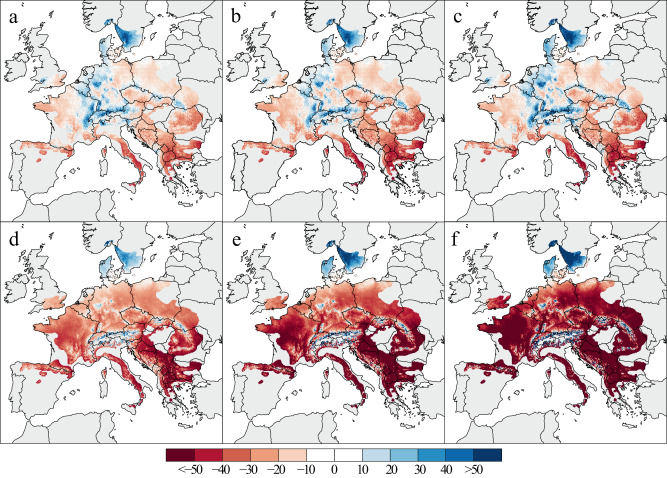
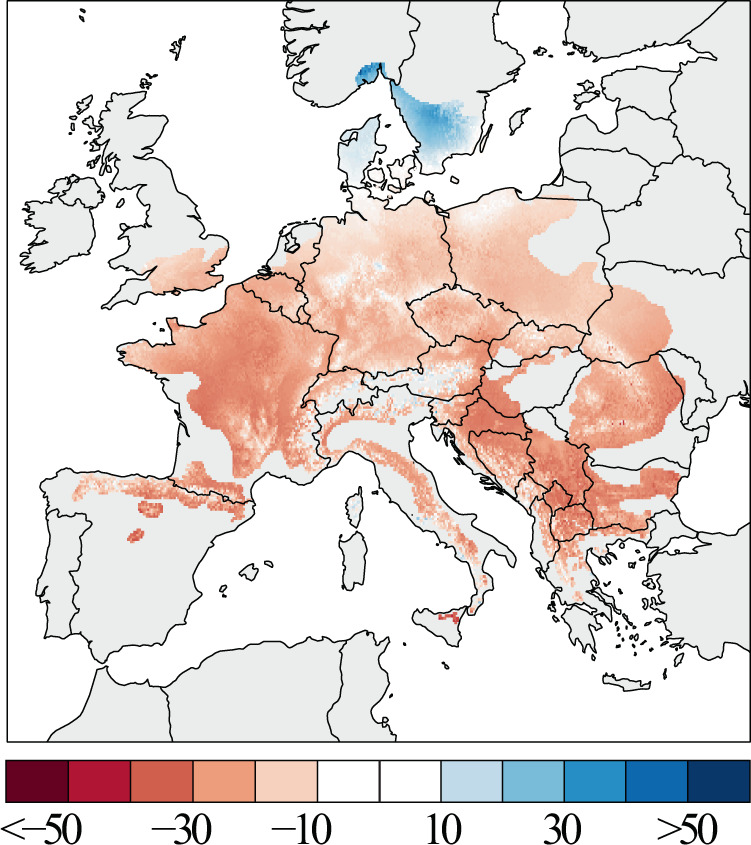
The growth of past, present, and future forests was, is and will be affected by climate variability. This multifaceted relationship has been assessed in several regional studies, but spatially resolved, large-scale analyses are largely missing so far. Here we estimate recent changes in growth of 5800 beech trees (Fagus sylvatica L.) from 324 sites, representing the full geographic and climatic range of species. Future growth trends were predicted considering state-of-the-art climate scenarios. The validated models indicate growth declines across large region of the distribution in recent decades, and project severe future growth declines ranging from -20% to more than -50% by 2090, depending on the region and climate change scenario (i.e. CMIP6 SSP1-2.6 and SSP5-8.5). Forecasted forest productivity losses are most striking towards the southern distribution limit of Fagus sylvatica, in regions where persisting atmospheric high-pressure systems are expected to increase drought severity. The projected 21 century growth changes across Europe indicate serious ecological and economic consequences that require immediate forest adaptation.
过去、现在和未来森林的生长都受到气候变异性的影响。这种多方面的关系已经在一些区域研究中进行了评估,但迄今为止,空间分辨率高的大规模分析还很大程度上缺失。在这里,我们估计了 5800 棵山毛榉树(Fagus sylvatica L.)在 324 个地点的近期生长变化,这些地点代表了该物种的全部地理和气候范围。考虑到最先进的气候情景,我们预测了未来的生长趋势。经验证的模型表明,在过去几十年里,该物种分布的大部分地区的生长都出现了下降,并预计到 2090 年,根据不同的地区和气候变化情景(即 CMIP6 SSP1-2.6 和 SSP5-8.5),未来的生长将严重下降,降幅从-20%到超过-50%不等。在山毛榉树分布的南部极限地区,以及预计大气高压系统持续存在的地区,预计森林生产力的损失最为显著,这些地区的干旱严重程度预计将增加。欧洲 21 世纪的生长变化预测表明,这将带来严重的生态和经济后果,需要立即进行森林适应。