Data Science Institute, Vanderbilt University, Nashville, Tennessee, USA.
Department of Health Policy, Vanderbilt University Medical Center, Nashville, Tennessee, USA.
Health Serv Res. 2022 Aug;57(4):963-972. doi: 10.1111/1475-6773.13972. Epub 2022 Mar 27.
To develop an algorithm using administrative data to measure adverse childhood experiences (ADM-ACE) within routinely collected health insurance claims and enrollment data.
We used claims and enrollment data from Tennessee's Medicaid program (TennCare) in 2018.
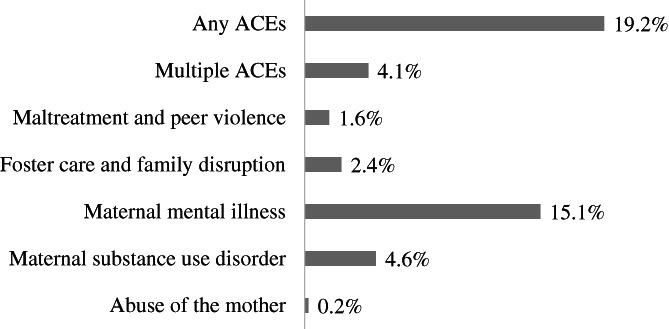
We studied five types of ACEs: maltreatment and peer violence, foster care and family disruption, maternal mental illness, maternal substance use disorder, and abuse of the mother. We used diagnosis and procedure codes, prescription drug fills, and enrollment files to develop the ADM-ACE, which we applied to measure the prevalence of ACEs and to examine prevalence by demographic characteristics among our sample of children in TennCare. We compared ADM-ACE prevalence to child welfare records and survey results from Tennessee.
DATA COLLECTION/EXTRACTION METHODS: Our study sample included children aged 0-17 years who were linked to their mothers if also enrolled in TennCare in 2018 (N = 763,836 children).
Approximately 19.2% of children in TennCare had indicators for ADM-ACEs. The prevalence of ACEs was higher among children who were younger (p < 0.001), non-Hispanic white or black (compared to Hispanic) (p < 0.001), and children residing in rural versus urban counties (p < 0.001). The prevalence of maltreatment identified through the ADM-ACE (1.6%) falls between the percent of children in Tennessee who were reported to child welfare authorities and the percent for whom reports of maltreatment were substantiated. Comparison with survey reports from Tennessee parents suggests an advantage in measuring maternal mental illness with the ADM-ACE using health insurance claims data.
The ADM-ACE can be applied to health encounter data to study and monitor the prevalence of certain ACEs, their association with health conditions, and the effects of policies on reducing exposure to ACEs or improving health outcomes for children with ACEs.
利用管理数据开发一种算法,以便在常规收集的健康保险索赔和登记数据中测量不良儿童经历(ADM-ACE)。
我们使用了 2018 年田纳西州医疗补助计划(TennCare)的索赔和登记数据。
我们研究了五种 ACE 类型:虐待和同伴暴力、寄养和家庭破裂、母亲精神疾病、母亲药物滥用障碍以及对母亲的虐待。我们使用诊断和程序代码、处方药配药和登记文件来开发 ADM-ACE,并用其来衡量 ACE 的流行程度,并在我们的 TennCare 儿童样本中按人口特征检查流行程度。我们将 ADM-ACE 的流行率与儿童福利记录和田纳西州的调查结果进行了比较。
数据收集/提取方法:我们的研究样本包括 2018 年年龄在 0-17 岁之间且与母亲一起参加 TennCare 的儿童(N=763836 名儿童)。
TennCare 中约有 19.2%的儿童有 ADM-ACE 指标。年龄较小的儿童(p<0.001)、非西班牙裔白人或黑人(与西班牙裔相比)(p<0.001)以及居住在农村县而非城市县的儿童(p<0.001)ACE 的发生率更高。通过 ADM-ACE 确定的虐待发生率(1.6%)介于向儿童福利机构报告的儿童比例和虐待报告得到证实的儿童比例之间。与田纳西州父母的调查报告相比,使用健康保险索赔数据通过 ADM-ACE 衡量母亲精神疾病具有优势。
ADM-ACE 可应用于健康接触数据,以研究和监测某些 ACE 的流行程度、它们与健康状况的关联以及政策对减少 ACE 暴露或改善 ACE 儿童健康结果的影响。