Department of Chemistry and Chemical Biology and Weill Institute for Cell and Molecular Biology, Cornell University, Ithaca, New York, USA.
Department of Chemistry and Chemical Biology and Weill Institute for Cell and Molecular Biology, Cornell University, Ithaca, New York, USA.
J Biol Chem. 2022 Apr;298(4):101810. doi: 10.1016/j.jbc.2022.101810. Epub 2022 Mar 8.
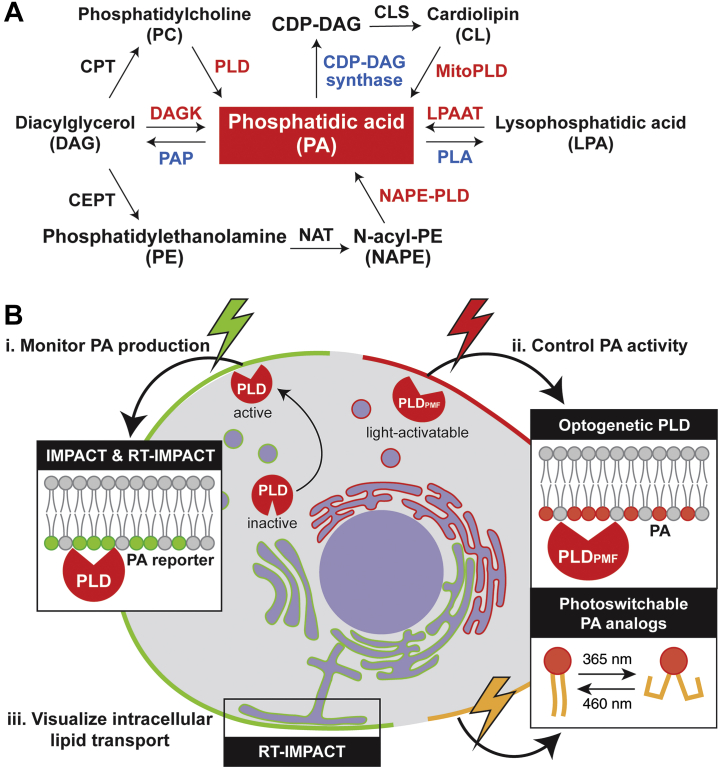
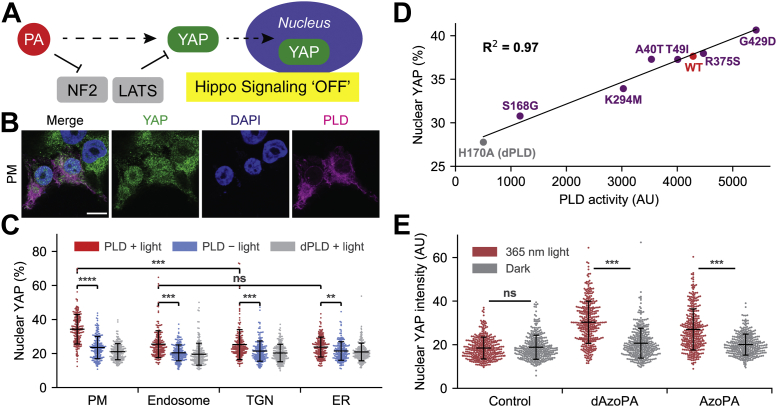
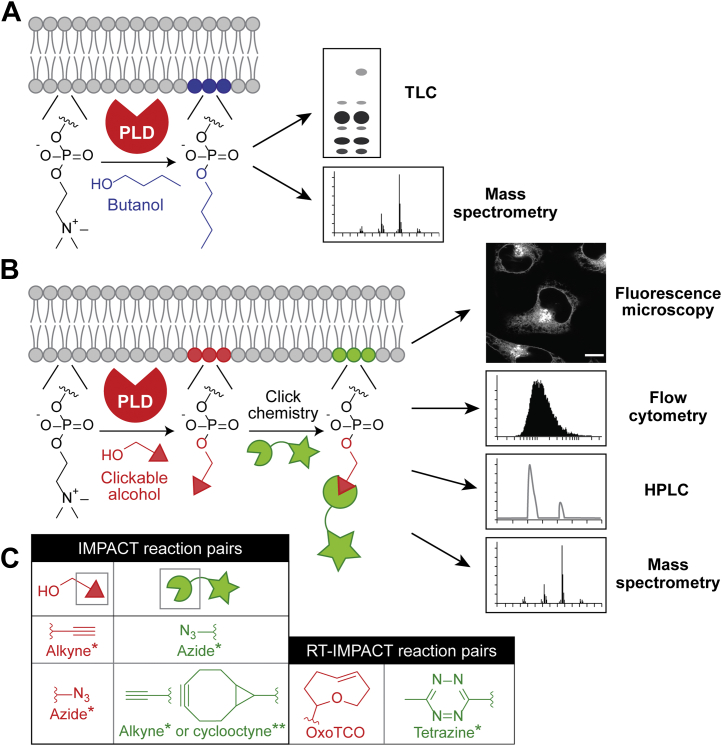
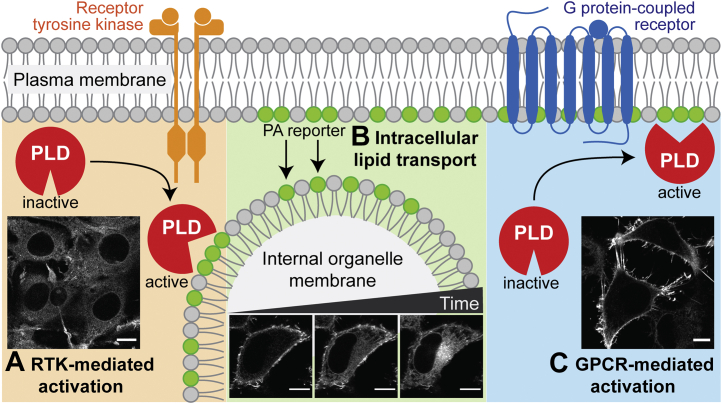
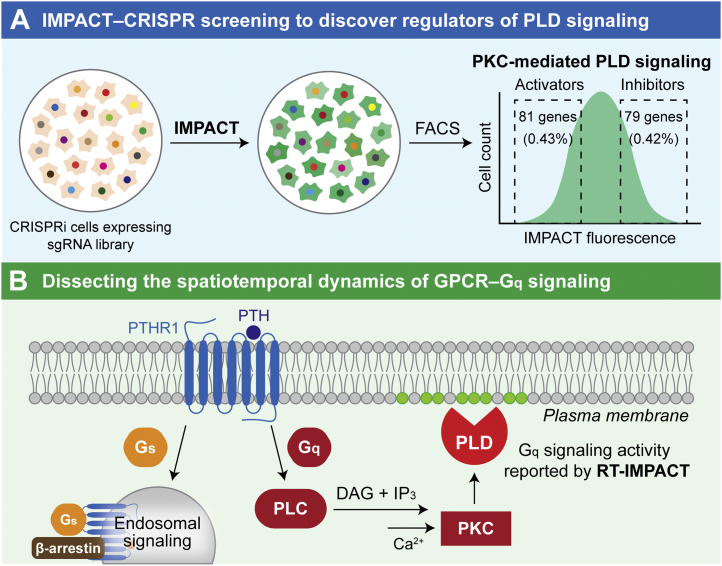
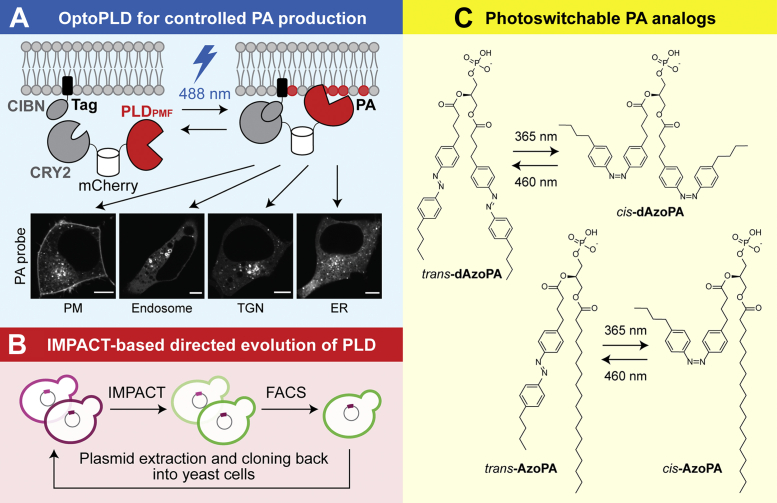
The simple structure of phosphatidic acid (PA) belies its complex biological functions as both a key phospholipid biosynthetic intermediate and a potent signaling molecule. In the latter role, PA controls processes including vesicle trafficking, actin dynamics, cell growth, and migration. However, experimental methods to decode the pleiotropy of PA are sorely lacking. Because PA metabolism and trafficking are rapid, approaches to accurately visualize and manipulate its levels require high spatiotemporal precision. Here, we describe recent efforts to create a suite of chemical tools that enable imaging and perturbation of PA signaling. First, we describe techniques to visualize PA production by phospholipase D (PLD) enzymes, which are major producers of PA, called Imaging Phospholipase D Activity with Clickable Alcohols via Transphosphatidylation (IMPACT). IMPACT harnesses the ability of endogenous PLD enzymes to accept bioorthogonally tagged alcohols in transphosphatidylation reactions to generate functionalized reporter lipids that are subsequently fluorescently tagged via click chemistry. Second, we describe two light-controlled approaches for precisely manipulating PA signaling. Optogenetic PLDs use light-mediated heterodimerization to recruit a bacterial PLD to desired organelle membranes, and photoswitchable PA analogs contain azobenzene photoswitches in their acyl tails, enabling molecular shape and bioactivity to be controlled by light. We highlight select applications of these tools for studying GPCR-G signaling, discovering regulators of PLD signaling, tracking intracellular lipid transport pathways, and elucidating new oncogenic signaling roles for PA. We envision that these chemical tools hold promise for revealing many new insights into lipid signaling pathways.
磷脂酸(PA)的结构简单,但其作为关键的磷脂生物合成中间产物和有效的信号分子,具有复杂的生物学功能。在后一种作用中,PA 控制着包括囊泡运输、肌动蛋白动力学、细胞生长和迁移在内的各种过程。然而,解码 PA 多效性的实验方法却严重缺乏。由于 PA 的代谢和运输速度很快,因此需要高精度的空间和时间来准确地可视化和操纵其水平。在这里,我们描述了最近为创建一套可用于成像和干扰 PA 信号的化学工具而做出的努力。首先,我们描述了可视化磷脂酶 D(PLD)酶产生 PA 的技术,PLD 酶是 PA 的主要产生者,称为通过转磷酸化的可点击醇的磷脂酶 D 活性成像(IMPACT)。IMPACT 利用内源性 PLD 酶在转磷酸化反应中接受生物正交标记醇的能力,生成随后通过点击化学标记的功能性报告脂质。其次,我们描述了两种用于精确操纵 PA 信号的光控方法。光遗传学 PLD 使用光介导的异二聚化将细菌 PLD 募集到所需的细胞器膜上,而光可切换的 PA 类似物在其酰基尾部含有偶氮苯光开关,从而可以通过光控制分子形状和生物活性。我们重点介绍了这些工具在研究 GPCR-G 信号、发现 PLD 信号调节剂、跟踪细胞内脂质运输途径以及阐明 PA 新的致癌信号作用方面的应用。我们设想,这些化学工具有望为揭示脂质信号通路的许多新见解提供前景。