Karonova Tatiana L, Chernikova Alena T, Golovatyuk Ksenia A, Bykova Ekaterina S, Grant William B, Kalinina Olga V, Grineva Elena N, Shlyakhto Evgeny V
Clinical Endocrinology Laboratory, Department of Endocrinology, Almazov National Medical Research Centre, 194021 Saint Petersburg, Russia.
Sunlight, Nutrition, and Health Research Center, San Francisco, CA 94164-1603, USA.
Nutrients. 2022 Jan 24;14(3):505. doi: 10.3390/nu14030505.
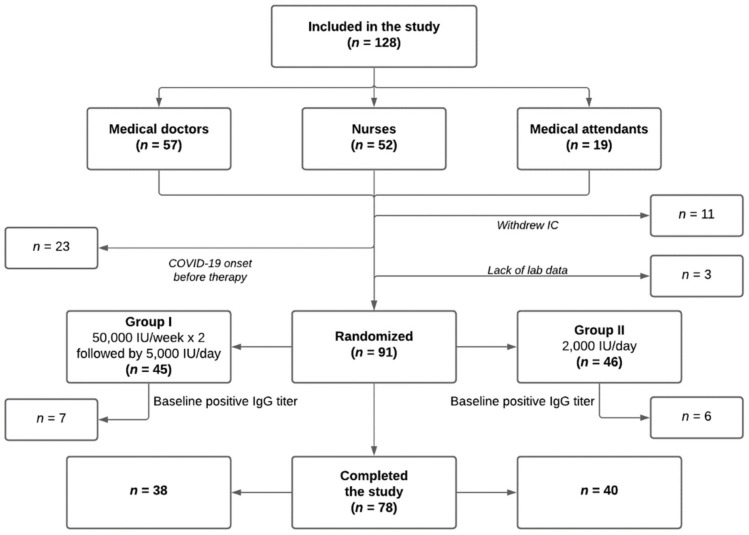
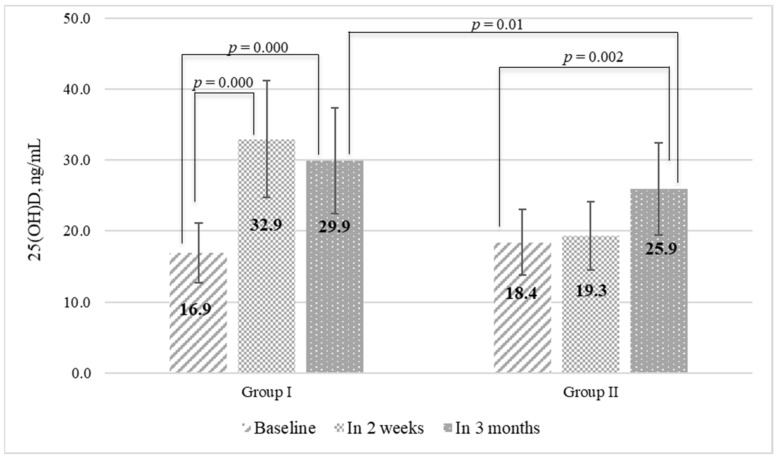
In the last 2 years, observational studies have shown that a low 25-hydroxyvitamin D (25(OH)D) level affected the severity of infection with the novel coronavirus (COVID-19). This study aimed to analyze the potential effect of vitamin D supplementation in reducing SARS-CoV-2 infection morbidity and severity in health care workers. Of 128 health care workers, 91 (consisting of 38 medical doctors (42%), 38 nurses (42%), and 15 medical attendants (16%)) were randomized into two groups receiving vitamin D supplementation. Participants of group I ( = 45) received water-soluble cholecalciferol at a dose of 50,000 IU/week for 2 consecutive weeks, followed by 5000 IU/day for the rest of the study. Participants of group II ( = 46) received water-soluble cholecalciferol at a dose of 2000 IU/day. For both groups, treatment lasted 3 months. Baseline serum 25(OH)D level in health care workers varied from 3.0 to 65.1 ng/mL (median, 17.7 (interquartile range, 12.2; 24.7) ng/mL). Vitamin D deficiency, insufficiency, and normal vitamin D status were diagnosed in 60%, 30%, and 10%, respectively. Only 78 subjects completed the study. Vitamin D supplementation was associated with an increase in serum 25(OH)D level, but only intake of 5000 IU/day was accompanied by normalization of serum 25(OH)D level, which occurred in 53% of cases. Neither vitamin D intake nor vitamin D deficiency/insufficiency were associated with a decrease in SARS-CoV-2 morbidity (odds ratio = 2.27; 95% confidence interval, 0.72 to 7.12). However, subjects receiving high-dose vitamin D had only asymptomatic SARS-CoV-2 in 10 (26%) cases; at the same time, participants who received 2000 IU/day showed twice as many SARS-CoV-2 cases, with mild clinical features in half of them.
在过去两年中,观察性研究表明,低水平的25-羟基维生素D(25(OH)D)会影响新型冠状病毒(COVID-19)感染的严重程度。本研究旨在分析补充维生素D对降低医护人员感染严重急性呼吸综合征冠状病毒2(SARS-CoV-2)的发病率和严重程度的潜在作用。在128名医护人员中,91人(包括38名医生(42%)、38名护士(42%)和15名医护助理(16%))被随机分为两组接受维生素D补充剂。第一组(n = 45)的参与者连续两周每周接受剂量为50,000 IU的水溶性胆钙化醇,在研究的剩余时间里每天接受5000 IU。第二组(n = 46)的参与者每天接受剂量为2000 IU的水溶性胆钙化醇。两组的治疗均持续3个月。医护人员的基线血清25(OH)D水平在3.0至65.1 ng/mL之间(中位数为17.7(四分位间距为12.2;24.7)ng/mL)。维生素D缺乏、不足和维生素D状态正常的诊断率分别为60%、30%和10%。只有78名受试者完成了研究。补充维生素D与血清25(OH)D水平升高有关,但只有每天摄入5000 IU时血清25(OH)D水平才会正常化,这种情况发生在53%的病例中。维生素D摄入量和维生素D缺乏/不足均与SARS-CoV-2发病率的降低无关(优势比 = 2.27;95%置信区间为0.72至7.12)。然而,接受高剂量维生素D的受试者中只有10例(26%)感染SARS-CoV-2且无症状;与此同时,每天接受2000 IU的参与者感染SARS-CoV-2的病例数是前者的两倍,其中一半有轻微临床症状。