Karonova T L, Andreeva A T, Golovatyuk K A, Bykova E S, Skibo I I, Grineva E N, Shlyakhto E V
Almazov National Medical Research Centre.
RPF HELIX LLC.
Probl Endokrinol (Mosk). 2021 Oct 6;67(5):20-28. doi: 10.14341/probl12820.
The association between vitamin D deficiency and the severity of COVID-19 is currently being actively discussed around the world.
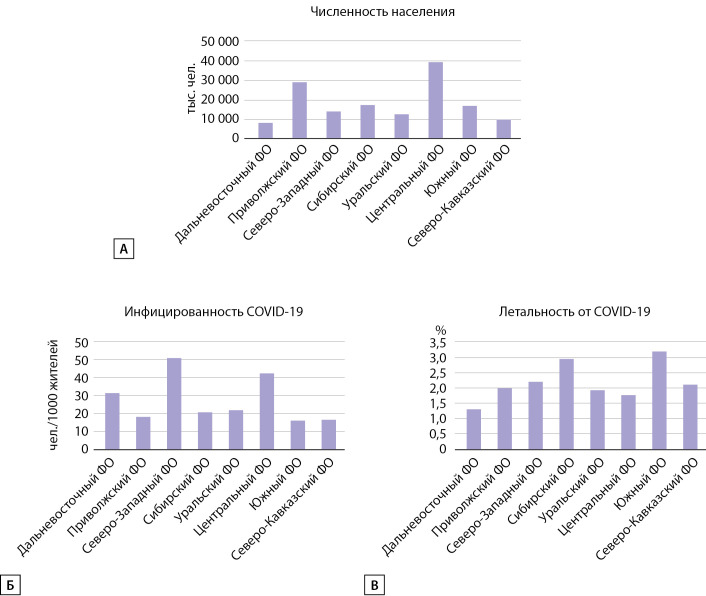
The aim of this study was to assess the prevalence of vitamin D insufficiency and deficiency and compare it with the incidence rates of SARS-CoV-2 in eight Federal Districts of the Russian Federation.
We included 304,564 patients (234,716 women; 77,1%) with serum 25(OH)D levels results performed September 2019 through October 2020.
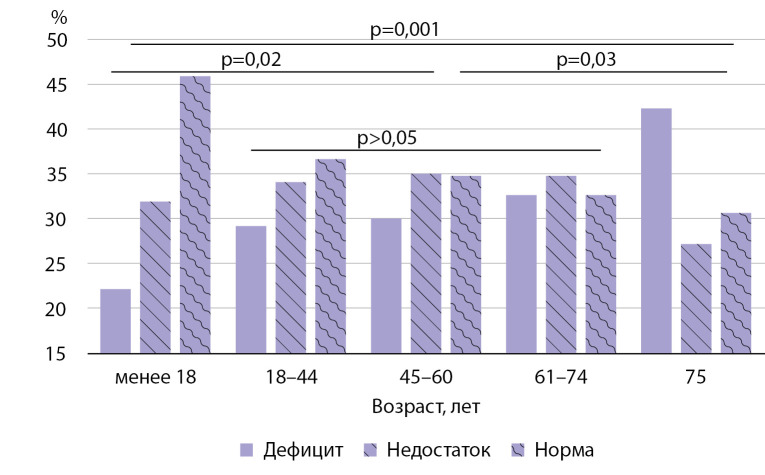
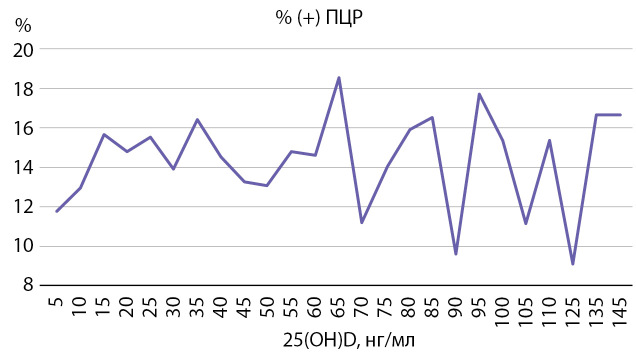
Only 112,877 people (37.1%) had a normal serum 25(OH)D level, others had a deficiency. Vitamin D insufficiency and deficiency was presented with the same frequency in women and men, and no differences were found depending on the geographical location and age in subjects from 18 to 74 years old. However, subjects over 75 years more often had vitamin D deficiency, while subjects under 18 years had normal levels in over 50% cases. In addition, 21,506 patients were tested for SARS-CoV-2 by PCR with further comparison of results with serum 25(OH)D level. The SARS-CoV-2 positivity rate was detected in 3,193 subjects, negative in 18,313. There were no differences in the morbidity in a vitamin D deficiency and a normal level. Thus, 14.8% subjects had positive PCR rates among vitamin D deficiency patients (4,978 tests), 14.9% when 25(OD)D level was from 20 to 30 ng/ml (7,542 tests), 15.0% among those who had 25(OH)D 30- 50 ng/ml (6,622 tests), and 13.9% when vitamin D was more than 50 ng/ml (4,612 tests).
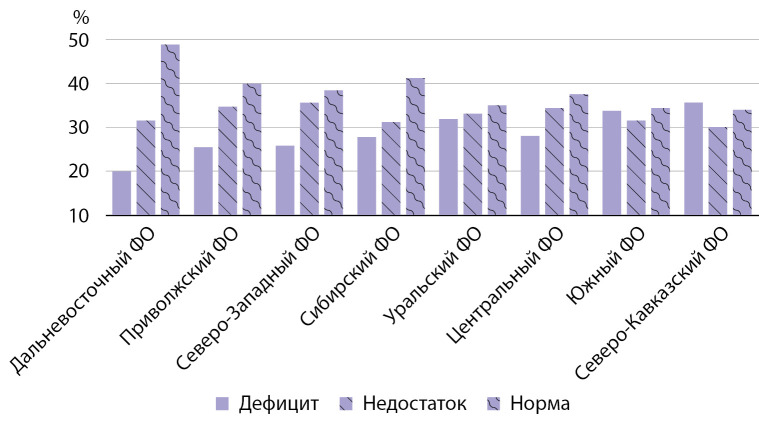
There was no association between the COVID-19 incidence and vitamin D status in different regions of Russia. Although the nutrient deficiency persists in all regions and is most often diagnosed in people over 75 years old.
维生素D缺乏与新冠病毒疾病(COVID-19)严重程度之间的关联目前正在全球范围内积极讨论。
本研究旨在评估俄罗斯联邦八个联邦区维生素D不足和缺乏的患病率,并将其与严重急性呼吸综合征冠状病毒2(SARS-CoV-2)发病率进行比较。
我们纳入了2019年9月至2020年10月期间进行血清25(OH)D水平检测的304564例患者(234716例女性;占77.1%)。
只有112877人(占37.1%)血清25(OH)D水平正常,其他人存在缺乏情况。维生素D不足和缺乏在男性和女性中出现的频率相同,在18至74岁的受试者中,未发现因地理位置和年龄不同而存在差异。然而,75岁以上的受试者更常出现维生素D缺乏,而18岁以下的受试者在超过50%的情况下维生素D水平正常。此外,对21506例患者进行了SARS-CoV-2的聚合酶链反应(PCR)检测,并将结果与血清25(OH)D水平进行进一步比较。在3193例受试者中检测到SARS-CoV-2阳性,18313例为阴性。维生素D缺乏组和正常水平组的发病率没有差异。因此,维生素D缺乏患者(4978次检测)中PCR阳性率为14.8%,25(OD)D水平为20至30 ng/ml时(7542次检测)为14.9%,25(OH)D为30 - 50 ng/ml时(6622次检测)为15.0%,维生素D超过50 ng/ml时(4612次检测)为13.9%。
俄罗斯不同地区的COVID-19发病率与维生素D状态之间没有关联。尽管所有地区都存在营养素缺乏情况,且最常出现在75岁以上人群中。