Gómez-García Mariana, Torrado Juan, Bia Daniel, Zócalo Yanina
Departamento de Educación Física y Salud, Instituto Superior de Educación Física, Universidad de la República, Montevideo, Uruguay.
Grupo "Centro Universitario de Investigación, Innovación y Diagnóstico Arterial - Movimiento, Actividad, Salud" (CUiiDARTE-MAS), Comisión Sectorial de Investigación Científica (CSIC), Universidad de la República, Montevideo, Uruguay.
Front Sports Act Living. 2022 Feb 24;4:799659. doi: 10.3389/fspor.2022.799659. eCollection 2022.
It remains to be established to what extent physical activity (PA) levels among individuals are independently associated with deviations from the "optimal" state of the arterial system. Accelerometers have been proposed as means to obtain reliable, objective, and more comprehensive data of PA. Decisions at the time of data collection/processing could influence the association between accelerometry-derived indices and arterial properties.
(i) To identify to what extent the strength of association between arterial properties and accelerometer-derived indices depend on the recording site and/or the epoch length; (ii) to determine whether some arterial characteristics (hemodynamic vs. structural vs. functional) or regions (elastic vs. transitional vs. muscular arteries; central vs. peripheral) have higher levels of association with accelerometry-derived indices.
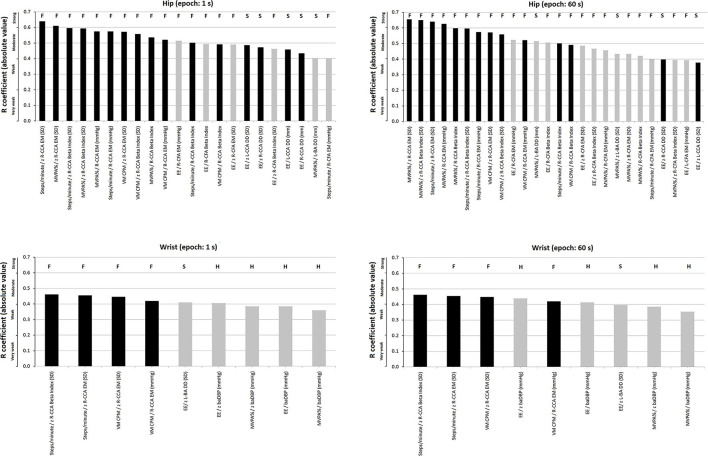
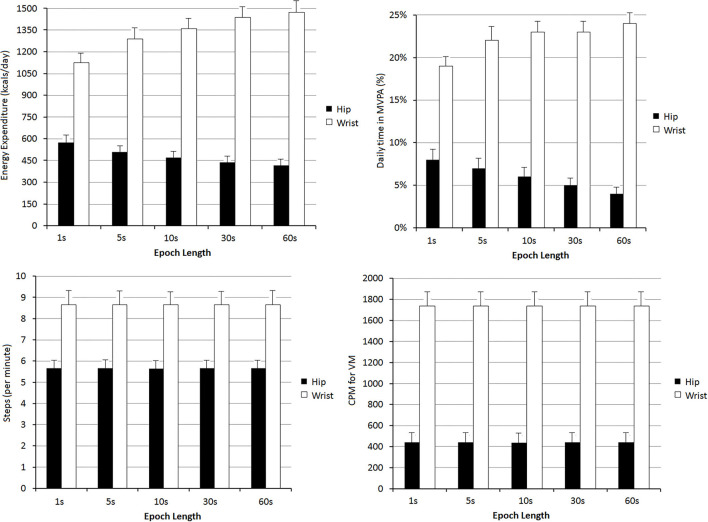
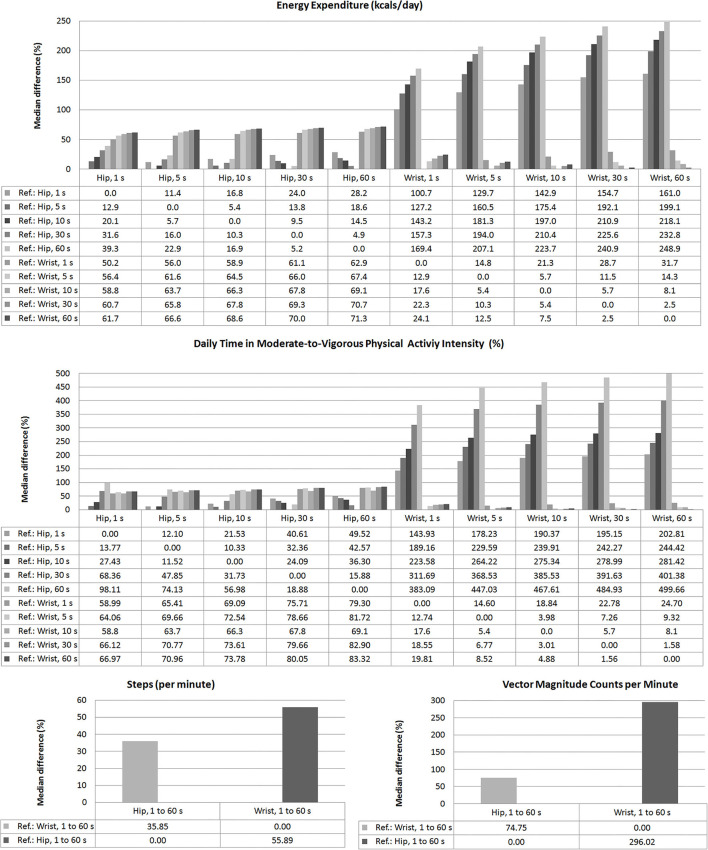
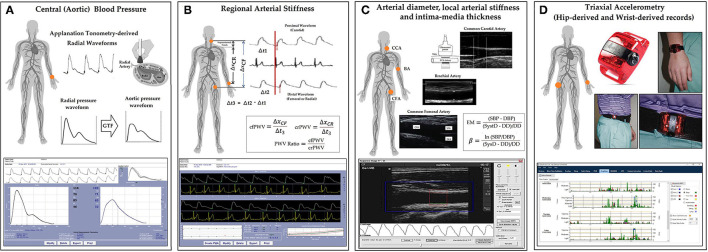
Physical activity (PA), cardiovascular risk factors (CRFs), and cardiovascular properties were evaluated in 60 volunteers (general population; age: 23-62 years; women: 43%). PA was measured daily for 7 days (free-living situation; triaxial-accelerometers ActiGraph-GT3X+; hip and wrist; "Worn-to-wrist" option) and raw data was converted at epoch lengths of 1, 5, 10, 30, and 60-s. PA-related energy expenditure, daily time in moderate-to-vigorous PA, steps/minute, and counts-per-minute for vector magnitude were calculated. The cardiovascular evaluation included hemodynamic (central and peripheral pressure), structural (diameters and intima-media thickness), and functional (local and regional stiffness) parameters of carotids, femoral, and brachial arteries, and carotid-femoral and carotid-radial pathways. Arterial z-scores were obtained using age-related equations derived from healthy participants not exposed to CRFs ( = 1,688; age: 2-84 years; female: 51.2%) to evaluate at which degree each parameter deviates from the "optimal" value.
In general, hip recordings outperformed those obtained on the wrist regarding the strength of association with arterial parameters. Accelerometer-derived indices and their association with arterial properties vary depending on the recording site and epoch length. PA indices are stronger associated with functional (local) than structural variables and with central than peripheral arteries.
Regardless of the PA index, there were independent associations with central artery characteristics, which reinforces that these territories would be the most related to PA levels. Differences in data acquisition and processing could lead to differences in conclusions when addressing the association between accelerometer-derived indices and the cardiovascular system.
个体的身体活动(PA)水平在多大程度上与动脉系统“最佳”状态的偏差独立相关,仍有待确定。加速度计已被提议作为获取可靠、客观且更全面的PA数据的手段。数据收集/处理时的决策可能会影响加速度计衍生指标与动脉特性之间的关联。
(i)确定动脉特性与加速度计衍生指标之间关联的强度在多大程度上取决于记录部位和/或时段长度;(ii)确定某些动脉特征(血液动力学、结构、功能)或区域(弹性动脉、过渡动脉、肌性动脉;中心动脉、外周动脉)与加速度计衍生指标的关联程度是否更高。
对60名志愿者(一般人群;年龄:23 - 62岁;女性:43%)进行身体活动(PA)、心血管危险因素(CRF)和心血管特性评估。连续7天每天测量PA(自由生活状态;三轴加速度计ActiGraph - GT3X +;髋部和腕部;“腕部佩戴”选项),并将原始数据转换为1、5、10、30和60秒的时段长度。计算与PA相关的能量消耗、中度至剧烈PA的每日时间、步/分钟以及矢量大小的计数/分钟。心血管评估包括颈动脉、股动脉和肱动脉的血液动力学(中心和外周压力)、结构(直径和内膜中层厚度)和功能(局部和区域僵硬度)参数,以及颈动脉 - 股动脉和颈动脉 - 桡动脉路径。使用来自未暴露于CRF的健康参与者(n = 1,688;年龄:2 - 84岁;女性:51.2%)的年龄相关方程获得动脉z评分,以评估每个参数偏离“最佳”值的程度。
总体而言,就与动脉参数的关联强度而言,髋部记录优于腕部记录。加速度计衍生指标及其与动脉特性的关联因记录部位和时段长度而异。PA指标与功能(局部)变量的关联强于结构变量,与中心动脉的关联强于外周动脉。
无论PA指标如何,与中心动脉特征均存在独立关联,这强化了这些区域与PA水平最相关的观点。在探讨加速度计衍生指标与心血管系统之间的关联时,数据采集和处理的差异可能导致结论的差异。