Yan Yujie, Fu Jiamei, Kowalchuk Roman O, Wright Christopher M, Zhang Ran, Li Xuefei, Xu Yaping
Department of Radiation Oncology, Shanghai Pulmonary Hospital, Tongji University Medical School Cancer Institute, Tongji University School of Medicine, Shanghai, China.
Department of Radiation Oncology, Mayo Clinic, Rochester, MN, USA.
Transl Lung Cancer Res. 2022 Feb;11(2):307-322. doi: 10.21037/tlcr-22-108.
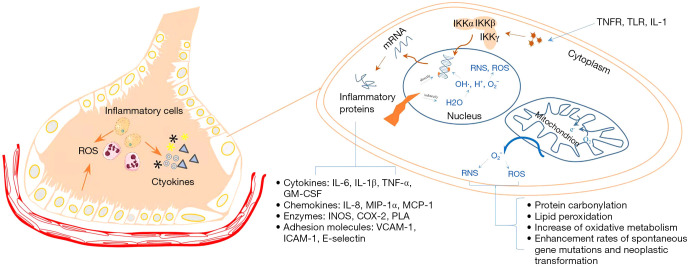
Radiation-induced lung injury (RILI) is often found in thoracic tumor patients after thoracic radiation therapy, and influences patient quality of life. However, systematic exploration of RILI, including its molecular biological mechanisms and standardized treatment, has not yet been fully elucidated. The main objective of the narrative review was to describe the available evidence concerning RILI, from the biological mechanism to the clinical management. The underlying causes of RILI are multifactorial, including gene-level changes, the influence of signaling pathways, the convergence of various cells, as well as the expression of cytokines and chemokines. Based on the various mechanisms of RILI, several novel treatment strategies have been proposed and gradually applied in clinical practice.
PubMed was used to collect articles about RILI from 1995 to 2021. The papers included clinical trials, reviews, as well as systematic reviews and meta-analyses. Based on the mechanism, diagnosis, and treatment, we synthesized and analyzed these papers to form a clearly logical and normative suggestion to guide clinical application.
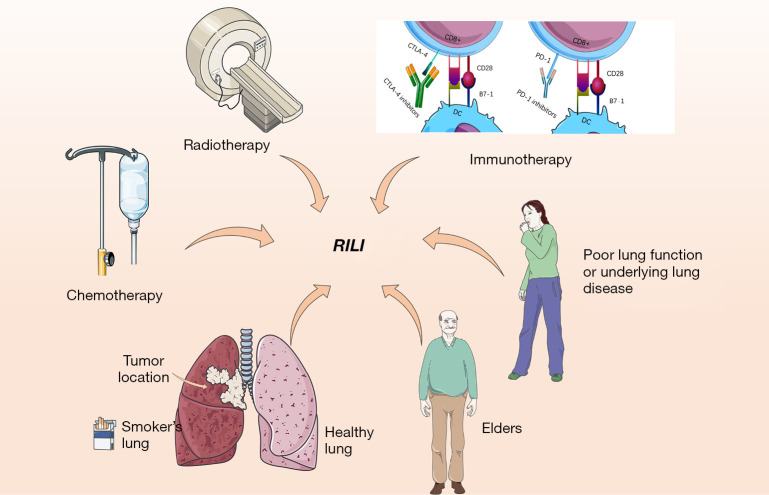
RILI is a constantly developing and changing process including radiation pneumonitis and radiation lung fibrosis. Different kinds of inflammatory and immune cells such as macrophages, fibroblasts, and T cells play key roles in the development of RILI, and transforming growth factor-β (TGF-β), interleukin-4 (IL-4), IL-13, and interferon-γ (IFN-γ) are also participants in this process. At present, glucocorticoids are mainly therapeutic drugs for the early stage of RILI, and drugs treatment should abide early period, sufficient doses, and the individual principles. Other novel drugs such as Azithromycin also have been tried in clinical application. radiation dose, combination therapy modality, the condition of the tumor, and the age and underlying conditions of patients all effect the occurrence of RILI. Importantly, RILI has a relatively higher incidence in patients who received radiotherapy combined with other treatments, especially immunotherapy.
The occurrence of RILI after radiotherapy will greatly affect the prognosis and quality of life of patients. In clinical practice, early intervention, active treatment, and more effective therapeutic drugs should be found.
放射性肺损伤(RILI)常见于胸部肿瘤患者接受胸部放疗后,影响患者生活质量。然而,对RILI的系统探索,包括其分子生物学机制和标准化治疗,尚未完全阐明。本叙述性综述的主要目的是描述有关RILI的现有证据,从生物学机制到临床管理。RILI的潜在原因是多因素的,包括基因水平变化、信号通路的影响、各种细胞的汇聚以及细胞因子和趋化因子的表达。基于RILI的各种机制,已经提出了几种新的治疗策略,并逐渐应用于临床实践。
使用PubMed收集1995年至2021年关于RILI的文章。这些论文包括临床试验、综述以及系统评价和荟萃分析。基于机制、诊断和治疗,我们对这些论文进行综合分析,形成一个逻辑清晰、规范的建议,以指导临床应用。
RILI是一个不断发展变化的过程,包括放射性肺炎和放射性肺纤维化。不同类型的炎症和免疫细胞,如巨噬细胞、成纤维细胞和T细胞,在RILI的发展中起关键作用,转化生长因子-β(TGF-β)、白细胞介素-4(IL-4)、IL-13和干扰素-γ(IFN-γ)也参与了这一过程。目前,糖皮质激素是RILI早期的主要治疗药物,药物治疗应遵循早期、足量、个体化原则。其他新药如阿奇霉素也已在临床应用中尝试。放射剂量、联合治疗方式、肿瘤情况以及患者的年龄和基础疾病均影响RILI的发生。重要的是,接受放疗联合其他治疗,尤其是免疫治疗的患者中,RILI的发生率相对较高。
放疗后RILI的发生将极大影响患者的预后和生活质量。在临床实践中,应进行早期干预、积极治疗,并寻找更有效的治疗药物。