Wang Yang, Wang Yuliuming, Ai Lianjie, Zhang Hao, Li Guodong, Wang Zitong, Jiang Xia, Yan Guoqing, Liu Yunxiao, Wang Chunlin, Xiong Huan, Wang Guiyu, Liu Ming
Department of Colorectal Surgery, The Second Affiliated Hospital of Harbin Medical University, Harbin, China.
Department of General Surgery, The Fourth Affiliated Hospital of Harbin Medical University, Harbin, China.
Front Oncol. 2022 Feb 23;12:839899. doi: 10.3389/fonc.2022.839899. eCollection 2022.
This study evaluated the association between body composition and clinical parameters and prognosis in patients with colorectal cancer (CRC) treated by radical resection.
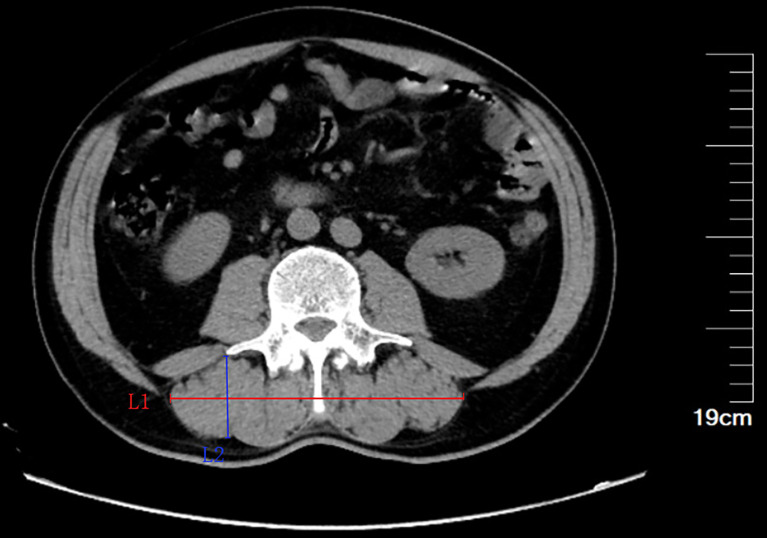
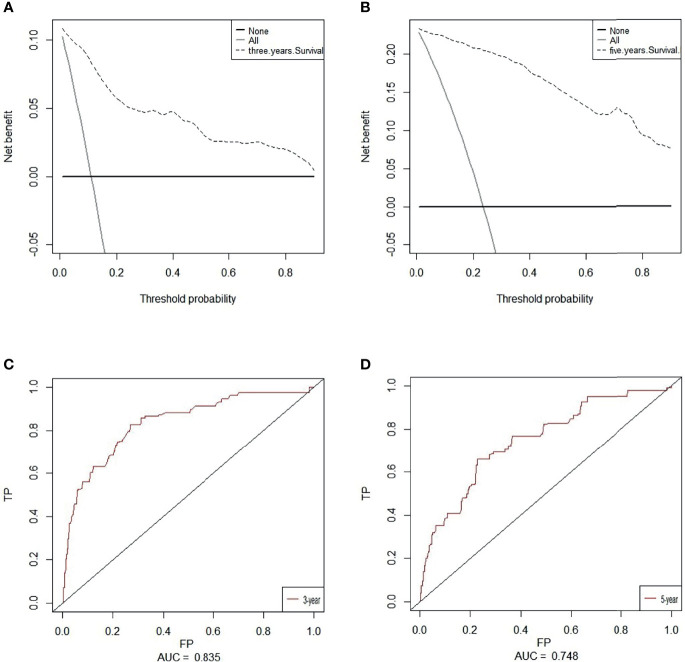
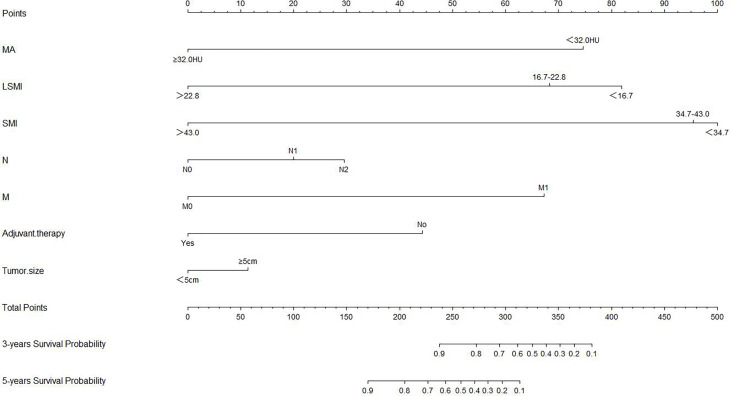
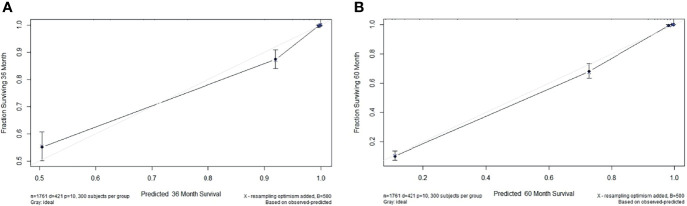
Baseline data on patient age, body mass index (BMI), bowel obstruction and tumor-related factors were collected retrospectively. Body composition parameters such as visceral fat area (VFA), total abdominal muscle area (TAMA), muscle attenuation (MA), posterior renal fat thickness (PPNF) and intermuscular fat area (IMF) are measured using Computed tomography (CT) scans. We also propose a new predictor of linear skeletal muscle index (LSMI) that can be easily measured clinically at CT. Follow-up endpoints were disease-free survival and all-cause death. We follow up with patients in hospital or by telephone. Univariate and multifactorial Cox proportional hazards analyses were performed to identify risk factors associated with prognosis. Survival analysis was performed using the Kaplan-Meier method and a nomogram was established to predict survival.
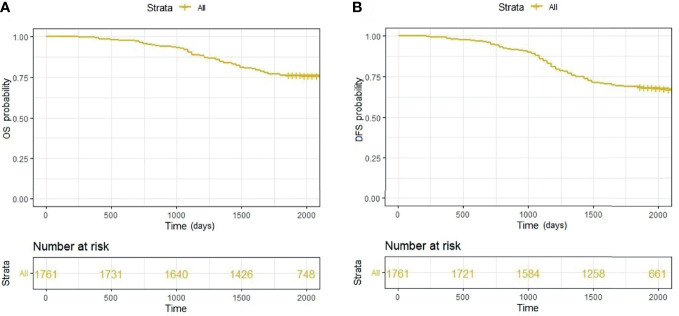
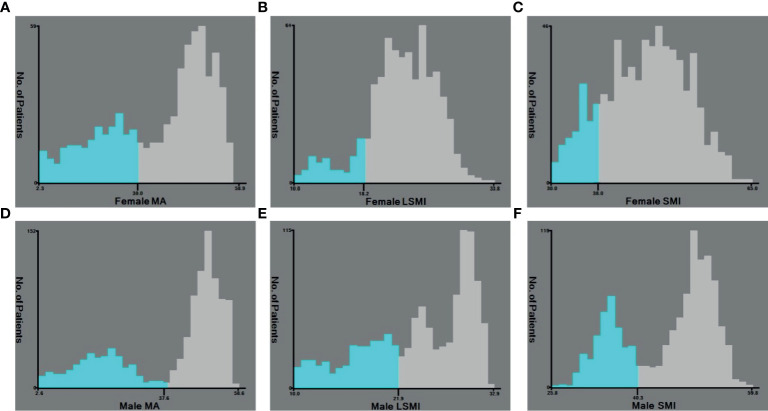
A total of 1761 patients (median age 62 years) with CRC were enrolled in our study, of whom 201 had intestinal obstruction and 673 had a BMI > 24.0. Among all patients, the 3- and 5-year disease-free survival rates were 84.55% and 68.60% respectively, and the overall survival rates were 88.87% and 76.38%. Overall survival was significantly correlated with MA, LSMI, SMI, Tumor size, N stage, metastasis and adjuvant therapy by Cox regression analysis (p < 0.05). The risk of tumor progression was significantly associated with MA, VFA, LSMI, SMI, Male, N stage, metastasis and adjuvant therapy (p < 0.05). In addition, based on the Chinese population, we found that female patients with MA < 30.0 HU, LSMI < 18.2, and SMI < 38.0 had a worse prognosis, male patients with MA < 37.6 HU, LSMI < 21.9, and SMI < 40.3 had a poorer prognosis.
Our findings suggest that linear skeletal muscle index and MA can be used as new independent predictors for colorectal cancer patients treated with radical surgery, and that baseline data such as body composition parameters, LSMI and tumor-related factors can collectively predict patient prognosis. These results could help us to optimize the management and treatment of patients after surgery.
本研究评估了接受根治性切除的结直肠癌(CRC)患者的身体成分与临床参数及预后之间的关联。
回顾性收集患者年龄、体重指数(BMI)、肠梗阻及肿瘤相关因素的基线数据。使用计算机断层扫描(CT)测量身体成分参数,如内脏脂肪面积(VFA)、腹侧总肌肉面积(TAMA)、肌肉衰减(MA)、肾后脂肪厚度(PPNF)和肌间脂肪面积(IMF)。我们还提出了一种新的线性骨骼肌指数(LSMI)预测指标,可在CT检查时轻松进行临床测量。随访终点为无病生存期和全因死亡。我们通过住院或电话对患者进行随访。进行单因素和多因素Cox比例风险分析以确定与预后相关的危险因素。采用Kaplan-Meier方法进行生存分析,并建立列线图以预测生存情况。
本研究共纳入1761例CRC患者(中位年龄62岁),其中201例有肠梗阻,673例BMI>24.0。在所有患者中,3年和5年无病生存率分别为84.55%和68.60%,总生存率分别为88.87%和76.38%。通过Cox回归分析,总生存与MA、LSMI、SMI、肿瘤大小、N分期、转移及辅助治疗显著相关(p<0.05)。肿瘤进展风险与MA、VFA、LSMI、SMI、男性、N分期、转移及辅助治疗显著相关(p<0.05)。此外,基于中国人群,我们发现MA<30.0 HU、LSMI<18.2且SMI<38.0的女性患者预后较差,MA<37.6 HU、LSMI<21.9且SMI<40.3的男性患者预后较差。
我们的研究结果表明,线性骨骼肌指数和MA可作为接受根治性手术的结直肠癌患者新的独立预测指标,并且身体成分参数、LSMI等基线数据及肿瘤相关因素可共同预测患者预后。这些结果有助于我们优化术后患者的管理和治疗。