Ma Dongxue, Marey Mohamed Ali, Shimada Masayuki, Miyamoto Akio
Global Agromedicine Research Center (GAMRC), Obihiro University of Agriculture and Veterinary Medicine, Obihiro, Japan.
Department of Theriogenology, Faculty of Veterinary Medicine, Damanhur University, Behera, Egypt.
Front Cell Dev Biol. 2022 Feb 24;10:810961. doi: 10.3389/fcell.2022.810961. eCollection 2022.
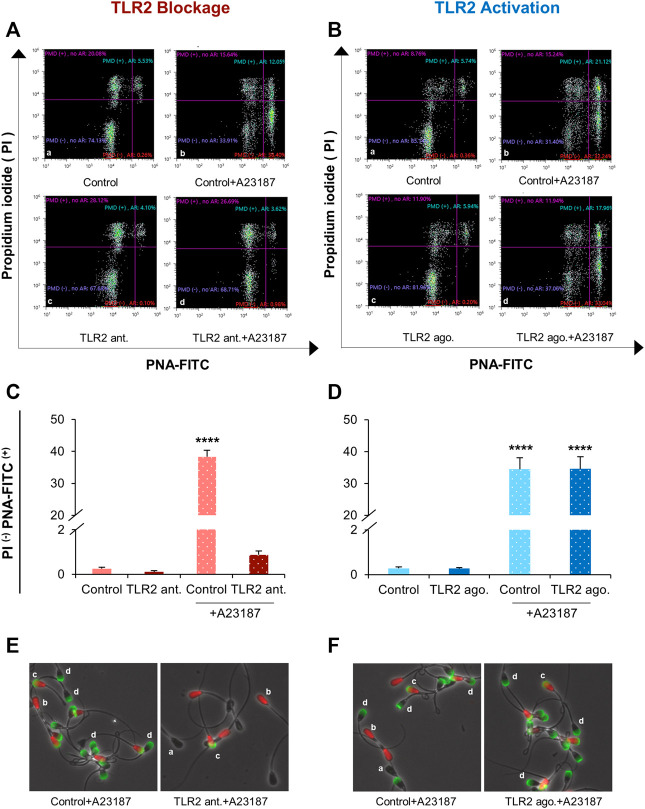
Cumulus cells of ovulated cumulus-oocyte complexes (COCs) express Toll-like receptor 2 (TLR2), pathogen recognition receptors, to recognize and react to sperm signals during fertilization. Sperm also express TLR2, but its contribution to the sperm-oocytes crosstalk is still unclear. Here, we adapted the fertilization (IVF) model to characterize the potential relevance of sperm TLR2 in sperm-oocytes interactions during fertilization in bovine. The IVF results showed that the ligation of sperm TLR2 with its specific antagonist/agonist resulted in down/up-regulation of the cleavage and blastocyst rates either in COCs or cumulus-free oocytes, but not in zona pellucida (ZP)-free oocytes. The computer-assisted sperm analysis (CASA) system revealed that sperm motility parameters were not affected in TLR2 antagonist/agonist-treated sperm. However, fluorescence imaging of sperm-ZP interactions revealed that the blockage or activation of the TLR2 system in sperm reduced or enhanced both binding and penetration abilities of sperm to ZP compared to control, respectively. Flow cytometrical analysis of acrosome reaction (AR) demonstrated that the TLR2 system adjusted the occurrence of AR in ZP-attached sperm, suggesting that sperm TLR2 plays physiological impacts on the sperm-oocyte crosstalk regulating ZP-triggered AR in sperm. Given that calcium (Ca) influx is a pre-requisite step for the induction of AR, we investigated the impact of the TLR2 system on the ionophore A23187-induced Ca influx into sperm. Notably, the exposure of sperm to TLR2 antagonist/agonist reduced/increased the intracellular Ca level in sperm. Together, these findings shed new light that the TLR2 system is involved in sperm AR induction which enables sperm to penetrate and fertilize oocytes during the fertilization, at least , in cows. This suggests that sperm possibly developed a quite flexible sensing mechanism simultaneously against pathogens as well as COCs toward fertilization with the same TLR2 of the innate immune system.
排卵时的卵丘-卵母细胞复合体(COC)中的卵丘细胞表达Toll样受体2(TLR2),即病原体识别受体,以在受精过程中识别精子信号并做出反应。精子也表达TLR2,但其在精子-卵母细胞相互作用中的作用仍不清楚。在此,我们采用体外受精(IVF)模型来表征精子TLR2在牛受精过程中精子-卵母细胞相互作用中的潜在相关性。IVF结果表明,用其特异性拮抗剂/激动剂连接精子TLR2会导致COC或无卵丘卵母细胞的卵裂率和囊胚率下调/上调,但对无透明带(ZP)的卵母细胞无影响。计算机辅助精子分析(CASA)系统显示,经TLR2拮抗剂/激动剂处理的精子的运动参数不受影响。然而,精子与ZP相互作用的荧光成像显示,与对照组相比,精子中TLR2系统的阻断或激活分别降低或增强了精子与ZP的结合和穿透能力。顶体反应(AR)的流式细胞术分析表明,TLR2系统调节了附着于ZP的精子中AR的发生,这表明精子TLR2对精子-卵母细胞相互作用具有生理影响,可调节精子中ZP触发的AR。鉴于钙(Ca)内流是诱导AR的先决步骤,我们研究了TLR2系统对离子载体A23187诱导的Ca流入精子的影响。值得注意的是,精子暴露于TLR2拮抗剂/激动剂会降低/增加精子细胞内的Ca水平。总之,这些发现揭示了新的观点,即TLR2系统参与精子AR的诱导,这使得精子在受精过程中能够穿透并使卵母细胞受精,至少在奶牛中是这样。这表明精子可能同时针对病原体和COC形成了一种相当灵活的感知机制,利用先天免疫系统的相同TLR2实现受精。