Cui Wenju, Yan Caiying, Yan Zhuangzhi, Peng Yunsong, Leng Yilin, Liu Chenlu, Chen Shuangqing, Jiang Xi, Zheng Jian, Yang Xiaodong
Institute of Biomedical Engineering, School of Communication and Information Engineering, Shanghai University, Shanghai, China.
Medical Imaging Department, Suzhou Institute of Biomedical Engineering and Technology, Chinese Academy of Sciences, Suzhou, China.
Front Neurosci. 2022 Feb 24;16:831533. doi: 10.3389/fnins.2022.831533. eCollection 2022.
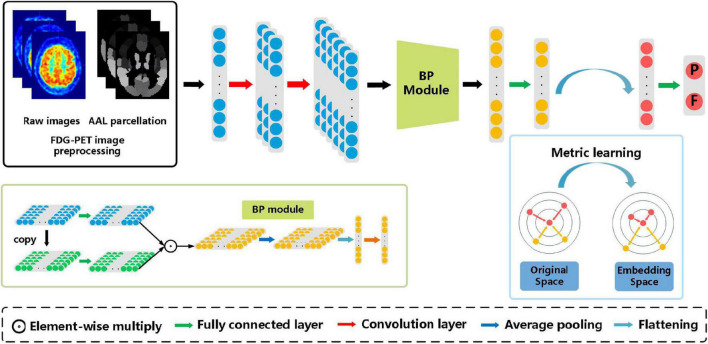
18F-fluorodeoxyglucose (FDG)-positron emission tomography (PET) reveals altered brain metabolism in individuals with mild cognitive impairment (MCI) and Alzheimer's disease (AD). Some biomarkers derived from FDG-PET by computer-aided-diagnosis (CAD) technologies have been proved that they can accurately diagnosis normal control (NC), MCI, and AD. However, existing FDG-PET-based researches are still insufficient for the identification of early MCI (EMCI) and late MCI (LMCI). Compared with methods based other modalities, current methods with FDG-PET are also inadequate in using the inter-region-based features for the diagnosis of early AD. Moreover, considering the variability in different individuals, some hard samples which are very similar with both two classes limit the classification performance. To tackle these problems, in this paper, we propose a novel bilinear pooling and metric learning network (BMNet), which can extract the inter-region representation features and distinguish hard samples by constructing the embedding space. To validate the proposed method, we collect 898 FDG-PET images from Alzheimer's disease neuroimaging initiative (ADNI) including 263 normal control (NC) patients, 290 EMCI patients, 147 LMCI patients, and 198 AD patients. Following the common preprocessing steps, 90 features are extracted from each FDG-PET image according to the automatic anatomical landmark (AAL) template and then sent into the proposed network. Extensive fivefold cross-validation experiments are performed for multiple two-class classifications. Experiments show that most metrics are improved after adding the bilinear pooling module and metric losses to the Baseline model respectively. Specifically, in the classification task between EMCI and LMCI, the specificity improves 6.38% after adding the triple metric loss, and the negative predictive value (NPV) improves 3.45% after using the bilinear pooling module. In addition, the accuracy of classification between EMCI and LMCI achieves 79.64% using imbalanced FDG-PET images, which illustrates that the proposed method yields a state-of-the-art result of the classification accuracy between EMCI and LMCI based on PET images.
18F-氟脱氧葡萄糖(FDG)正电子发射断层扫描(PET)显示,轻度认知障碍(MCI)和阿尔茨海默病(AD)患者的大脑代谢发生改变。一些通过计算机辅助诊断(CAD)技术从FDG-PET得出的生物标志物已被证明能够准确诊断正常对照(NC)、MCI和AD。然而,现有的基于FDG-PET的研究在识别早期MCI(EMCI)和晚期MCI(LMCI)方面仍不充分。与基于其他模态的方法相比,当前基于FDG-PET的方法在利用基于区域间的特征来诊断早期AD方面也存在不足。此外,考虑到不同个体之间的变异性,一些与两类都非常相似的困难样本限制了分类性能。为了解决这些问题,在本文中,我们提出了一种新颖的双线性池化和度量学习网络(BMNet),它可以提取区域间的表征特征,并通过构建嵌入空间来区分困难样本。为了验证所提出的方法,我们从阿尔茨海默病神经影像学倡议(ADNI)收集了898张FDG-PET图像,包括263名正常对照(NC)患者、290名EMCI患者、147名LMCI患者和198名AD患者。按照常见的预处理步骤,根据自动解剖标记(AAL)模板从每张FDG-PET图像中提取90个特征,然后将其送入所提出的网络。对多个两类分类进行了广泛的五折交叉验证实验。实验表明,分别向基线模型添加双线性池化模块和度量损失后,大多数指标都得到了改善。具体而言,在EMCI和LMCI之间的分类任务中,添加三重度量损失后特异性提高了6.38%,使用双线性池化模块后阴性预测值(NPV)提高了3.45%。此外,使用不平衡的FDG-PET图像时,EMCI和LMCI之间的分类准确率达到了79.64%,这表明所提出的方法在基于PET图像的EMCI和LMCI之间的分类准确率方面产生了领先的结果。