Murovec Jana, Eržen Jan Jurij, Flajšman Marko, Vodnik Dominik
Department of Agronomy, Biotechnical Faculty, University of Ljubljana, Ljubljana, Slovenia.
Front Plant Sci. 2022 Feb 24;13:786161. doi: 10.3389/fpls.2022.786161. eCollection 2022.
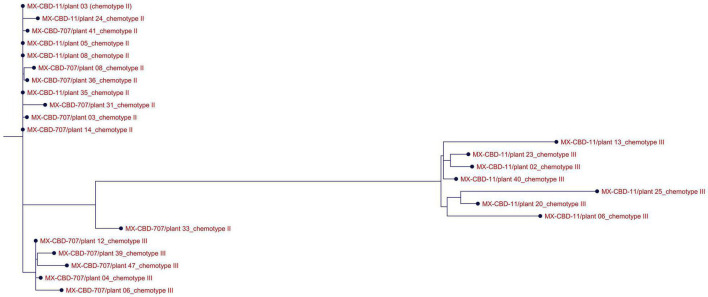
L. is one of the oldest cultivated crops, used in medicine for millennia due to therapeutic characteristics of the phytocannabinoids it contains. Its medicinal properties are highly influenced by the chemotype, that is, the ratio of the two main cannabinoids cannabidiol (CBD) and Δ-9-tetrahydrocannabinol (THC). Based on published data, the chemotype should correlate with plant morphology, genetics, and photosynthetic properties. In this work, we investigated leaf morphology, plant growth characteristics, cannabinoid profiles, gene sequences, and plant photosynthetic traits in two breeding populations of medical cannabis (MX-CBD-11 and MX-CBD-707). The populations differed significantly in morphological traits. The MX-CBD-11 plants were taller, less branched, and their leaves had narrower leaflets than the bushier, wideleaved MX-CBD-707 plants, and there were significant differences between populations in the dry biomass of different plant parts. Based on these morphological differences, MX-CBD-11 was designated as a narrow leaflet drug type or vernacular "Sativa" type, while MX-CBD-707 was classified as wide leaflet drug type or "Indica" type. Chemical characterisation revealed a discrepancy between the expected chemotypes based on plant morphology; although both populations have high CBD, within each Type II (CBD/THC intermediate) and Type III (CBD dominant) plants were detected. The gene sequence analysis clustered the plants based on their chemotypes and showed high similarity to the sequences deposited in NCBI. complementary analysis, using published molecular markers for chemotype determination, showed their low discrimination power in our two populations, demonstrating the genotype dependence of the molecular markers. Basic photosynthetic traits derived from light and CO response curves were similar in the populations. However, measurements of gas exchange under chamber conditions revealed higher stomatal conductivity and photosynthesis in MX-CBD-707 plants, which were also characterised by higher day respiration. The results of this study showed that based on visual appearance and some morphological measurements, it is not possible to determine a plant's chemotype. Visually homogenous plants had different cannabinoid profiles and, vice versa, morphologically distinct plants contained similar CBD and THC content. The two chemotypes identified in our experimental plants therefore did not correlate with plant visual appearance, leaf morphometry, and photosynthetic properties of the populations studied. Correlation was only demonstrated with the respect to sequences, which showed great discrimination power between the chemotypes.
大麻是最古老的栽培作物之一,由于其所含植物大麻素的治疗特性,数千年来一直被用于医学。其药用特性受化学型的高度影响,即两种主要大麻素大麻二酚(CBD)和Δ-9-四氢大麻酚(THC)的比例。根据已发表的数据,化学型应与植物形态、遗传学和光合特性相关。在这项工作中,我们研究了两个医用大麻育种群体(MX-CBD-11和MX-CBD-707)的叶片形态、植物生长特性、大麻素谱、基因序列和植物光合特征。这些群体在形态特征上有显著差异。MX-CBD-11植株更高,分枝更少,其叶片的小叶比更浓密、叶片更宽的MX-CBD-707植株的小叶更窄,不同植株部分的干生物量在群体之间也存在显著差异。基于这些形态差异,MX-CBD-11被指定为小叶毒品类型或通俗的“印度大麻”类型,而MX-CBD-707被归类为大叶毒品类型或“大麻”类型。化学表征揭示了基于植物形态预期的化学型之间存在差异;尽管两个群体都有高含量的CBD,但在每个群体中都检测到了II型(CBD/THC中间型)和III型(CBD主导型)植株。基因序列分析根据化学型对植株进行了聚类,并显示出与NCBI中 deposited 的序列高度相似。使用已发表的用于化学型测定的分子标记进行的互补分析表明,它们在我们的两个群体中的区分能力较低,证明了分子标记的基因型依赖性。从光响应曲线和CO2响应曲线得出的基本光合特征在群体中相似。然而,在室内条件下的气体交换测量显示,MX-CBD-707植株的气孔导度和光合作用更高,其白天呼吸也更高。这项研究的结果表明,基于视觉外观和一些形态测量,不可能确定植物的化学型。外观上同质的植株有不同的大麻素谱,反之,形态上不同的植株含有相似的CBD和THC含量。因此,我们实验植株中确定的两种化学型与所研究群体的植物视觉外观、叶片形态测量和光合特性不相关。仅在基因序列方面显示出相关性,基因序列在化学型之间显示出很大的区分能力。