Koch Nikolaj G, Baumann Tobias, Budisa Nediljko
Biokatalyse, Institut für Chemie, Technische Universität Berlin, Berlin, Germany.
Bioanalytik, Institut für Biotechnologie, Technische Universität Berlin, Berlin, Germany.
Front Bioeng Biotechnol. 2021 Dec 23;9:807438. doi: 10.3389/fbioe.2021.807438. eCollection 2021.
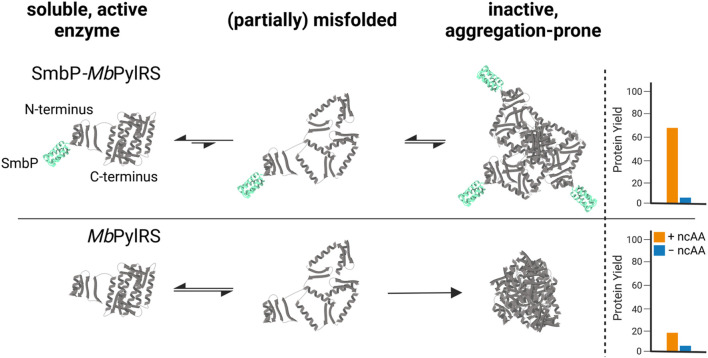
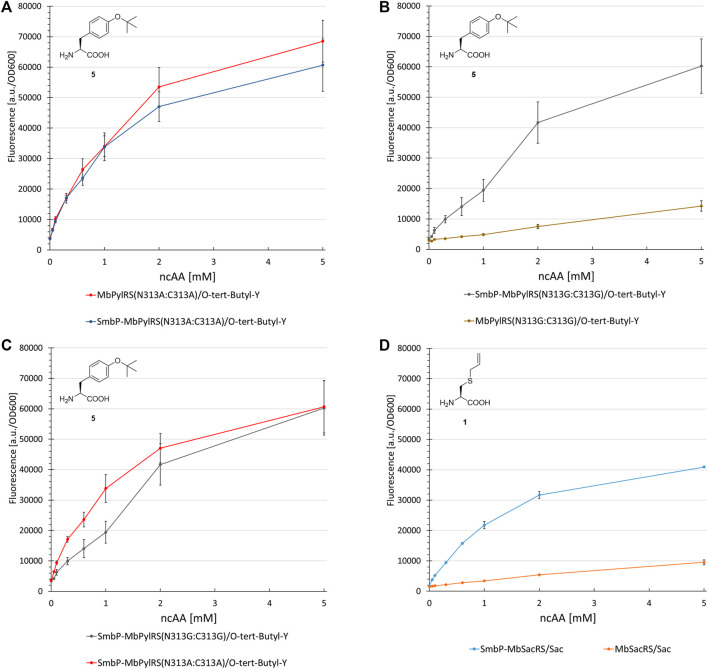
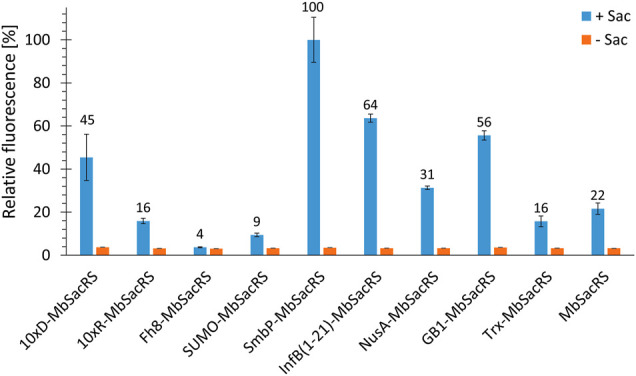
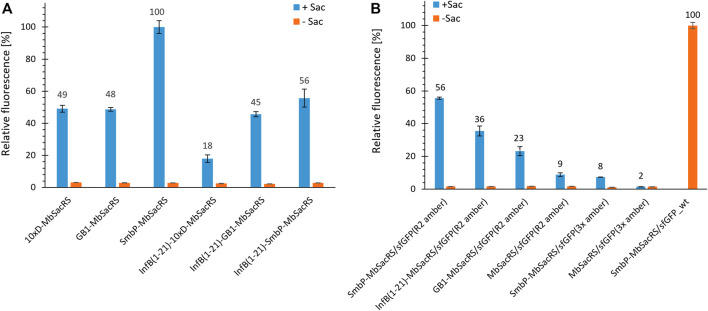
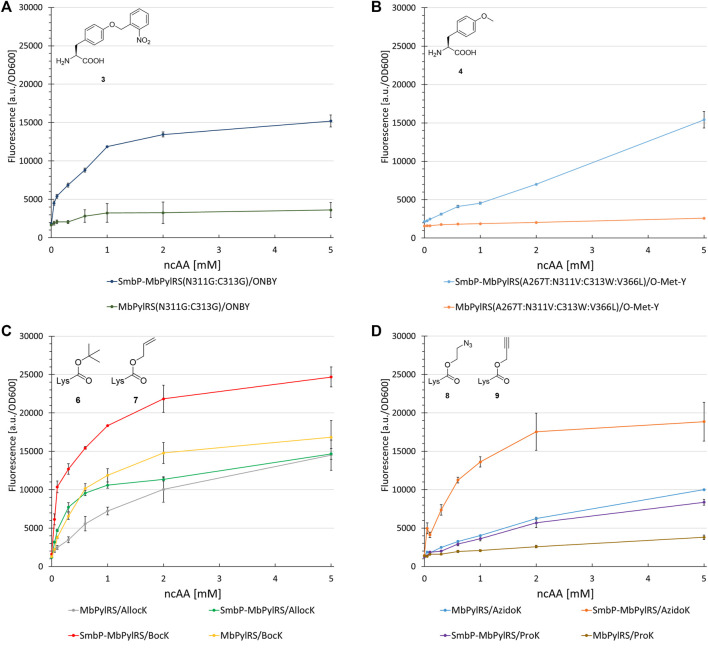
Introducing non-canonical amino acids (ncAAs) by engineered orthogonal pairs of aminoacyl-tRNA synthetases and tRNAs has proven to be a highly useful tool for the expansion of the genetic code. Pyrrolysyl-tRNA synthetase (PylRS) from methanogenic archaeal and bacterial species is particularly attractive due to its natural orthogonal reactivity in bacterial and eukaryotic cells. However, the scope of such a reprogrammed translation is often limited, due to low yields of chemically modified target protein. This can be the result of substrate specificity engineering, which decreases the aminoacyl-tRNA synthetase stability and reduces the abundance of active enzyme. We show that the solubility and folding of these engineered enzymes can become a bottleneck for the production of ncAA-containing proteins . Solubility tags derived from various species provide a strategy to remedy this issue. We find the N-terminal fusion of the small metal binding protein from to the PylRS sequence to improve enzyme solubility and to boost orthogonal translation efficiency. Our strategy enhances the production of site-specifically labelled proteins with a variety of engineered PylRS variants by 200-540%, and further allows triple labeling. Even the wild-type enzyme gains up to 245% efficiency for established ncAA substrates.
通过工程改造的氨酰 - tRNA合成酶和tRNA的正交对引入非标准氨基酸(ncAA)已被证明是扩展遗传密码的一种非常有用的工具。来自产甲烷古菌和细菌物种的吡咯赖氨酰 - tRNA合成酶(PylRS)因其在细菌和真核细胞中的天然正交反应性而特别具有吸引力。然而,由于化学修饰的靶蛋白产量低,这种重新编程翻译的范围通常受到限制。这可能是底物特异性工程的结果,底物特异性工程会降低氨酰 - tRNA合成酶的稳定性并减少活性酶的丰度。我们表明,这些工程酶的溶解度和折叠可能成为含ncAA蛋白质生产的瓶颈。来自各种物种的溶解度标签提供了一种解决此问题的策略。我们发现将来自的小金属结合蛋白与PylRS序列进行N端融合可提高酶的溶解度并提高正交翻译效率。我们的策略通过200 - 540%提高了多种工程化PylRS变体的位点特异性标记蛋白质的产量,并进一步实现了三重标记。即使是野生型酶,对于已确定的ncAA底物,效率也提高了245%。