Wang Beibei, Dong Nian, Wu Dengmin, Fang Ya, Chen Junjie, Lin Yuting, Bellusci Saverio, Zhang Jin-San, Dai Kezhi, Chen Chengshui
Key Laboratory of Interventional Pulmonology of Zhejiang Province, Department of Pulmonary and Critical Care Medicine, The First Affiliated Hospital of Wenzhou Medical University, Wenzhou, China.
The Second Affiliated Hospital and Yuying Children's Hospital of Wenzhou Medical University, Wenzhou, China.
Ann Transl Med. 2022 Feb;10(3):136. doi: 10.21037/atm-21-6679.
The sphingosine 1-phosphate (S1P)/S1P receptor (S1pr) 1 signaling plays an essential role in regulating vascular integrity and angiogenesis. We have previously shown that cell-surface expression of endoglin (Eng) is sustained by S1P/S1pr1 signaling in endothelial cells (ECs). However, whether S1pr1 mediates Eng signaling, or vice versa, remains unknown.
S1pr1 inhibitors were used to study whether pharmacological inhibition induces basal vascular leakage . An acute respiratory distress syndrome (ARDS) model was used to study whether S1pr1 inhibition evoked greater inflammation in lungs. A S1pr1 inhibitor, a bone morphogenetic protein 9 (BMP9) blocking antibody, or lentivirus-mediated expression of soluble extracellular domain of Eng (sEng) were used to test whether blocking both S1P/S1pr1 and BMP9/Eng signaling axes would impose any interaction in retinal angiogenesis. To clarify whether S1P and BMP9 function in a linear pathway, a study of trans-endothelial electrical resistance (TEER) measurement was carried out using a mouse islet EC line MS1; time course studies were executed to exam downstream effectors of S1P and BMP9 signaling pathways in ECs; two stable MS1 cell lines were generated, one with overexpression of human S1PR1 and the other with knockdown of Eng, to validate S1pr1 and Eng were the key players for the crosstalk. Inhibitor of extracellular regulated protein kinases (ERK) was used to check whether this signaling was involved in S1P-induced cell-surface localization of Eng.
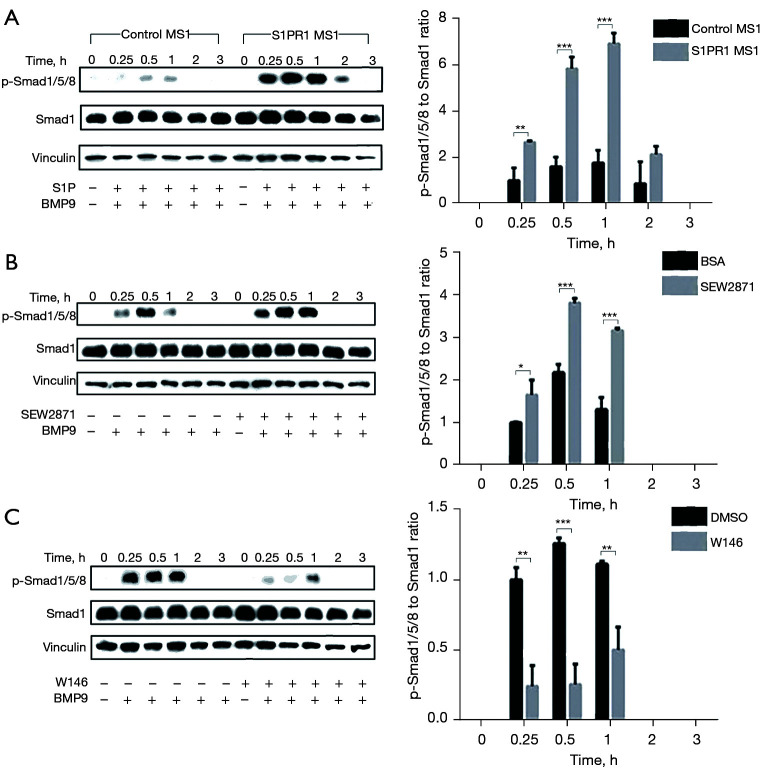
The present study elucidated that S1pr1 and Eng are both pivotal for angiogenesis in the postnatal mouse retina, and that the activation of S1pr1 or Eng increases vascular barrier function. Activation of S1pr1 enhanced the phosphorylation of Smad family members 1, 5, and 8 (pSmad1/5/8), while the inhibition of S1pr1 reduced the levels of pSma1/5/8 induced by BMP9 treatment. Activation or loss of Eng did not affect S1pr1 signaling. Moreover, activation of ERK was involved in promoting EC-surface expression of Eng by S1pr1.
Our data demonstrates for the first time that there exists a linear pathway of S1pr1-Eng signaling axis in ECs, which governs vascular homeostasis. Functional BMP9/Eng signaling requires S1P/S1pr1 activation, and S1pr1 signaling acts as a vascular protection mechanism upstream of Eng.
1-磷酸鞘氨醇(S1P)/S1P受体(S1pr)1信号传导在调节血管完整性和血管生成中起重要作用。我们之前已经表明,内皮糖蛋白(Eng)的细胞表面表达在内皮细胞(ECs)中由S1P/S1pr1信号传导维持。然而,S1pr1是否介导Eng信号传导,反之亦然,仍然未知。
使用S1pr1抑制剂研究药物抑制是否会诱导基础血管渗漏。使用急性呼吸窘迫综合征(ARDS)模型研究S1pr1抑制是否会在肺部引发更大的炎症。使用S1pr1抑制剂、骨形态发生蛋白9(BMP9)阻断抗体或慢病毒介导的Eng可溶性细胞外结构域(sEng)表达来测试阻断S1P/S1pr1和BMP9/Eng信号轴是否会在视网膜血管生成中产生任何相互作用。为了阐明S1P和BMP9是否在线性途径中起作用,使用小鼠胰岛EC系MS1进行跨内皮电阻(TEER)测量研究;进行时间进程研究以检查ECs中S1P和BMP9信号通路的下游效应器;生成了两个稳定的MS1细胞系,一个过表达人S1PR1,另一个敲低Eng,以验证S1pr1和Eng是相互作用的关键参与者。使用细胞外调节蛋白激酶(ERK)抑制剂检查该信号传导是否参与S1P诱导的Eng细胞表面定位。
本研究阐明,S1pr1和Eng在出生后小鼠视网膜血管生成中均起关键作用,并且S1pr1或Eng的激活增加血管屏障功能。S1pr1的激活增强了Smad家族成员1、5和8(pSmad1/5/8)的磷酸化,而S1pr1的抑制降低了BMP9处理诱导的pSma1/5/8水平。Eng的激活或缺失不影响S1pr1信号传导。此外,ERK的激活参与促进S1pr1介导的Eng在EC表面的表达。
我们的数据首次证明,ECs中存在S1pr1-Eng信号轴的线性途径,该途径控制血管稳态。功能性BMP9/Eng信号传导需要S1P/S1pr1激活,并且S1pr1信号传导作为Eng上游的血管保护机制。