
对 SARS-CoV-2 感染的造血反应。
Hematopoietic responses to SARS-CoV-2 infection.
机构信息
Faculty of Medicine and Dentistry, School of Dentistry, Division of Foundational Sciences, Department of Oncology, and Li Ka Shing Institute of Virology, University of Alberta, 7020 Katz Group Centre, 11361-87th Ave NW, Edmonton, AB, T6G 2E1, Canada.
出版信息
Cell Mol Life Sci. 2022 Mar 13;79(3):187. doi: 10.1007/s00018-022-04220-6.
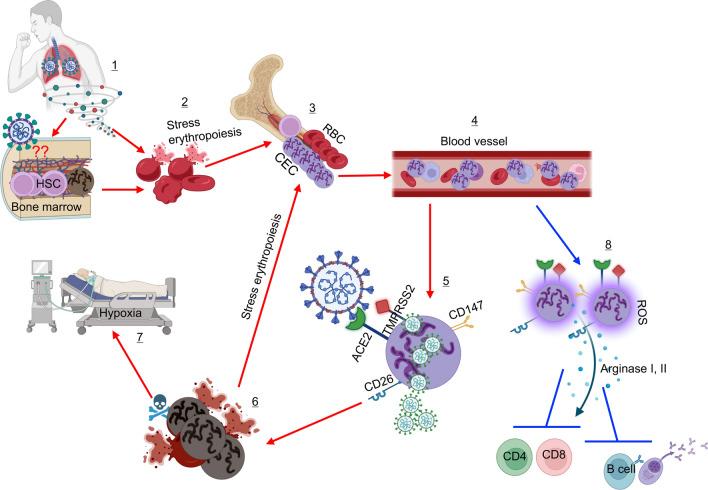
Under physiological conditions, hematopoietic stem and progenitor cells (HSPCs) in the bone marrow niches are responsible for the highly regulated and interconnected hematopoiesis process. At the same time, they must recognize potential threats and respond promptly to protect the host. A wide spectrum of microbial agents/products and the consequences of infection-induced mediators (e.g. cytokines, chemokines, and growth factors) can have prominent impact on HSPCs. While COVID-19 starts as a respiratory tract infection, it is considered a systemic disease which profoundly alters the hematopoietic system. Lymphopenia, neutrophilia, thrombocytopenia, and stress erythropoiesis are the hallmark of SARS-CoV-2 infection. Moreover, thrombocytopenia and blood hypercoagulability are common among COVID-19 patients with severe disease. Notably, the invasion of erythroid precursors and progenitors by SARS-CoV-2 is a cardinal feature of COVID-19 disease which may in part explain the mechanism underlying hypoxia. These pieces of evidence support the notion of skewed steady-state hematopoiesis to stress hematopoiesis following SARS-CoV-2 infection. The functional consequences of these alterations depend on the magnitude of the effect, which launches a unique hematopoietic response that is associated with increased myeloid at the expense of decreased lymphoid cells. This article reviews some of the key pathways including the infectious and inflammatory processes that control hematopoiesis, followed by a comprehensive review that summarizes the latest evidence and discusses how SARS-CoV-2 infection impacts hematopoiesis.
在生理条件下,骨髓龛中的造血干细胞和祖细胞 (HSPCs) 负责高度调节和相互关联的造血过程。同时,它们必须识别潜在威胁并迅速做出反应以保护宿主。广泛的微生物剂/产物以及感染诱导介质(例如细胞因子、趋化因子和生长因子)的后果会对 HSPCs 产生显著影响。虽然 COVID-19 最初是一种呼吸道感染,但它被认为是一种全身性疾病,会深刻改变造血系统。淋巴细胞减少症、中性粒细胞增多症、血小板减少症和应激性红细胞生成是 SARS-CoV-2 感染的标志。此外,血小板减少症和血液高凝状态在 COVID-19 重症患者中很常见。值得注意的是,SARS-CoV-2 对红细胞前体细胞和祖细胞的侵袭是 COVID-19 疾病的一个主要特征,这可能部分解释了缺氧的机制。这些证据支持 SARS-CoV-2 感染后稳态造血向应激造血倾斜的观点。这些改变的功能后果取决于影响的程度,它引发了一种独特的造血反应,与增加的髓系细胞以牺牲减少的淋巴细胞为代价有关。本文综述了一些关键途径,包括控制造血的感染和炎症过程,然后全面综述了最新证据,并讨论了 SARS-CoV-2 感染如何影响造血。


 Zotero 插件