Aldo Ravelli' Research Center for Neurotechnology and Experimental Brain therapeutics, Department of Health Sciences, University of Milan, Milan, Italy.
ASST Santi Paolo e Carlo, San Paolo University Hospital, Milan, Italy.
Eur J Neurol. 2022 Jul;29(7):2006-2014. doi: 10.1111/ene.15324. Epub 2022 Mar 29.
Cognitive dysfunction has been observed following recovery from COVID-19. To the best of our knowledge, however, no study has assessed the progression of cognitive impairment after 1 year. The aim was to assess cognitive functioning at 1 year from hospital discharge, and eventual associations with specific clinical variables.
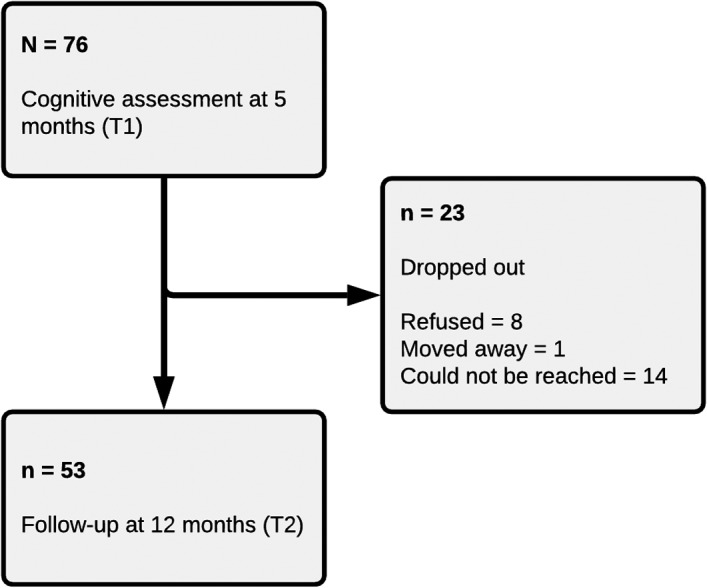
Seventy-six patients (aged 22-74 years) who had been hospitalized for COVID-19 were recruited. Patients received neuropsychological assessments at 5 (n = 76) and 12 months (n = 53) from hospital discharge.
Over half (63.2%) of the patients had deficits in at least one test at 5 months. Compared to the assessment at 5 months, verbal memory, attention and processing speed improved significantly after 1 year (all p < 0.05), whereas visuospatial memory did not (all p > 0.500). The most affected domains after 1 year were processing speed (28.3%) and long-term visuospatial (18.1%) and verbal (15.1%) memory. Lower PaO /FiO ratios in the acute phase were associated with worse verbal long-term memory (p = 0.029) and visuospatial learning (p = 0.041) at 5 months. Worse visuospatial long-term memory at 5 months was associated with hyposmia (p = 0.020) and dysgeusia (p = 0.037).
Our study expands the results from previous studies showing that cognitive impairment can still be observed after 1 year. Patients with severe COVID-19 should receive periodic cognitive follow-up evaluations, as cognitive deficits in recovered patients could have social and occupational implications.
新冠肺炎康复后会出现认知功能障碍。然而,据我们所知,尚无研究评估新冠肺炎后 1 年的认知障碍进展情况。本研究旨在评估出院后 1 年的认知功能,并最终评估与特定临床变量的相关性。
共招募了 76 名(年龄 22-74 岁)因新冠肺炎住院的患者。患者在出院后 5 个月(n=76)和 12 个月(n=53)时接受神经心理学评估。
超过一半(63.2%)的患者在 5 个月时至少有一项测试结果异常。与 5 个月时相比,1 年后言语记忆、注意力和处理速度明显改善(均 p<0.05),而视空间记忆没有改善(均 p>0.500)。1 年后受影响最大的领域是处理速度(28.3%)和长期视空间(18.1%)及言语(15.1%)记忆。急性期 PaO /FiO 比值较低与 5 个月时言语长时记忆(p=0.029)和视空间学习(p=0.041)较差有关。5 个月时视空间长时记忆较差与嗅觉减退(p=0.020)和味觉障碍(p=0.037)有关。
本研究扩展了之前的研究结果,表明新冠肺炎后 1 年仍可观察到认知障碍。严重新冠肺炎患者应接受定期认知随访评估,因为康复患者的认知缺陷可能会对其社交和职业产生影响。