Department of Electrical and Computer Engineering, Kansas State University, Manhattan, KS 66506, USA.
J R Soc Interface. 2022 Mar;19(188):20210920. doi: 10.1098/rsif.2021.0920. Epub 2022 Mar 14.
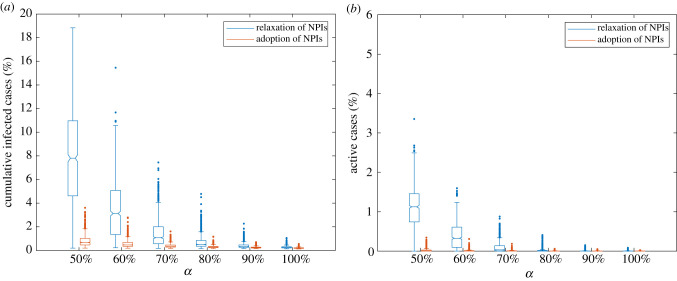
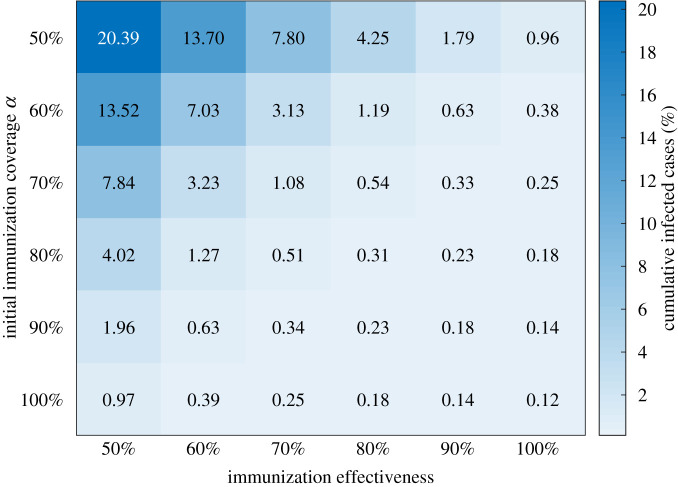
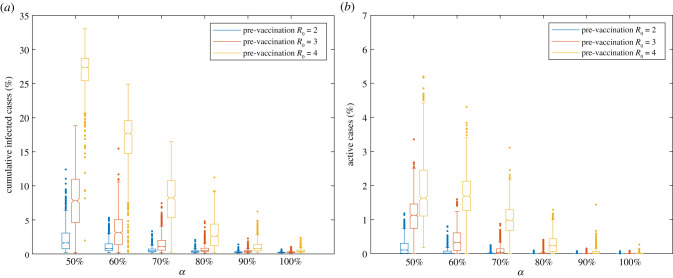
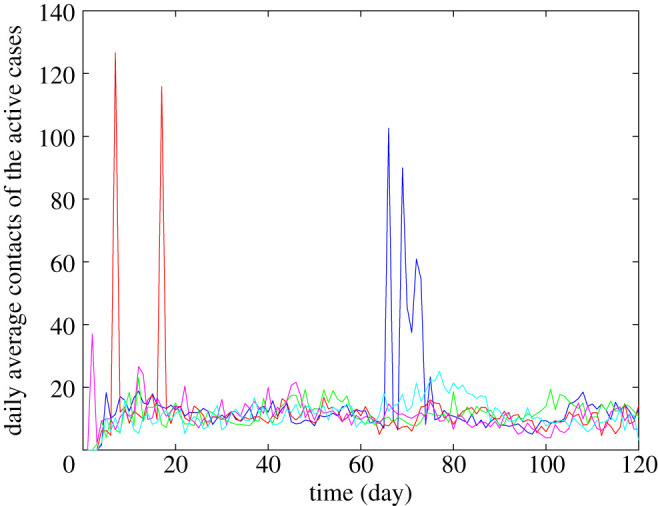
After one pandemic year of remote or hybrid instructional modes, universities struggled with plans for an in-person autumn (fall) semester in 2021. To help inform university reopening policies, we collected survey data on social contact patterns and developed an agent-based model to simulate the spread of severe acute respiratory syndrome coronavirus 2 in university settings. Considering a reproduction number of = 3 and 70% immunization effectiveness, we estimated that at least 80% of the university population immunized through natural infection or vaccination is needed for safe university reopening with relaxed non-pharmaceutical interventions (NPIs). By contrast, at least 60% of the university population immunized through natural infection or vaccination is needed for safe university reopening when NPIs are adopted. Nevertheless, attention needs to be paid to large-gathering events that could lead to infection size spikes. At an immunization coverage of 70%, continuing NPIs, such as wearing masks, could lead to a 78.39% reduction in the maximum cumulative infections and a 67.59% reduction in the median cumulative infections. However, even though this reduction is very beneficial, there is still a possibility of non-negligible size outbreaks because the maximum cumulative infection size is equal to 1.61% of the population, which is substantial.
在经历了一年的远程或混合教学模式之后,各大学在 2021 年秋季都在努力制定面对面教学的计划。为了帮助制定大学重新开放的政策,我们收集了有关社交接触模式的调查数据,并开发了一个基于代理的模型来模拟严重急性呼吸系统综合症冠状病毒 2 在大学环境中的传播。考虑到繁殖数 = 3 和 70%的免疫有效性,我们估计,至少需要 80%的大学人群通过自然感染或接种疫苗来实现安全的大学重新开放,并放宽非药物干预措施(NPIs)。相比之下,当采用 NPIs 时,至少需要 60%的大学人群通过自然感染或接种疫苗来实现安全的大学重新开放。然而,仍需要关注可能导致感染规模激增的大型集会活动。在接种率为 70%的情况下,继续采取 NPIs,如佩戴口罩,可以将最大累计感染量减少 78.39%,将中位数累计感染量减少 67.59%。然而,尽管这种减少非常有益,但仍有可能发生不可忽视的大规模疫情爆发,因为最大累计感染量等于人口的 1.61%,这是相当大的。