Ministry of Education - Shanghai Key Laboratory of Children's Environmental Health, Xinhua Hospital, Shanghai Jiao Tong University School of Medicine, Shanghai, China.
Department of Environmental Health, School of Public Health, Shanghai Jiao Tong University School of Medicine, Shanghai, China.
Environ Health Perspect. 2022 Mar;130(3):37006. doi: 10.1289/EHP9875. Epub 2022 Mar 14.
Pregnant women are ubiquitously exposed to per- and polyfluoroalkyl substances (PFAS). Prenatal exposure to PFAS has been associated with lower birth weight but also with excess adiposity and higher weight in childhood. These mixed findings warrant investigation of the relationship between PFAS and dynamic offspring growth.
To investigate the association between prenatal PFAS exposure and early-life growth trajectories during the first 2 y.
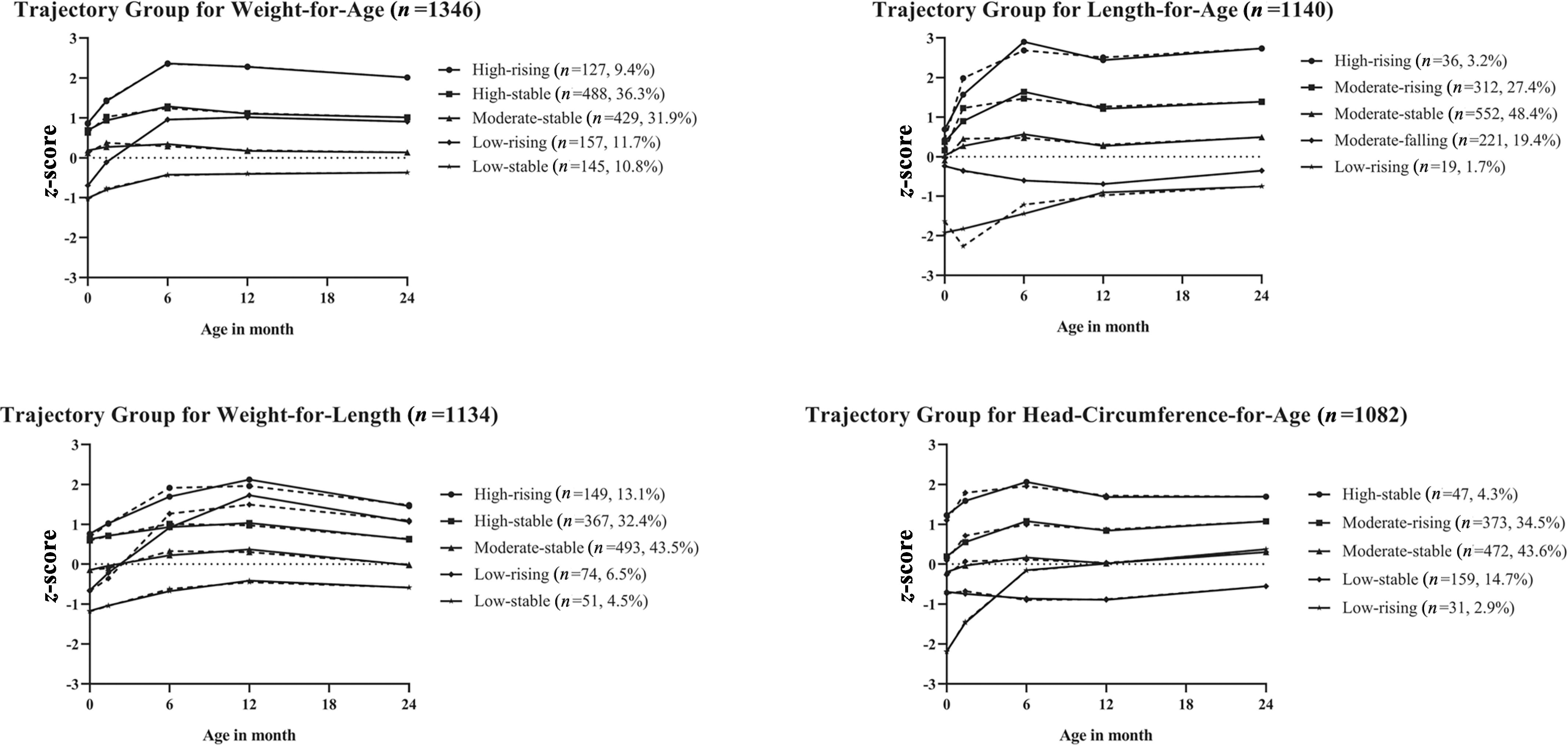
Pregnant women () were recruited from 2013 to 2016 from the Shanghai Birth Cohort (SBC) Study, and their children were followed up from birth to 2 y of age. Seven PFAS congeners were quantified in pregnant women's serum during the first trimester. Our study population was restricted to 1,350 children who had five repeated measurements for at least one anthropometric measure. Four anthropometric measures, including weight, length/height, weight-for-length, and head circumference, were evaluated at birth, 42 d, 6 months, 12 months, and 24 months, and standardized into -scores using the World Health Organization reference. Trajectories of each measure were classified into five groups using group-based trajectory modeling. Multinomial logistic regression was used to estimate odds ratio (OR) and 95% confidence interval (CI) for trajectory groups according to -transformed PFAS concentrations, and the moderate-stable group was selected as the reference group for all measures.
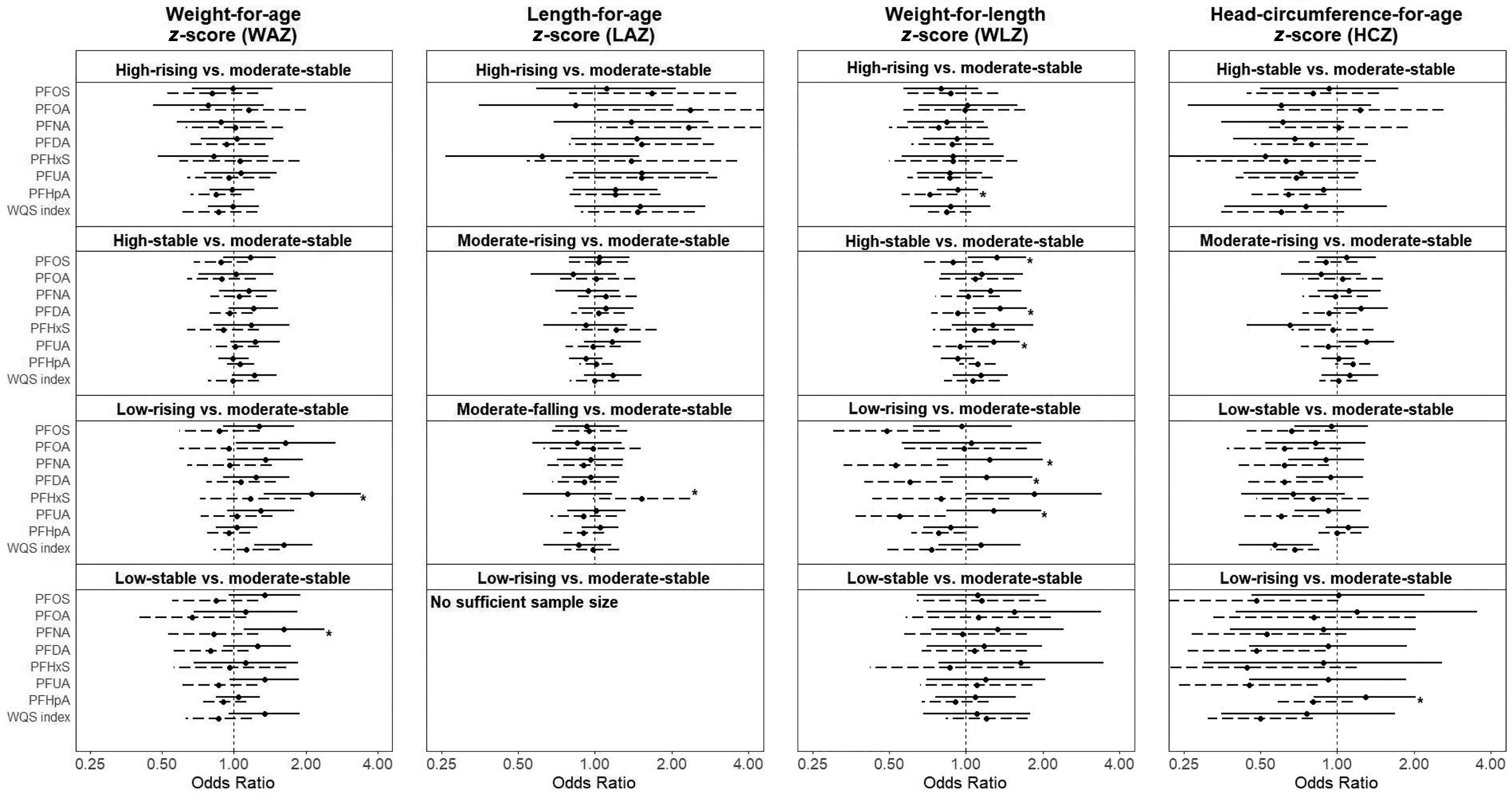
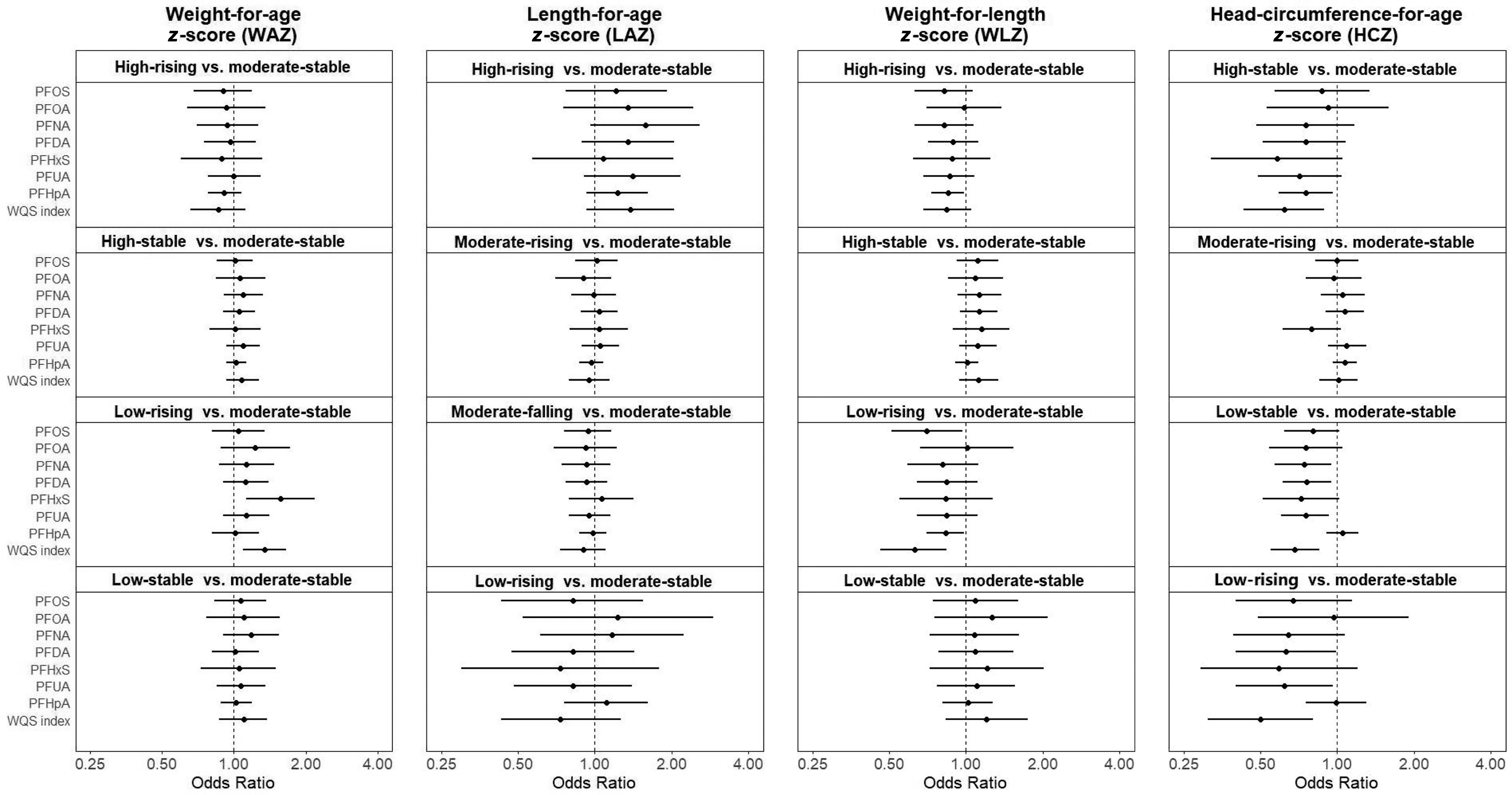
Higher prenatal exposure to PFAS was associated with elevated odds for the low-rising weight-for-age -score (WAZ) trajectory, and the high-rising length-for-age -score (LAZ) trajectory. Meanwhile, PFAS levels were associated with decreased odds for the low-rising and high-rising weight-for-length -score (WLZ) trajectories. In addition, the associations of PFAS with growth trajectory groups differed by sex, where males had greater odds for the low-rising and low-stable WAZ trajectories and for the high-stable and low-rising WLZ trajectories. In contrast, inverse associations were consistently observed with trajectories of the high-stable, low-stable, and low-rising head-circumference-for-age -score (HCZ) in relation to most individual PFAS congeners. PFAS mixtures analysis further confirmed the above findings.
Trajectory analysis approach provided insight into the complex associations between PFAS exposure and offspring growth. Future studies are warranted to confirm the present findings with trajectory modeling strategies and understand the clinical significance of these trajectory groups. https://doi.org/10.1289/EHP9875.
孕妇普遍接触到全氟和多氟烷基物质(PFAS)。产前接触 PFAS 与出生体重较低有关,但也与儿童时期超重和体重增加有关。这些混杂的发现表明有必要研究 PFAS 与后代生长的动态关系。
调查孕妇产前 PFAS 暴露与出生后 2 年内的早期生长轨迹之间的关系。
2013 年至 2016 年,从上海出生队列(SBC)研究中招募了孕妇,并对其子女进行了从出生到 2 岁的随访。在妊娠早期对孕妇血清中的 7 种 PFAS 同系物进行了定量检测。我们的研究人群仅限于至少有 5 次重复测量的 1350 名儿童,这些儿童的测量值包括体重、身长/身高、体重-身长比和头围。在出生时、42 天、6 个月、12 个月和 24 个月时对这四个体格测量值进行评估,并使用世界卫生组织参考标准将其标准化为 -分数。使用基于群组的轨迹建模对每个测量值的轨迹进行分类为五个组。根据 -转化的 PFAS 浓度,使用多项逻辑回归估计轨迹组的比值比(OR)和 95%置信区间(CI),并将中度稳定组作为所有测量值的参考组。
较高的产前 PFAS 暴露与较低的体重-年龄 -分数(WAZ)轨迹升高的几率和较高的身长-年龄 -分数(LAZ)轨迹升高的几率相关。同时,PFAS 水平与体重-身长比(WLZ)轨迹的较低升高和较高升高的几率降低相关。此外,PFAS 与生长轨迹组的关联因性别而异,男性出现较低升高和低稳定 WAZ 轨迹以及较高稳定和低升高 WLZ 轨迹的几率更大。相反,与大多数个体 PFAS 同系物相比,反向关联与高稳定、低稳定和低升高头围-年龄 -分数(HCZ)轨迹一致。PFAS 混合物分析进一步证实了上述发现。
轨迹分析方法深入了解了 PFAS 暴露与后代生长之间的复杂关系。未来的研究需要使用轨迹建模策略来证实目前的发现,并了解这些轨迹组的临床意义。