Pediatric Intensive Care Unit, Children's Hospital of Nanjing Medical University, No 72 Guangzhou Road, Nanjing, China.
Nanjing Infectious Disease Center, The Second Hospital of Nanjing, Nanjing University of Chinese Medicine, Nanjing, China.
World J Pediatr. 2022 May;18(5):343-349. doi: 10.1007/s12519-022-00529-1. Epub 2022 Mar 14.
The aim of this study was to analyze the clinical characteristics of 66 pediatric patients with B.1.617.2 (Delta) variant of coronavirus disease 2019 (COVID-19).
Sixty-six pediatric patients with B.1.617.2 (Delta) variant of COVID-19 admitted to the hospital from July to August 2021 were classified into mild (n = 41) and moderate groups (n = 25). Clinical characteristics, laboratory data and dynamic trends in different time periods were analyzed retrospectively.
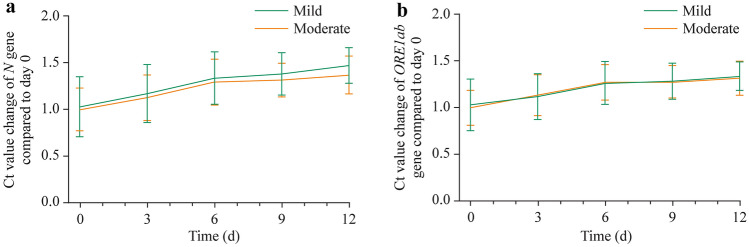
There were no statistically significant differences in age, gender ratios and clinical symptoms between the mild group and the moderate group. All the patients in the moderate group had clusters of onsets, and the incubation period was shorter than that of the mild group. Within 24 hours of admission, the levels of erythrocyte sedimentation rate, cardiac troponin I, D-dimer in the moderate group were higher than that in the mild group (P < 0.05). The titers of immunoglobulin (Ig) G and IgM antibodies gradually increased after disease onset. Thirty-five (53.03%) children were tested positive for antibodies in 4-12 days. IgG increased gradually, while IgM decreased obviously in about 15 days after disease onset. The cycle threshold values of open reading frame 1ab and nucleocapsid protein gene in the severe acute respiratory syndrome coronavirus 2 genomes increased gradually on the 3rd, 6th, 9th, and 12th days after disease onset, compared with those in day 0.
The symptoms of children with B.1.617.2 (Delta) variant of COVID-19 were mild. The description and analysis of the clinical characteristics and laboratory data can help medical staff to evaluate the condition of children with COVID-19 and to accumulate more clinical experience.
本研究旨在分析 66 例儿童 2019 年冠状病毒病(COVID-19)B.1.617.2(德尔塔)变异株患儿的临床特征。
回顾性分析 2021 年 7 月至 8 月期间收治的 66 例 B.1.617.2(德尔塔)变异株 COVID-19 患儿,分为轻症组(n=41)和中症组(n=25)。分析比较两组患儿的临床特征、实验室数据及不同时间段的动态变化趋势。
轻症组与中症组在年龄、性别比及临床症状方面均无统计学差异。中症组患儿均有聚集性发病,潜伏期较轻症组缩短。入院 24 h 内,中症组患儿红细胞沉降率、心肌肌钙蛋白 I、D-二聚体水平均高于轻症组(P<0.05)。发病后,IgG、IgM 抗体滴度逐渐升高,35 例(53.03%)患儿在发病后 4~12 d 抗体检测阳性。IgG 逐渐升高,而 IgM 在发病后约 15 d 明显下降。第 3、6、9、12 天,严重急性呼吸综合征冠状病毒 2 基因组开放阅读框 1ab 和核衣壳蛋白基因的循环阈值较发病第 0 天逐渐升高。
儿童感染 B.1.617.2(德尔塔)变异株 COVID-19 症状较轻。对临床特征和实验室数据的描述和分析有助于医务人员评估 COVID-19 患儿的病情,积累更多的临床经验。