Lee Yeon-Hee, Auh Q-Schick, An Jung-Sub, Kim Tae
Department of Orofacial Pain and Oral Medicine, Kyung Hee University Dental Hospital, #26 Kyunghee-daero, Dongdaemun-gu, Seoul, 02447, South Korea.
Department of Orthodontics, Seoul National University Dental Hospital, Seoul, South Korea.
BMC Musculoskelet Disord. 2022 Mar 14;23(1):246. doi: 10.1186/s12891-022-05195-y.
This study aimed to investigate and compare sleep quality between patients with chronic temporomandibular disorder and healthy controls, and to analyze the association of sleep quality with disease characteristics, obstructive sleep apnea risk factors, and excessive daytime sleepiness.
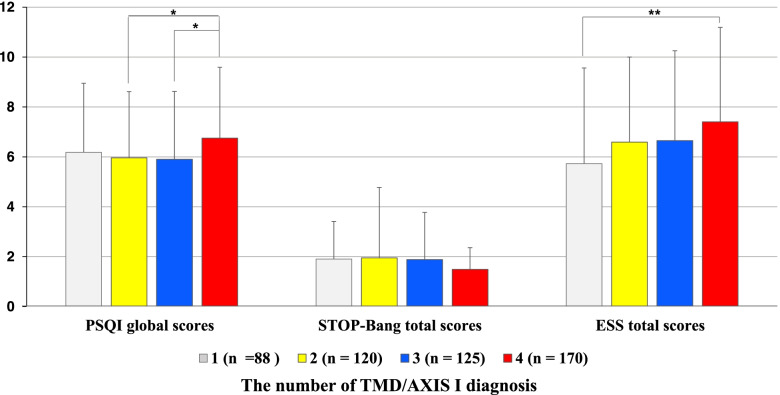
Chronic temporomandibular disorder patients (n = 503, mean age: 33.10 ± 13.26 years, 333 females) and 180 age- and sex-matched healthy controls (mean age: 32.77 ± 12.95 years, 116 females) were included, who completed well-organized clinical report and answered questions on sleep quality (Pittsburgh Sleep Quality Index), sleep apnea risk factors (STOP-Bang questionnaire), and excessive daytime sleepiness (Epworth sleepiness scale).
Mean global Pittsburgh Sleep Quality Index scores were significantly higher in the patients (6.25 ± 2.77) than in healthy controls (3.84 ± 2.29) (p < 0.001). Poor sleep was significantly more prevalent in the patient group (56.9%) than in healthy controls (22.2%) (p < 0.001). Compared with healthy controls, chronic temporomandibular disorder patients had a higher likelihood of obstructive sleep apnea (STOP-Bang total score ≥ 3; 7.2% vs. 16.1%; p < 0.01) and higher excessive daytime sleepiness (Epworth sleepiness scale score ≥ 10; 12.8% vs. 19.7%; p < 0.05). Age (odds ratio = 2.551; p < 0.001), female sex (odds ratio = 1.885; p = 0.007), total Epworth sleepiness scale score (odds ratio = 1.839; p = 0.014), and headache attributed to temporomandibular disorder (odds ratio = 1.519; p = 0.049) were the most powerful predictors of poor sleep (global Pittsburgh Sleep Quality Index score ≥ 5) in chronic temporomandibular disorder patients.
Chronic temporomandibular disorder patients had markedly impaired sleep quality than healthy controls. Poorer sleep in patients with chronic temporomandibular disorder was associated with a variety of clinical factors, including a higher likelihood of excessive daytime sleepiness, older age, female gender, higher Epworth sleepiness scale scores, and the presence of headache attributed to temporomandibular disorder.
本研究旨在调查和比较慢性颞下颌关节紊乱症患者与健康对照者的睡眠质量,并分析睡眠质量与疾病特征、阻塞性睡眠呼吸暂停风险因素及日间过度嗜睡之间的关联。
纳入慢性颞下颌关节紊乱症患者(n = 503,平均年龄:33.10 ± 13.26岁,女性333例)和180例年龄及性别匹配的健康对照者(平均年龄:32.77 ± 12.95岁,女性116例),他们完成了条理清晰的临床报告,并回答了关于睡眠质量(匹兹堡睡眠质量指数)、睡眠呼吸暂停风险因素(STOP - Bang问卷)和日间过度嗜睡(爱泼沃斯嗜睡量表)的问题。
患者的匹兹堡睡眠质量指数总体平均得分(6.25 ± 2.77)显著高于健康对照者(3.84 ± 2.29)(p < 0.001)。睡眠不佳在患者组中的发生率(56.9%)显著高于健康对照者(22.2%)(p < 0.001)。与健康对照者相比,慢性颞下颌关节紊乱症患者发生阻塞性睡眠呼吸暂停的可能性更高(STOP - Bang总分≥3;7.2% 对16.1%;p < 0.01),日间过度嗜睡程度更高(爱泼沃斯嗜睡量表得分≥10;12.8% 对19.7%;p < 0.05)。年龄(优势比 = 2.551;p < 0.001)、女性(优势比 = 1.885;p = 0.007)、爱泼沃斯嗜睡量表总得分(优势比 = 1.839;p = 0.014)以及颞下颌关节紊乱症所致头痛(优势比 = 1.519;p = 0.049)是慢性颞下颌关节紊乱症患者睡眠不佳(匹兹堡睡眠质量指数总体得分≥5)的最强预测因素。
慢性颞下颌关节紊乱症患者的睡眠质量明显低于健康对照者。慢性颞下颌关节紊乱症患者睡眠较差与多种临床因素有关,包括日间过度嗜睡可能性更高、年龄较大、女性、爱泼沃斯嗜睡量表得分较高以及存在颞下颌关节紊乱症所致头痛。