Department of Orthopaedics and Traumatology, Faculty of Medicine, The Chinese University of Hong Kong, Hong Kong, SAR, China.
Department of Orthopaedics and Traumatology, Prince of Wales Hospital, Hong Kong, SAR, China.
BMC Musculoskelet Disord. 2022 Mar 14;23(1):247. doi: 10.1186/s12891-022-05174-3.
Meniscus root tear is an uncommon but detrimental injury of the knee. Hoop stress is lost during meniscus root tear, which can lead to excessive tibiofemoral contact pressure and early development of osteoarthritis. Posterolateral meniscus root tears (PLRT) are more commonly associated with anterior cruciate ligament (ACL) tears. As the lateral compartment is less congruent than the medial compartment, it is more susceptible to a shearing force, which is increased in the ACL-deficient knee. In accordance with the compressive axial load, the increase in the tibial slope would generate a greater shearing force. The additional lateral compartment mobility caused by ACL tear should be reduced after ACL reconstruction (ACLR). However, there is a lack of evidence to conclude that ACLR can sufficiently limit the effect of large tibial slope (LTS) on the healing after PLRT repair. This study aimed to evaluate whether a steep LTS would be a risk factor for poorer clinical outcomes after PLRT repair concomitant with ACLR.
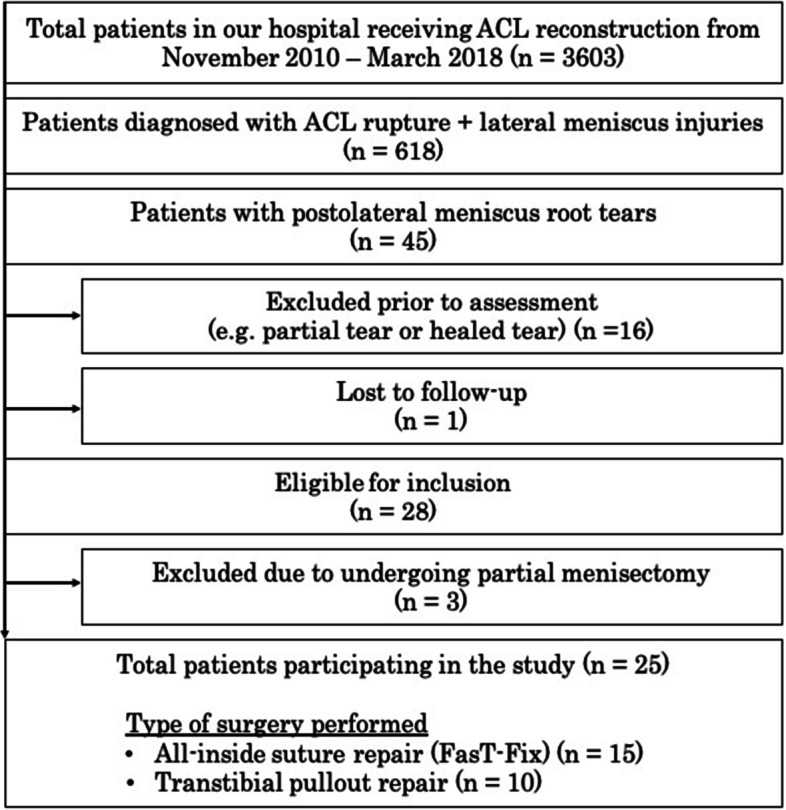
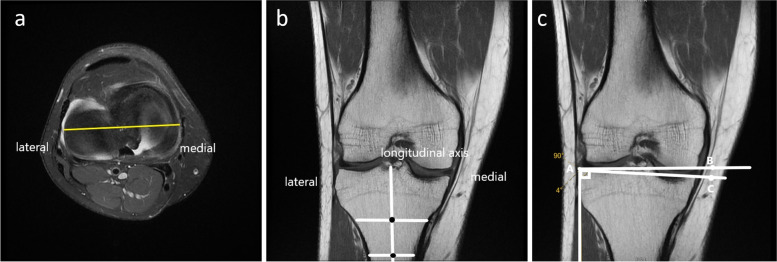
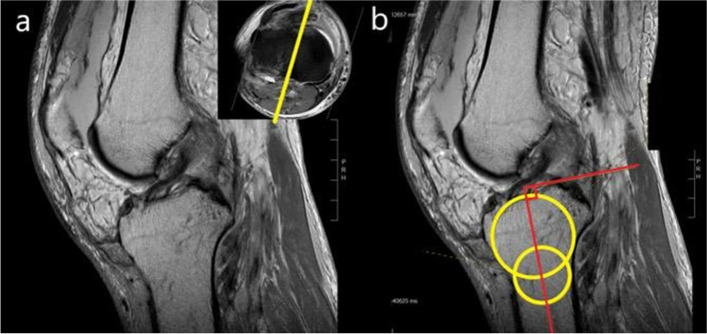
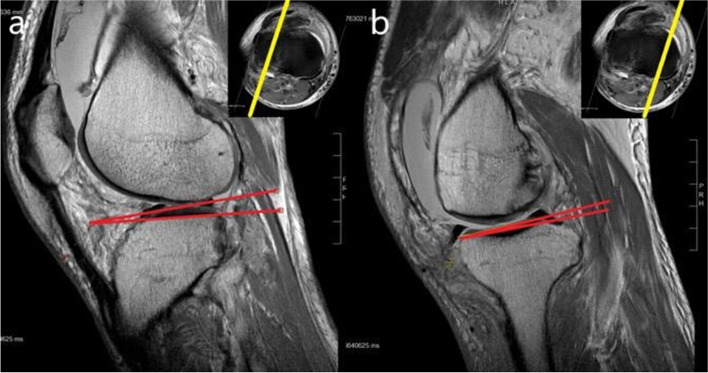
In this retrospective study, a chart review was conducted to identify patients with concomitant unilateral primary ACLR and PLRT repair. Patients with a partial tear or healed tear were excluded. Postoperative MRI and clinical assessments were performed at a mean follow up of 35 months. MRI data was used to measure the LTS, medial tibial slope (MTS), coronal tibial slope (CTS), the lateral-to-medial slope difference (LTS-MTS) and meniscus healing and extrusion. Functional outcomes were evaluated by patient-reported outcomes (International Knee Documentation Committee [IKDC], Lysholm and Tegner scores) and KT-1000 arthrometer assessment. Interobserver reproducibility was assessed by two reviewers.
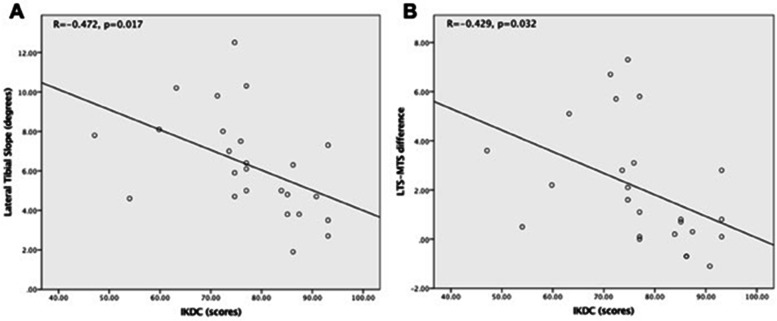
Twenty-five patients were identified for the analysis. Patients with larger LTS and larger LTS-MTS differences were shown to be correlated with poorer IKDC scores after surgery (R = -0.472, p = 0.017 and R = -0.429, p = 0.032, respectively). Herein, patients with LTS ≥ 6° or LTS-MTS ≥ 3° demonstrated poorer IKDC scores.
A large LTS (≥ 6°) and a large difference of LTS-MTS (≥ 3°) were shown to be risk factors for poorer functional and radiological outcomes for PLRT repair in patients after ACLR. Clinically, closer monitoring and a more stringent rehabilitation plan for patients with LTS ≥ 6° or LTS-MTS ≥ 3° would be recommended.
半月板根部撕裂是一种罕见但有害的膝关节损伤。半月板根部撕裂会导致环形张力丧失,从而导致胫骨股骨接触压力过大和骨关节炎早期发展。后外侧半月板根部撕裂(PLRT)通常与前交叉韧带(ACL)撕裂有关。由于外侧间室比内侧间室更不一致,因此更容易受到剪切力的影响,而在 ACL 缺失的膝关节中,剪切力会增加。根据压缩轴向载荷,胫骨坡度的增加会产生更大的剪切力。ACL 撕裂后,ACL 重建(ACLR)会减少外侧间室的额外活动度。然而,目前尚无证据表明 ACLR 可以充分限制大胫骨坡度(LTS)对 PLRT 修复后愈合的影响。本研究旨在评估陡峭的 LTS 是否会成为 PLRT 修复后并发 ACLR 后临床结果较差的危险因素。
在这项回顾性研究中,对接受单侧原发性 ACLR 和 PLRT 修复的患者进行了图表审查。排除部分撕裂或已愈合撕裂的患者。在平均 35 个月的随访时进行术后 MRI 和临床评估。MRI 数据用于测量 LTS、内侧胫骨坡度(MTS)、冠状胫骨坡度(CTS)、外侧到内侧坡度差(LTS-MTS)以及半月板愈合和挤压。通过患者报告的结果(国际膝关节文献委员会 [IKDC]、Lysholm 和 Tegner 评分)和 KT-1000 关节测量仪评估功能结果。两名审阅者评估了观察者间的可重复性。
共确定了 25 名患者进行分析。结果显示,LTS 较大和较大的 LTS-MTS 差异与术后 IKDC 评分较差相关(R=-0.472,p=0.017 和 R=-0.429,p=0.032)。在此,LTS≥6°或 LTS-MTS≥3°的患者 IKDC 评分较差。
LTS 较大(≥6°)和 LTS-MTS 差值较大(≥3°)是 ACLR 后 PLRT 修复患者功能和影像学结果较差的危险因素。临床上,对于 LTS≥6°或 LTS-MTS≥3°的患者,建议进行更密切的监测和更严格的康复计划。