Cederberg Matilda, Alsén Sara, Ali Lilas, Ekman Inger, Glise Kristina, Jonsdottir Ingibjörg H, Gyllensten Hanna, Swedberg Karl, Fors Andreas
Institute of Health and Care Sciences, Sahlgrenska Academy, University of Gothenburg, Gothenburg, Sweden.
University of Gothenburg Centre for Person-Centred Care (GPCC), Sahlgrenska Academy, University of Gothenburg, Gothenburg, Sweden.
JMIR Ment Health. 2022 Mar 15;9(3):e30966. doi: 10.2196/30966.
Sick leave due to common mental disorders (CMDs) is a public health problem in several countries, including Sweden. Given that symptom relief does not necessarily correspond to return to work, health care interventions focusing on factors that have proven important to influence the return to work process, such as self-efficacy, are warranted. Self-efficacy is also a central concept in person-centered care.
The aim of this study is to evaluate the effects of a person-centered eHealth intervention for patients on sick leave due to CMDs.
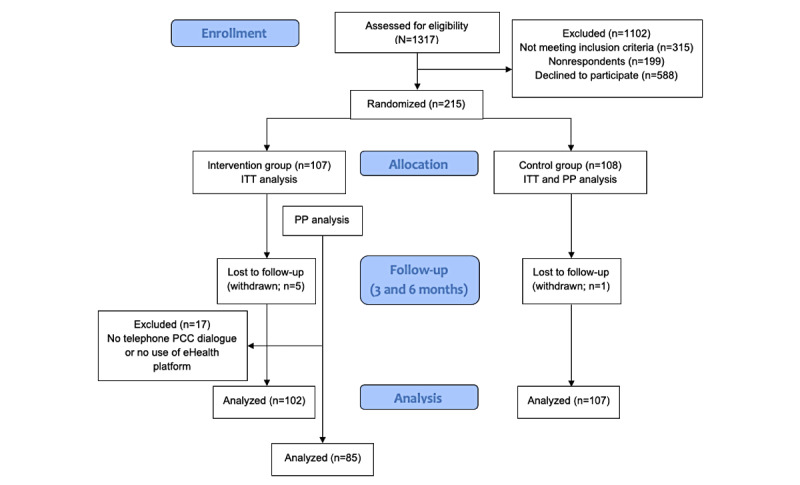
A randomized controlled trial of 209 patients allocated to either a control group (107/209, 51.2%) or an intervention group (102/209, 48.8%) was conducted. The control group received usual care, whereas the intervention group received usual care with the addition of a person-centered eHealth intervention. The intervention was built on person-centered care principles and consisted of telephone support and a web-based platform. The primary outcome was a composite score of changes in general self-efficacy (GSE) and level of sick leave at the 6-month follow-up. An intention-to-treat analysis included all participants, and a per-protocol analysis consisted of those using both the telephone support and the web-based platform.
At the 3-month follow-up, in the intention-to-treat analysis, more patients in the intervention group improved on the composite score than those in the control group (20/102, 19.6%, vs 10/107, 9.3%; odds ratio [OR] 2.37, 95% CI 1.05-5.34; P=.04). At the 6-month follow-up, the difference was no longer significant between the groups (31/100, 31%, vs 25/107, 23.4%; OR 1.47, 95% CI 0.80-2.73; P=.22). In the per-protocol analysis, a significant difference was observed between the intervention and control groups at the 3-month follow-up (18/85, 21.2%, vs 10/107, 9.3%; OR 2.6, 95% CI 1.13-6.00; P=.02) but not at 6 months (30/84, 35.7%, vs 25/107, 23.4%; OR 1.8, 95% CI 0.97-3.43; P=.06). Changes in GSE drove the effects in the composite score, but the intervention did not affect the level of sick leave.
A person-centered eHealth intervention for patients on sick leave due to CMDs improved GSE but did not affect the level of sick leave.
ClinicalTrials.gov NCT03404583; https://clinicaltrials.gov/ct2/show/NCT03404583.
在包括瑞典在内的多个国家,因常见精神障碍(CMD)导致的病假是一个公共卫生问题。鉴于症状缓解并不一定意味着能够重返工作岗位,因此有必要开展以已被证明对影响重返工作过程至关重要的因素(如自我效能感)为重点的医疗保健干预措施。自我效能感也是以患者为中心的护理中的一个核心概念。
本研究旨在评估针对因CMD而休病假的患者开展的以患者为中心的电子健康干预措施的效果。
对209名患者进行了一项随机对照试验,这些患者被分为对照组(107/209,51.2%)或干预组(102/209,48.8%)。对照组接受常规护理,而干预组在接受常规护理的基础上增加了以患者为中心的电子健康干预措施。该干预措施基于以患者为中心的护理原则,包括电话支持和一个基于网络的平台。主要结局是在6个月随访时一般自我效能感(GSE)变化和病假水平的综合评分。意向性分析纳入了所有参与者,符合方案分析则由同时使用电话支持和基于网络平台的患者组成。
在3个月随访时,在意向性分析中,干预组中综合评分改善的患者比对照组更多(20/102,19.6%,对比10/107,9.3%;优势比[OR] 2.37,95%置信区间1.05 - 5.34;P = 0.04)。在6个月随访时,两组之间的差异不再显著(31/100,31%,对比25/107,23.4%;OR 1.47,95%置信区间0.80 - 2.73;P = 0.22)。在符合方案分析中,干预组和对照组在3个月随访时有显著差异(18/85,21.2%,对比10/107,9.3%;OR 2.6,95%置信区间1.13 - 6.00;P = 0.02),但在6个月时没有差异(30/84,35.7%,对比25/107,23.4%;OR 1.8,95%置信区间0.97 - 3.43;P = 0.06)。GSE的变化推动了综合评分的效果,但该干预措施并未影响病假水平。
针对因CMD而休病假的患者开展的以患者为中心的电子健康干预措施改善了GSE,但并未影响病假水平。
ClinicalTrials.gov NCT03404583;https://clinicaltrials.gov/ct2/show/NCT03404583