Department of General Surgery, Xinhua Hospital Chongming Branch, 25 Nanmen Road, ShanghaiChongming, 202150, China.
Department of Respiratory Medicine, Hainan Cancer Hospital, Haikou, 570311, Hainan, China.
BMC Cancer. 2022 Mar 15;22(1):273. doi: 10.1186/s12885-022-09382-x.
Associations of High-density lipoprotein (HDL) cholesterol, low-density lipoprotein (LDL) cholesterol, total cholesterol (CHL), and triglyceride (TRG) concentrations with risk of biliary tract cancer (BtC) were conflicting in observational studies. We aim to investigate the causal link between circulating lipids and BtC using genetic information.
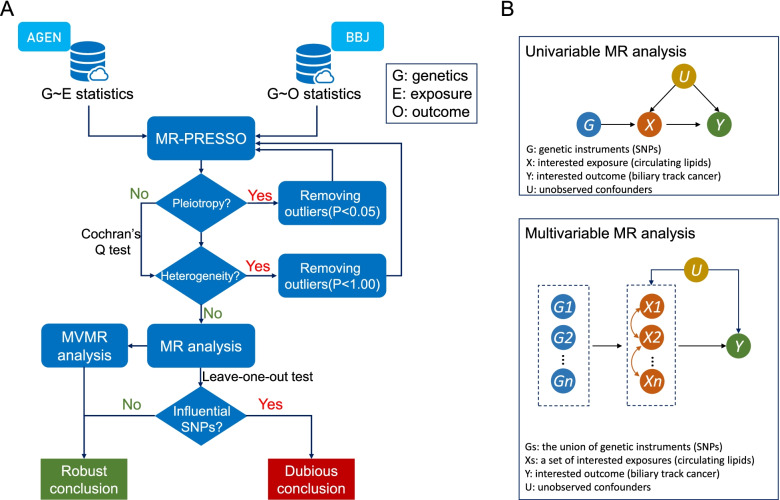
Single nucleotide polymorphisms of the four circulating lipids (n = 34,421) and BtC (418 cases and 159,201 controls) were retrieved from two independent GWAS studies performed in East Asian populations. Two-sample univariate and multivariate Mendelian Randomization (MR) analyses were conducted to determine the causal link between circulating lipids and BtC.
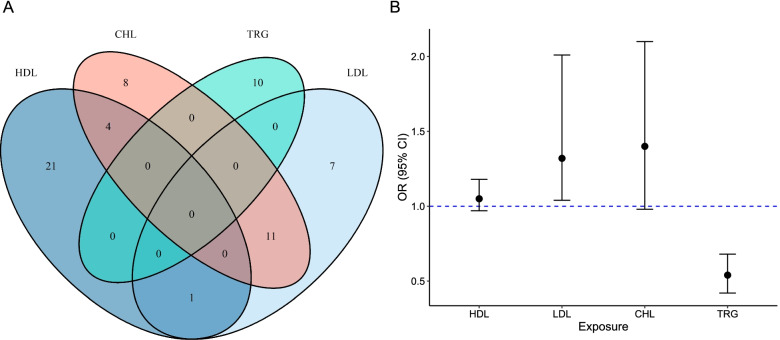
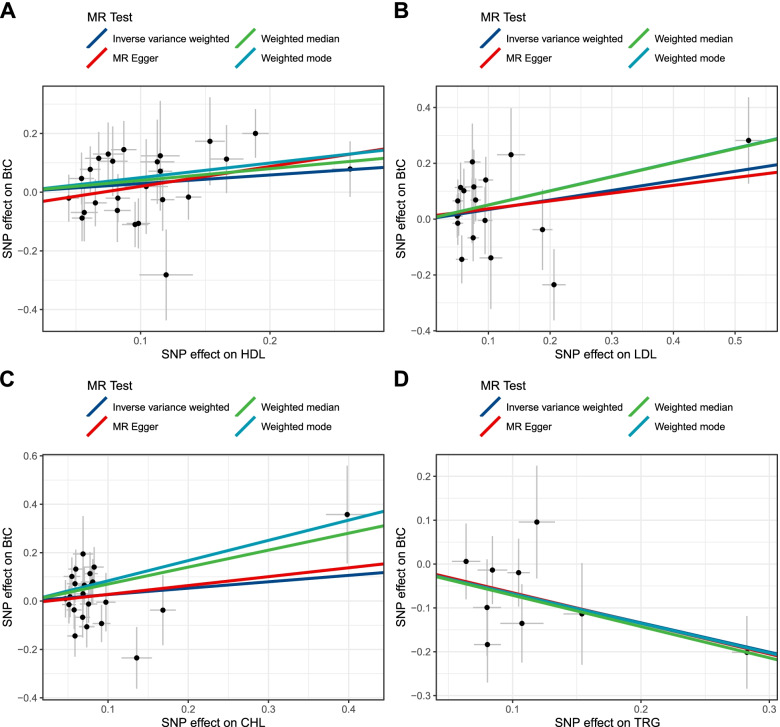
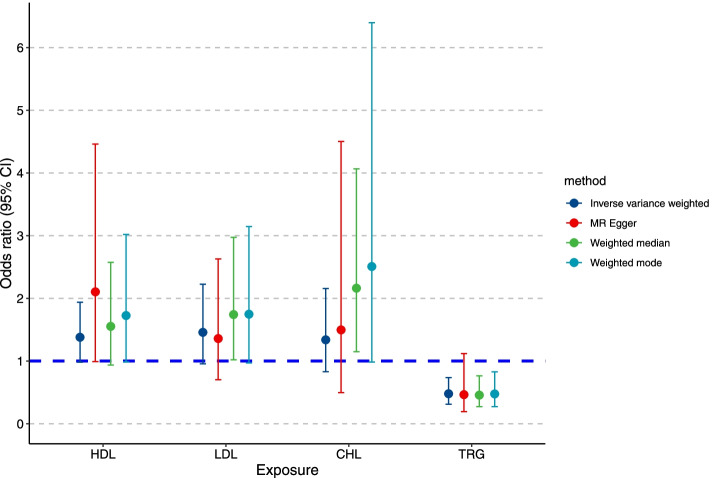
No significant horizontal pleiotropy was detected for all circulating lipids according to the MR-PRESSO global test (P = 0.458, 0.368, 0.522, and 0.587 for HDL, LDL, CHL, and TRG, respectively). No significant evidence of heterogeneity and directional pleiotropy was detected by the Cochran's Q test and MR-Egger regression. Univariate MR estimates from inverse variance weighting method suggested that one standard deviation (1-SD) increase of inverse-normal transformed HDL (OR = 1.38, 95% CI 0.98-1.94), LDL (OR = 1.46, 95% CI 0.96-2.23), and CHL (OR = 1.34, 95% CI 0.83-2.16) were not significantly associated with BtC risk. Whereas 1-SD increase of inverse-normal transformed TRG showed a significantly negative association with BtC risk (OR = 0.48, 95% CI 0.31-0.74). In multivariate MR analyses including all the four lipid traits, we found that 1-SD increase of LDL and TRG was significantly associated with elevated (OR = 1.32, 95% CI 1.04-2.01) and decreased (OR = 0.54, 95% CI 0.42-0.68) risk of BtC, respectively.
Circulating lipids, particularly LDL and TRG, may have roles in the development of BtC. However, the results of this study should be replicated in MR with larger GWAS sample sizes for BtC.
高密度脂蛋白(HDL)胆固醇、低密度脂蛋白(LDL)胆固醇、总胆固醇(CHL)和甘油三酯(TRG)浓度与胆道癌(BtC)风险的关联在观察性研究中存在争议。我们旨在利用遗传信息研究循环脂质与 BtC 之间的因果关系。
从两项在东亚人群中进行的独立全基因组关联研究中检索到四种循环脂质(n=34421)和 BtC(418 例病例和 159201 例对照)的单核苷酸多态性。采用两样本单变量和多变量孟德尔随机化(MR)分析来确定循环脂质与 BtC 之间的因果关系。
根据 MR-PRESSO 全局检验,所有循环脂质均未检测到明显的水平多效性(HDL、LDL、CHL 和 TRG 的 P 值分别为 0.458、0.368、0.522 和 0.587)。Cochran's Q 检验和 MR-Egger 回归未检测到明显的异质性和方向性多效性。逆方差加权法的单变量 MR 估计表明,逆正态转换后的 HDL(OR=1.38,95%CI 0.98-1.94)、LDL(OR=1.46,95%CI 0.96-2.23)和 CHL(OR=1.34,95%CI 0.83-2.16)每增加 1 个标准差(1-SD)与 BtC 风险无显著相关性。而逆正态转换后的 TRG 每增加 1-SD 与 BtC 风险呈显著负相关(OR=0.48,95%CI 0.31-0.74)。在包括所有四种脂质特征的多变量 MR 分析中,我们发现 LDL 和 TRG 的 1-SD 增加与 BtC 风险的升高(OR=1.32,95%CI 1.04-2.01)和降低(OR=0.54,95%CI 0.42-0.68)显著相关。
循环脂质,特别是 LDL 和 TRG,可能在 BtC 的发生发展中起作用。然而,本研究的结果需要在更大的 BtC 全基因组关联研究样本量的 MR 中进行复制。