Department of Life Sciences, Imperial College London, Silwood Park, Berkshire, United Kingdom.
Forest Research Centre, Forestry Department, Sandakan, Sabah, Malaysia.
PLoS Negl Trop Dis. 2022 Mar 16;16(3):e0009525. doi: 10.1371/journal.pntd.0009525. eCollection 2022 Mar.
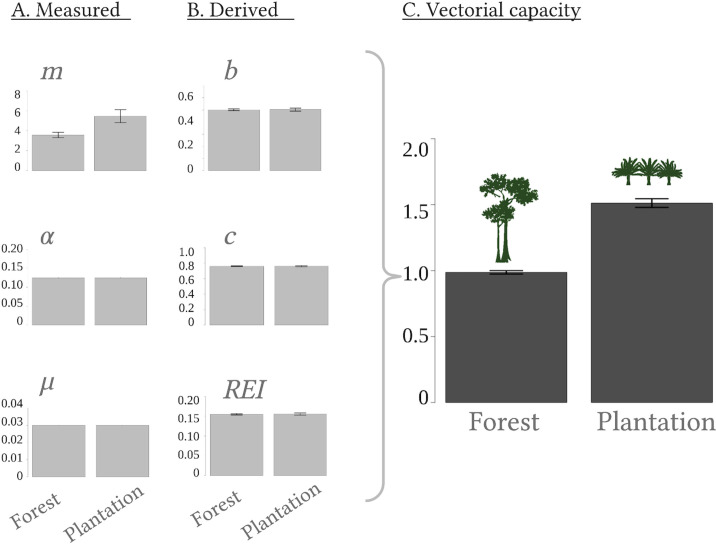
Changes in land-use and the associated shifts in environmental conditions can have large effects on the transmission and emergence of mosquito-borne disease. Mosquito-borne disease are particularly sensitive to these changes because mosquito growth, reproduction, survival and susceptibility to infection are all thermally sensitive traits, and land use change dramatically alters local microclimate. Predicting disease transmission under environmental change is increasingly critical for targeting mosquito-borne disease control and for identifying hotspots of disease emergence. Mechanistic models offer a powerful tool for improving these predictions. However, these approaches are limited by the quality and scale of temperature data and the thermal response curves that underlie predictions. Here, we used fine-scale temperature monitoring and a combination of empirical, laboratory and temperature-dependent estimates to estimate the vectorial capacity of Aedes albopictus mosquitoes across a tropical forest-oil palm plantation conversion gradient in Malaysian Borneo. We found that fine-scale differences in temperature between logged forest and oil palm plantation sites were not sufficient to produce differences in temperature-dependent demographic trait estimates using published thermal performance curves. However, when measured under field conditions a key parameter, adult abundance, differed significantly between land-use types, resulting in estimates of vectorial capacity that were 1.5 times higher in plantations than in forests. The prediction that oil palm plantations would support mosquito populations with higher vectorial capacity was robust to uncertainties in our adult survival estimates. These results provide a mechanistic basis for understanding the effects of forest conversion to agriculture on mosquito-borne disease risk, and a framework for interpreting emergent relationships between land-use and disease transmission. As the burden of Ae. albopictus-vectored diseases, such as dengue virus, increases globally and rising demand for palm oil products drives continued expansion of plantations, these findings have important implications for conservation, land management and public health policy at the global scale.
土地利用变化以及由此导致的环境条件变化会对蚊媒传染病的传播和出现产生重大影响。蚊媒传染病特别容易受到这些变化的影响,因为蚊子的生长、繁殖、生存和易感性感染都是对温度敏感的特征,而土地利用的变化会极大地改变当地的小气候。在环境变化下预测疾病传播对于针对蚊媒传染病控制和识别疾病出现的热点越来越重要。机制模型为改善这些预测提供了有力的工具。然而,这些方法受到温度数据的质量和规模以及预测基础的热响应曲线的限制。在这里,我们使用了精细的温度监测以及经验、实验室和与温度相关的估计的组合,来估计马来西亚婆罗洲热带森林-油棕种植园转化梯度上白纹伊蚊的媒介能力。我们发现,记录森林和油棕种植园站点之间的温度细微差异不足以使用已发表的热性能曲线产生温度相关人口统计特征估计的差异。然而,当在野外条件下进行测量时,一个关键参数,即成虫丰度,在土地利用类型之间存在显著差异,导致媒介能力的估计值在种植园中比在森林中高出 1.5 倍。油棕种植园将支持具有更高媒介能力的蚊子种群的预测,这一预测对我们成虫存活率估计的不确定性具有鲁棒性。这些结果为理解森林转化为农业对蚊媒传染病风险的影响提供了一个机制基础,并为解释土地利用与疾病传播之间新出现的关系提供了一个框架。随着登革热病毒等由白纹伊蚊传播的疾病负担在全球范围内增加,以及对棕榈油产品需求的增加推动了种植园的持续扩张,这些发现对全球范围内的保护、土地管理和公共卫生政策具有重要意义。