Department of Medicine, Division of Allergy, Pulmonary and Critical Care Medicine, Vanderbilt University Medical Center, Nashville, Tennessee, United States of America.
Department of Radiology and Radiological Sciences, Vanderbilt University Medical Center, Nashville, Tennessee, United States of America.
PLoS One. 2022 Mar 16;17(3):e0265427. doi: 10.1371/journal.pone.0265427. eCollection 2022.
18F-fluorodeoxyglucose (FDG) PET/CT is recommended for evaluation of intermediate-risk indeterminate pulmonary nodules (IPNs). While highly sensitive, the specificity of FDG remains suboptimal for differentiating malignant from benign nodules, particularly in areas where fungal lung diseases are prevalent. Thus, a cancer-specific imaging probe is greatly needed. In this study, we tested the hypothesis that a PET radiotracer (S)-4-(3-[18F]-fluoropropyl)-L-glutamic acid (FSPG) improves the diagnostic accuracy of IPNs compared to 18F-FDG PET/CT.
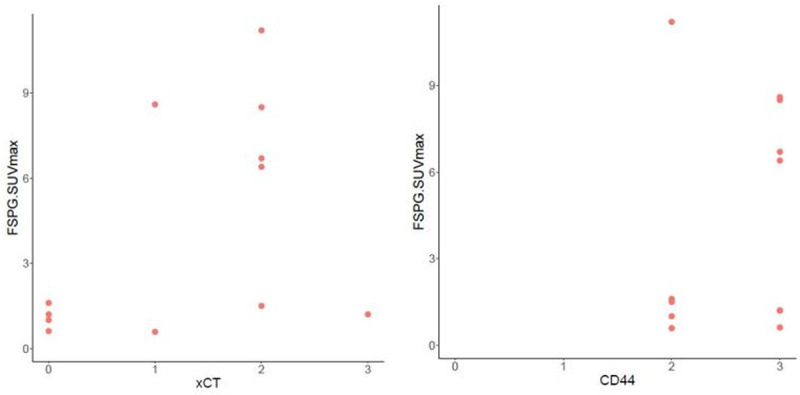
This study was conducted at a major academic medical center and an affiliated VA medical center. Twenty-six patients with newly discovered IPNs 7-30mm diameter or newly diagnosed lung cancer completed serial PET/CT scans utilizing 18F-FDG and 18F-FSPG, without intervening treatment of the lesion. The scans were independently reviewed by two dual-trained diagnostic radiology and nuclear medicine physicians. Characteristics evaluated included quantitative SUVmax values of the pulmonary nodules and metastases.
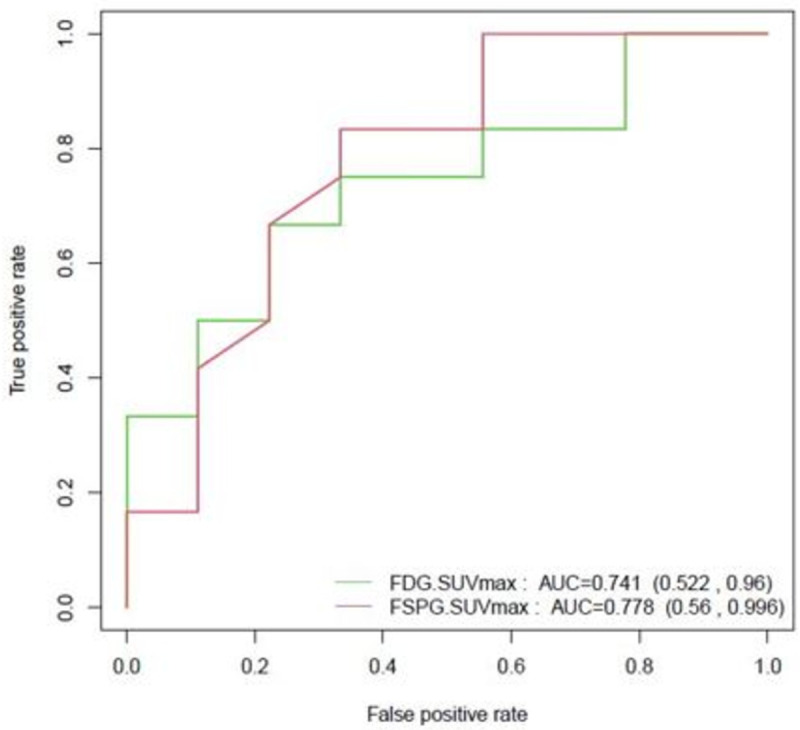
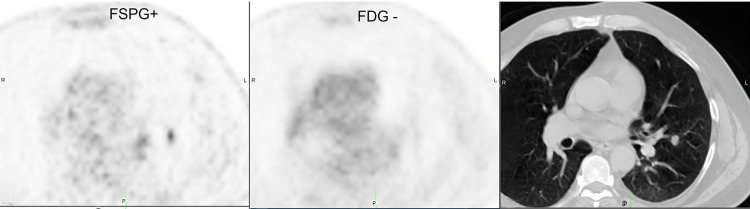
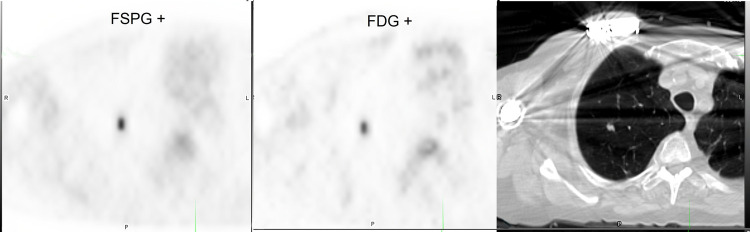
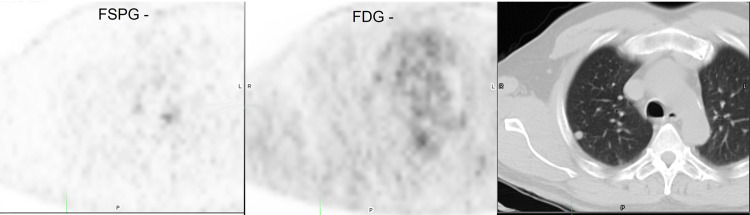
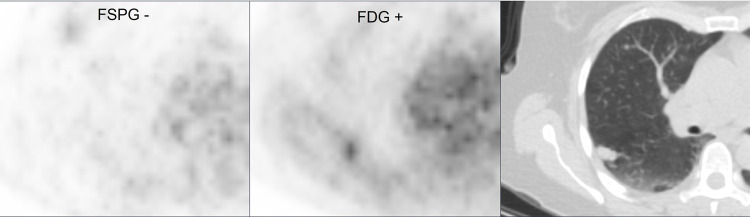
A total of 17 out of 26 patients had cancer and 9 had benign lesions. 18F-FSPG was negative in 6 of 9 benign lesions compared to 7 of 9 with 18F-FDG. 18F-FSPG and 18F-FDG were positive in 14 of 17 and 12 of 17 malignant lesions, respectively. 18F-FSPG detected brain and intracardiac metastases missed by 18F-FDG PET in one case, while 18F-FDG detected a metastasis to the kidney missed by 18F-FSPG.
In this pilot study, there was no significant difference in overall diagnostic accuracy between 18F-FSPG and 18F-FDG for the evaluation of IPNs and staging of lung cancer. Additional studies will be needed to determine the clinical utility of this tracer in the management of IPNs and lung cancer.
18F-氟代脱氧葡萄糖(FDG)PET/CT 被推荐用于评估中危不确定肺结节(IPN)。虽然 FDG 的灵敏度很高,但对于区分良恶性结节,其特异性仍不理想,特别是在真菌性肺部疾病流行的地区。因此,非常需要一种特异性的癌症成像探针。在这项研究中,我们检验了这样一个假设,即与 18F-FDG PET/CT 相比,一种 PET 放射性示踪剂(S)-4-(3-[18F]-氟丙基)-L-谷氨酸(FSPG)可提高 IPN 的诊断准确性。
这项研究在一家主要的学术医疗中心和一家附属的退伍军人事务医疗中心进行。26 例直径为 7-30mm 的新发现的 IPN 或新诊断的肺癌患者完成了利用 18F-FDG 和 18F-FSPG 的连续 PET/CT 扫描,在对病变进行干预治疗之前进行了扫描。扫描由两名具有双重培训的诊断放射学和核医学医师进行独立评估。评估的特征包括肺结节和转移灶的定量 SUVmax 值。
26 例患者中共有 17 例患有癌症,9 例患有良性病变。在 9 例良性病变中,6 例 18F-FSPG 为阴性,而 9 例中 7 例 18F-FDG 为阴性。在 17 例恶性病变中,18F-FSPG 和 18F-FDG 分别为 14 例和 12 例阳性。在一个病例中,18F-FSPG 检测到了 18F-FDG PET 漏诊的脑和心脏内转移灶,而 18F-FDG 检测到了 18F-FSPG 漏诊的肾转移灶。
在这项初步研究中,18F-FSPG 与 18F-FDG 在评估 IPN 和分期肺癌方面的总体诊断准确性没有显著差异。需要进一步的研究来确定该示踪剂在管理 IPN 和肺癌方面的临床应用价值。