Sesso Howard D, Rist Pamela M, Aragaki Aaron K, Rautiainen Susanne, Johnson Lisa G, Friedenberg Georgina, Copeland Trisha, Clar Allison, Mora Samia, Moorthy M Vinayaga, Sarkissian Ara, Wactawski-Wende Jean, Tinker Lesley F, Carrick William R, Anderson Garnet L, Manson JoAnn E
Division of Preventive Medicine, Brigham and Women's Hospital and Harvard Medical School, Boston, MA, USA.
Department of Epidemiology, Harvard T.H. Chan School of Public Health, Boston, MA, USA.
Am J Clin Nutr. 2022 Jun 7;115(6):1501-1510. doi: 10.1093/ajcn/nqac056.
Although older adults commonly take multivitamin-multimineral (MVM) supplements to promote health, evidence on the use of daily MVMs on invasive cancer is limited.
The study objective was to determine if a daily MVM decreases total invasive cancer among older adults.
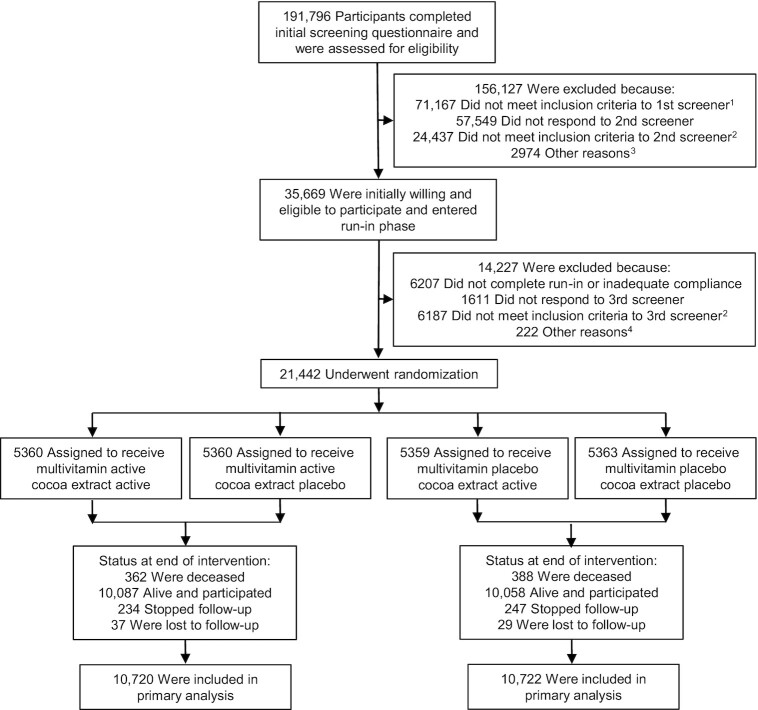
We performed a randomized, double-blind, placebo-controlled, 2-by-2 factorial trial of a daily MVM and cocoa extract for prevention of cancer and cardiovascular disease (CVD) among 21,442 US adults (12,666 women aged ≥65 y and 8776 men aged ≥60 y) free of major CVD and recently diagnosed cancer. The intervention phase was from June 2015 through December 2020. This article reports on the MVM intervention. Participants were randomly assigned to daily MVM or placebo. The primary outcome was total invasive cancer, excluding nonmelanoma skin cancer. Secondary outcomes included major site-specific cancers, total CVD, all-cause mortality, and total cancer risk among those with a baseline history of cancer.
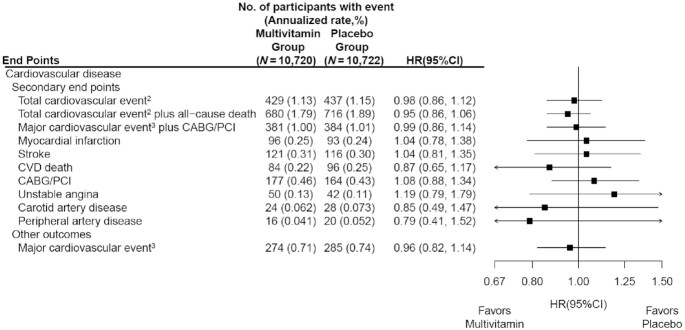
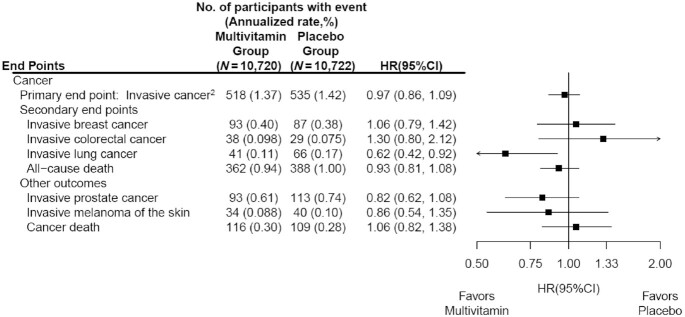
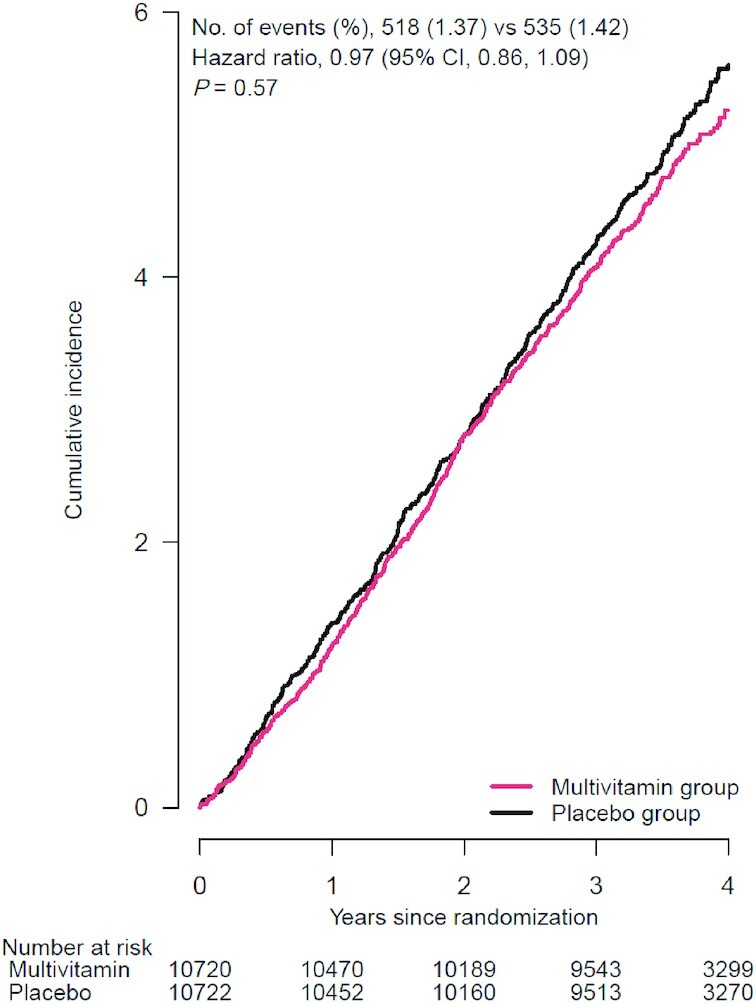
During a median follow-up of 3.6 y, invasive cancer occurred in 518 participants in the MVM group and 535 participants in the placebo group (HR: 0.97; 95% CI: 0.86, 1.09; P = 0.57). We observed no significant effect of a daily MVM on breast cancer (HR: 1.06; 95% CI: 0.79, 1.42) or colorectal cancer (HR: 1.30; 95% CI: 0.80, 2.12). We observed a protective effect of a daily MVM on lung cancer (HR: 0.62; 95% CI: 0.42, 0.92). The composite CVD outcome occurred in 429 participants in the MVM group and 437 participants in the placebo group (HR: 0.98; 95% CI: 0.86, 1.12). MVM use did not significantly affect all-cause mortality (HR: 0.93; 95% CI: 0.81, 1.08). There were no safety concerns.
A daily MVM supplement, compared with placebo, did not significantly reduce the incidence of total cancer among older men and women. Future studies are needed to determine the effects of MVMs on other aging-related outcomes among older adults. This trial is registered at www.clinicaltrials.gov as NCT02422745.
尽管老年人通常服用多种维生素-多种矿物质(MVM)补充剂以促进健康,但关于每日服用MVM对浸润性癌症影响的证据有限。
本研究的目的是确定每日服用MVM是否能降低老年人中浸润性癌症的总体发病率。
我们在美国21442名无重大心血管疾病(CVD)且近期未诊断出癌症的成年人(12666名年龄≥65岁的女性和8776名年龄≥60岁的男性)中进行了一项随机、双盲、安慰剂对照的2×2析因试验,以研究每日服用MVM和可可提取物对癌症和心血管疾病(CVD)的预防作用。干预阶段为2015年6月至2020年12月。本文报告MVM干预的结果。参与者被随机分配至每日服用MVM组或安慰剂组。主要结局为总体浸润性癌症,不包括非黑素瘤皮肤癌。次要结局包括主要部位特异性癌症、总体CVD、全因死亡率以及有癌症基线病史者的总体癌症风险。
在中位随访3.6年期间,MVM组有518名参与者发生浸润性癌症,安慰剂组有535名参与者发生浸润性癌症(风险比:0.97;95%置信区间:0.86,1.09;P = 0.57)。我们观察到每日服用MVM对乳腺癌(风险比:1.06;95%置信区间:0.79,1.42)或结直肠癌(风险比:1.30;95%置信区间:0.80,2.12)无显著影响。我们观察到每日服用MVM对肺癌有保护作用(风险比:0.62;95%置信区间:0.42,0.92)。MVM组有429名参与者发生复合CVD结局,安慰剂组有437名参与者发生复合CVD结局(风险比:0.98;95%置信区间:0.86,1.12)。服用MVM对全因死亡率无显著影响(风险比:0.93;95%置信区间:0.81,1.08)。无安全性问题。
与安慰剂相比,每日服用MVM补充剂并未显著降低老年男性和女性中总体癌症的发病率。需要进一步研究以确定MVM对老年人其他与衰老相关结局的影响。本试验已在www.clinicaltrials.gov注册,注册号为NCT02422745。