Laboratory for Experimental Oncology and Radiobiology (LEXOR), Center for Experimental and Molecular Medicine (CEMM), Cancer Center Amsterdam and Amsterdam Gastroenterology and Metabolism, Amsterdam University Medical Centers, The Netherlands.
Oncode Institute, Amsterdam, The Netherlands.
Mol Oncol. 2022 Jul;16(14):2693-2709. doi: 10.1002/1878-0261.13210. Epub 2022 Apr 29.
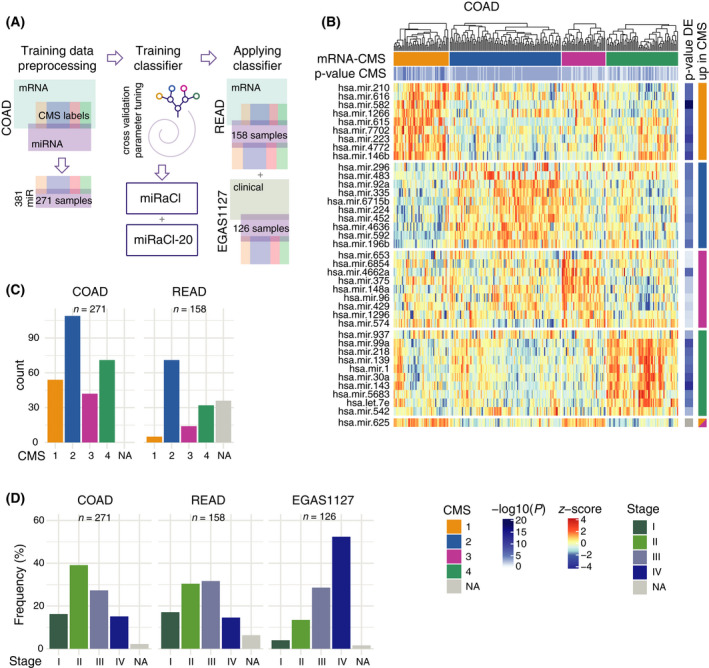
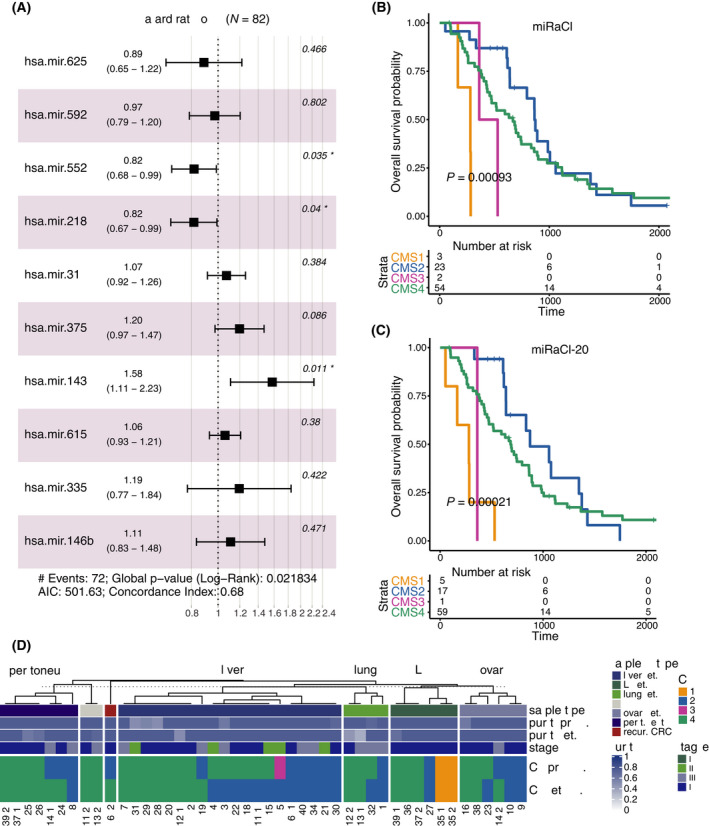
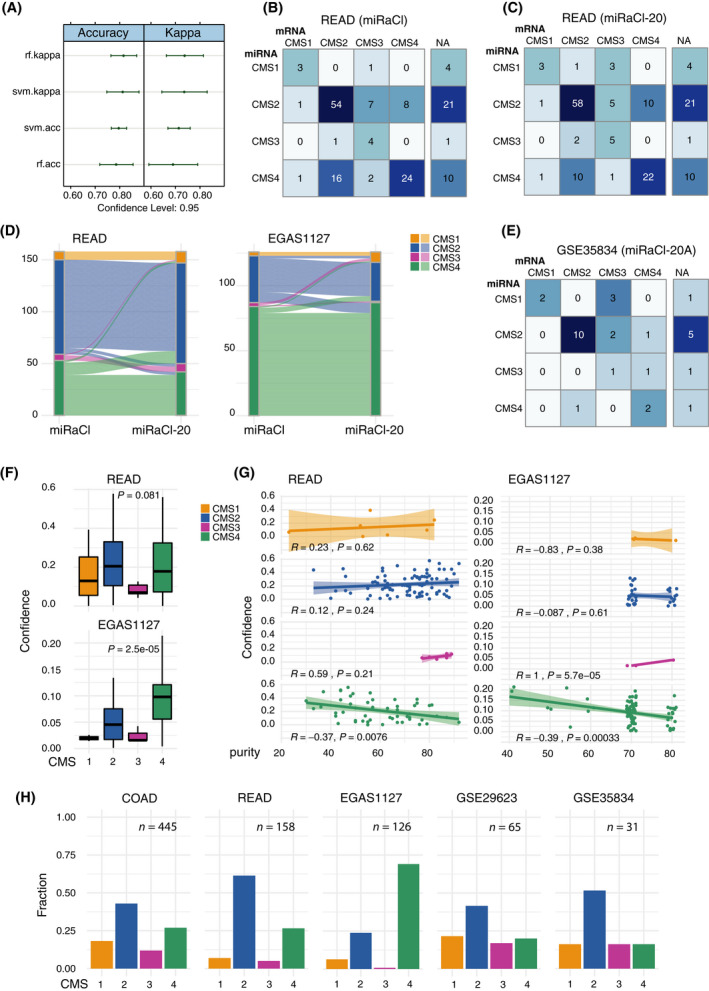
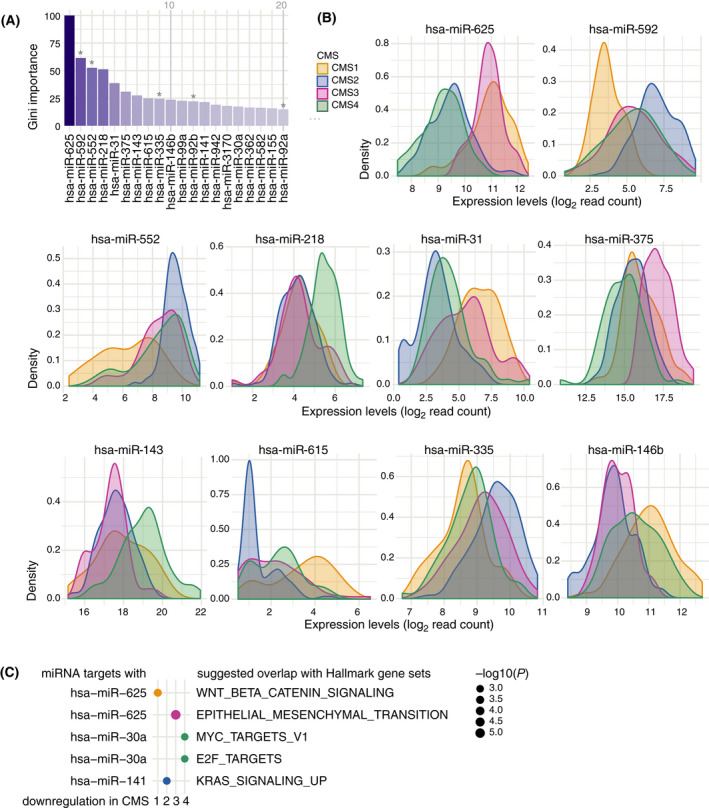
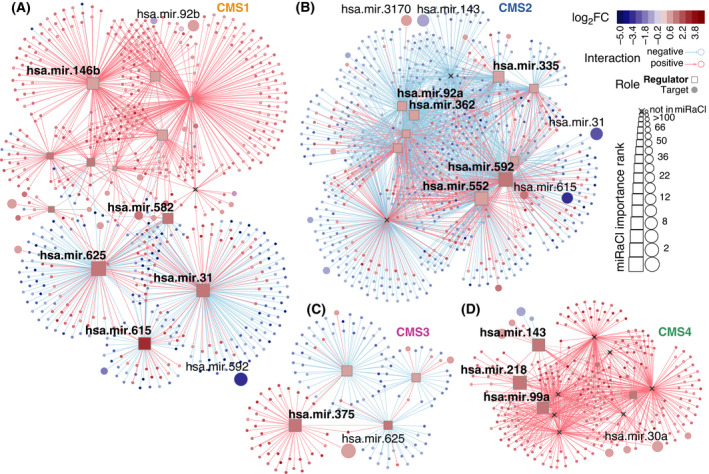
Previously, colorectal cancer (CRC) has been classified into four distinct molecular subtypes based on transcriptome data. These consensus molecular subtypes (CMSs) have implications for our understanding of tumor heterogeneity and the prognosis of patients. So far, this classification has been based on the use of messenger RNAs (mRNAs), although microRNAs (miRNAs) have also been shown to play a role in tumor heterogeneity and biological differences between CMSs. In contrast to mRNAs, miRNAs have a smaller size and increased stability, facilitating their detection. Therefore, we built a miRNA-based CMS classifier by converting the existing mRNA-based CMS classification using machine learning (training dataset of n = 271). The performance of this miRNA-assigned CMS classifier (CMS-miRaCl) was evaluated in several datasets, achieving an overall accuracy of ~ 0.72 (0.6329-0.7987) in the largest dataset (n = 158). To gain insight into the biological relevance of CMS-miRaCl, we evaluated the most important features in the classifier. We found that miRNAs previously reported to be relevant in microsatellite-instable CRCs or Wnt signaling were important features for CMS-miRaCl. Following further studies to validate its robustness, this miRNA-based alternative might simplify the implementation of CMS classification in clinical workflows.
先前,基于转录组数据,结直肠癌(CRC)已被分为四个不同的分子亚型。这些共识分子亚型(CMS)对于我们理解肿瘤异质性和患者预后具有重要意义。到目前为止,这种分类方法一直基于信使 RNA(mRNA)的使用,尽管 microRNA(miRNA)也被证明在肿瘤异质性和 CMS 之间的生物学差异中发挥作用。与 mRNAs 相比,miRNAs 体积更小、稳定性更高,便于检测。因此,我们使用机器学习(训练数据集 n = 271)将现有的基于 mRNA 的 CMS 分类转换为基于 miRNA 的 CMS 分类器。在几个数据集上评估了这个基于 miRNA 的 CMS 分类器(CMS-miRaCl)的性能,在最大的数据集(n = 158)中达到了约 0.72(0.6329-0.7987)的整体准确性。为了深入了解 CMS-miRaCl 的生物学相关性,我们评估了分类器中的最重要特征。我们发现,先前报道与微卫星不稳定 CRC 或 Wnt 信号相关的 miRNAs 是 CMS-miRaCl 的重要特征。在进一步研究以验证其稳健性之后,这种基于 miRNA 的替代方法可能会简化 CMS 分类在临床工作流程中的实施。