Paz-Cabezas Mateo, Calvo-López Tania, Romera-Lopez Alejandro, Tabas-Madrid Daniel, Ogando Jesus, Fernández-Aceñero María-Jesús, Sastre Javier, Pascual-Montano Alberto, Mañes Santos, Díaz-Rubio Eduardo, Perez-Villamil Beatriz
Genomics and Microarrays Laboratory, Medical Oncology Department, Instituto de Investigación Sanitaria San Carlos (IdiSSC), Hospital Clinico San Carlos, 28040 Madrid, Spain.
Immunology and Oncology Department, Centro Nacional de Biotecnología (CSIC), 28049 Madrid, Spain.
Cancers (Basel). 2022 Oct 22;14(21):5175. doi: 10.3390/cancers14215175.
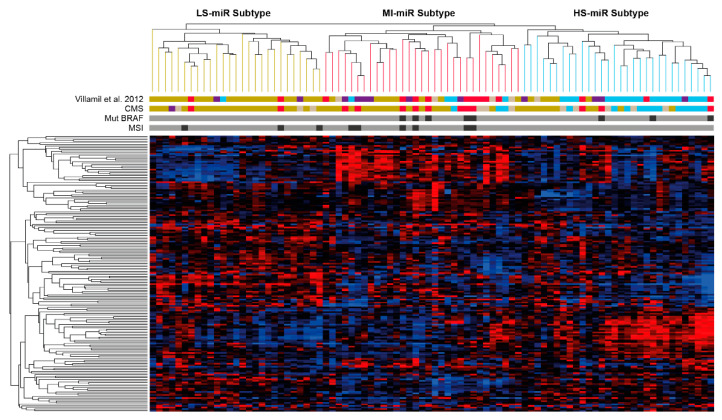
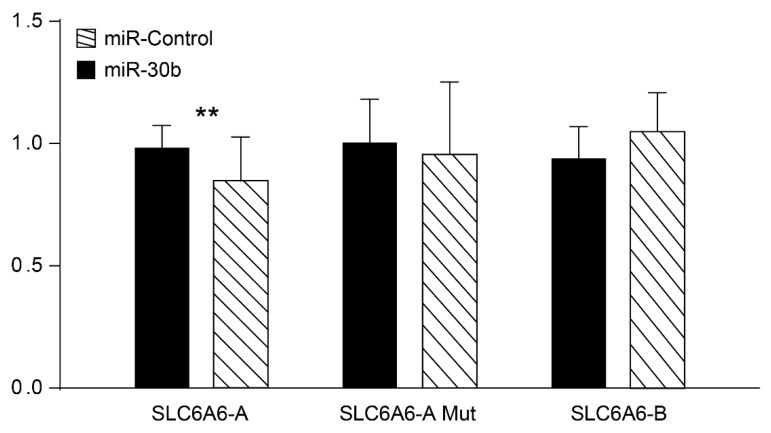
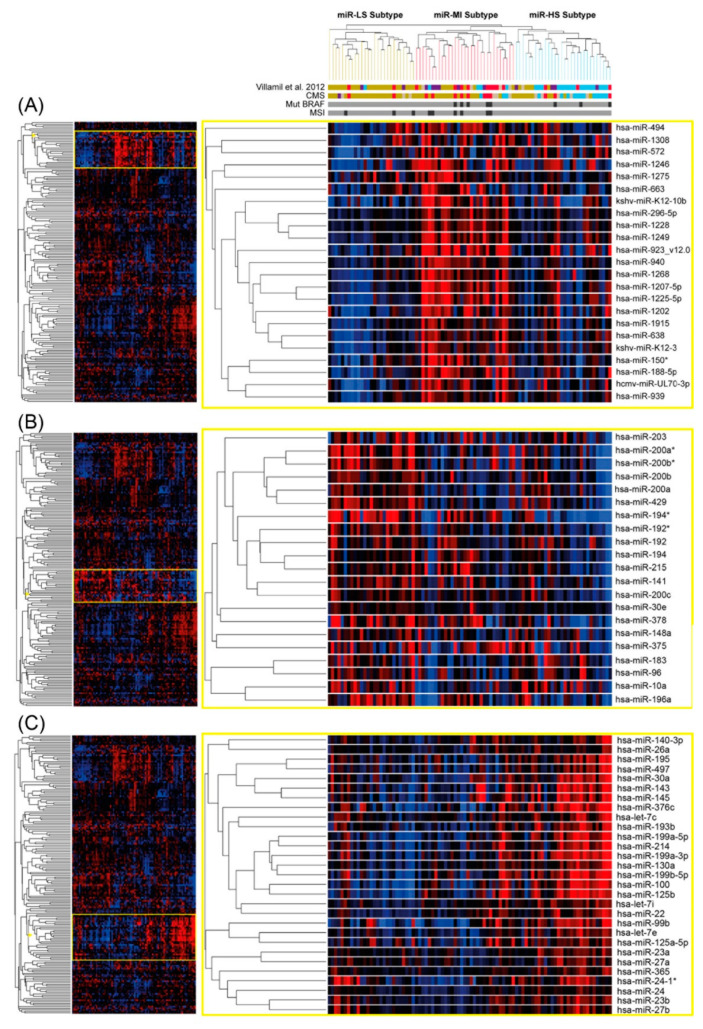
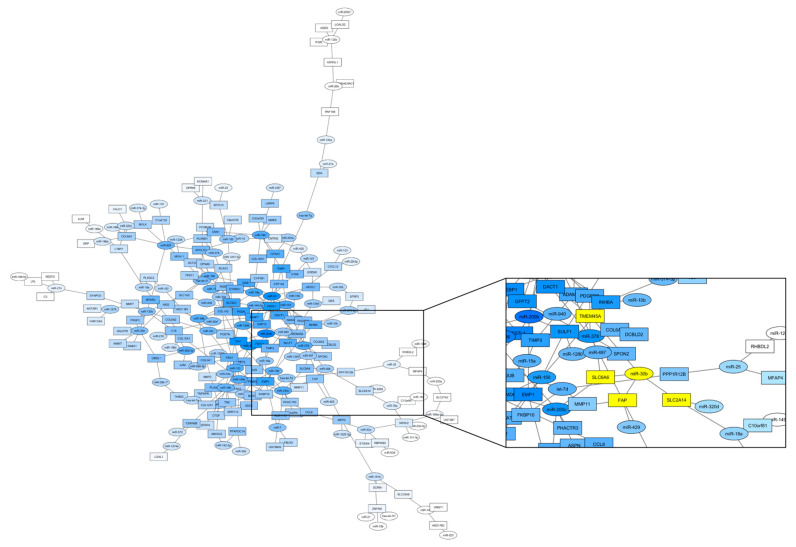
Colorectal cancer consensus molecular subtypes (CMSs) are widely accepted and constitutes the basis for patient stratification to improve clinical practice. We aimed to find whether miRNAs could reproduce molecular subtypes, and to identify miRNA targets associated to the High-stroma/CMS4 subtype. The expression of 939 miRNAs was analyzed in tumors classified in CMS. TALASSO was used to find gene-miRNA interactions. A miR-mRNA regulatory network was constructed using Cytoscape. Candidate gene-miR interactions were validated in 293T cells. Hierarchical-Clustering identified three miRNA tumor subtypes (miR-LS; miR-MI; and miR-HS) which were significantly associated (p < 0.001) to the reported mRNA subtypes. miR-LS correlated with the low-stroma/CMS2; miR-MI with the mucinous-MSI/CMS1 and miR-HS with high-stroma/CMS4. MicroRNA tumor subtypes and association to CMSs were validated with TCGA datasets. TALASSO identified 1462 interactions (p < 0.05) out of 21,615 found between 176 miRs and 788 genes. Based on the regulatory network, 88 miR-mRNA interactions were selected as candidates. This network was functionally validated for the pair miR-30b/SLC6A6. We found that miR-30b overexpression silenced 3′-UTR-SLC6A6-driven luciferase expression in 293T-cells; mutation of the target sequence in the 3′-UTR-SLC6A6 prevented the miR-30b inhibitory effect. In conclusion CRC subtype classification using a miR-signature might facilitate a real-time analysis of the disease course and treatment response.
结直肠癌共识分子亚型(CMSs)已被广泛接受,并构成患者分层的基础,以改善临床实践。我们旨在研究miRNA是否能够重现分子亚型,并鉴定与高基质/CMS4亚型相关的miRNA靶标。在根据CMS分类的肿瘤中分析了939种miRNA的表达。使用TALASSO来寻找基因-miRNA相互作用。使用Cytoscape构建miR-mRNA调控网络。在293T细胞中验证候选基因-miR相互作用。层次聚类确定了三种miRNA肿瘤亚型(miR-LS;miR-MI;和miR-HS),它们与报道的mRNA亚型显著相关(p < 0.001)。miR-LS与低基质/CMS2相关;miR-MI与黏液性微卫星不稳定/CMS1相关,miR-HS与高基质/CMS4相关。miRNA肿瘤亚型及其与CMSs的关联通过TCGA数据集进行了验证。TALASSO在176个miR和788个基因之间发现的21,615个相互作用中鉴定出1462个相互作用(p < 0.05)。基于调控网络,选择了88个miR-mRNA相互作用作为候选。该网络针对miR-30b/SLC6A6对进行了功能验证。我们发现,miR-30b过表达使293T细胞中3'-UTR-SLC6A6驱动的荧光素酶表达沉默;3'-UTR-SLC6A6中靶序列的突变阻止了miR-30b的抑制作用。总之,使用miR特征进行CRC亚型分类可能有助于对疾病进程和治疗反应进行实时分析。