Tokyo Women's Medical University Institute for Integrated Medical Sciences (TIIMS), Tokyo, Japan.
Department of Neurosurgery, Tokyo Women's Medical University Medical Center East, Tokyo, Japan.
PLoS One. 2022 Mar 17;17(3):e0265359. doi: 10.1371/journal.pone.0265359. eCollection 2022.
Intracranial aneurysms (IAs) cause subarachnoid hemorrhage, which has high rates of mortality and morbidity when ruptured. Recently, the role of rare variants in the genetic background of complex diseases has been increasingly recognized. The aim of this study was to identify rare variants for susceptibility to IA.
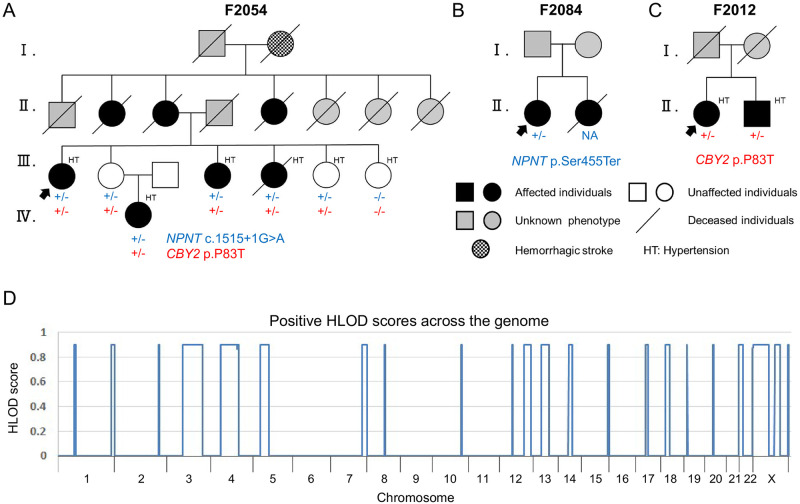
Whole-exome sequencing was performed on seven members of a Japanese pedigree with highly aggregated IA. Candidate genes harboring co-segregating rare variants with IA were re-sequenced and tested for association with IA using additional 500 probands and 323 non-IA controls. Functional analysis of rare variants detected in the pedigree was also conducted.
We identified two gene variants shared among all four affected participants in the pedigree. One was the splicing donor c.1515+1G>A variant in NPNT (Nephronectin), which was confirmed to cause aberrant splicing by a minigene assay. The other was the missense p.P83T variant in CBY2 (Chibby family member 2). Overexpression of p.P83T CBY2 fused with red fluorescent protein tended to aggregate in the cytoplasm. Although Nephronectin has been previously reported to be involved in endothelial angiogenic functions, CBY2 is a novel molecule in terms of vascular pathophysiology. We confirmed that CBY2 was expressed in cerebrovascular smooth muscle cells in an isoform2-specific manner. Targeted CBY2 re-sequencing in additional case-control samples identified three deleterious rare variants (p.R46H, p.P83T, and p.L183R) in seven probands, showing a significant enrichment in the overall probands (8/501) compared to the controls (0/323) (p = 0.026, Fisher's extract test).
NPNT and CBY2 were identified as novel susceptibility genes for IA. The highly heterogeneous and polygenic architecture of IA susceptibility can be uncovered by accumulating extensive analyses that focus on each pedigree with a high incidence of IA.
颅内动脉瘤(IAs)可导致蛛网膜下腔出血,破裂时死亡率和发病率均较高。最近,人们越来越认识到稀有变异在复杂疾病遗传背景中的作用。本研究旨在鉴定易患 IA 的罕见变异。
对一个具有高度聚集性 IA 的日本家系的七名成员进行全外显子组测序。对携带与 IA 共分离的稀有变异的候选基因进行重测序,并使用另外 500 名患者和 323 名非 IA 对照对其与 IA 的关联性进行测试。还对在家系中检测到的稀有变异进行了功能分析。
我们在家系的所有四个受影响参与者中发现了两个共同的基因变异。一个是 NPNT(Nephronectin)中的剪接供体 c.1515+1G>A 变异,通过小基因检测证实其导致异常剪接。另一个是 CBY2(Chibby 家族成员 2)中的错义 p.P83T 变异。与红色荧光蛋白融合的 p.P83T CBY2 过表达往往在细胞质中聚集。虽然 Nephronectin 以前曾被报道参与内皮血管生成功能,但 CBY2 在血管病理生理学方面是一种新的分子。我们证实 CBY2 以特定于同工型 2 的方式在脑血管平滑肌细胞中表达。在另外的病例对照样本中对 CBY2 进行靶向重测序,在七个患者中发现了三个有害的稀有变异(p.R46H、p.P83T 和 p.L183R),与对照组(0/323)相比,总体患者(8/501)中明显富集(p = 0.026,Fisher 提取检验)。
NPNT 和 CBY2 被鉴定为 IA 的新易感基因。通过对具有高 IA 发生率的每个家系进行广泛分析,可以揭示 IA 易感性的高度异质和多基因结构。