Marschke Melissa, Vandergeest Peter, Havice Elizabeth, Kadfak Alin, Duker Peter, Isopescu Ilinca, MacDonnell Mallory
School of International Development and Global Studies, University of Ottawa, 120 University Private, Ottawa, ON K1N 6N5 Canada.
York University, Toronto, Canada.
Marit Stud. 2021;20(1):87-99. doi: 10.1007/s40152-020-00205-y. Epub 2020 Nov 23.
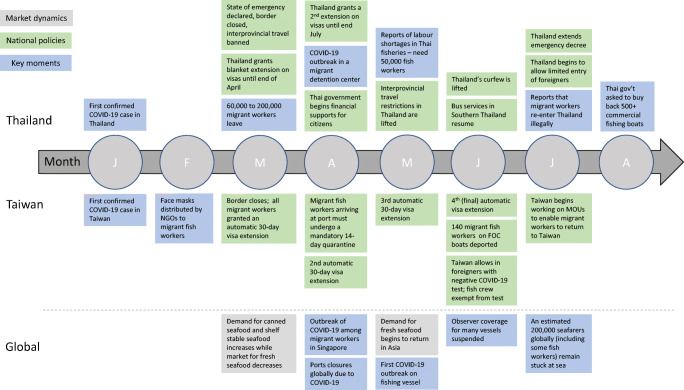
This paper seeks to establish how COVID-19 is impacting migrant fish workers through focusing on two global fish hubs, Thailand and Taiwan. Through a careful review of the news reports, social media, and NGO reports and press releases, three significant themes emerged: employment disruptions due to seafood system instabilities; travel or mobility restrictions; and poor access to services such as health care or social programs. We unpack each theme in turn to spotlight the impacts COVID-19 is having on yet another vulnerable worker population, fish workers. We further reflect on what this pandemic reveals about unacceptable work in industrial fisheries and consider if the pandemic may be producing opportunities to advocate for better working conditions.
本文旨在通过聚焦泰国和台湾这两个全球渔业中心,来确定新冠疫情如何影响流动渔业工人。通过仔细审查新闻报道、社交媒体、非政府组织报告及新闻稿,出现了三个重要主题:海鲜系统不稳定导致的就业中断;旅行或行动限制;以及获得医疗保健或社会项目等服务的机会有限。我们依次剖析每个主题,以突出新冠疫情对另一弱势群体——渔业工人的影响。我们进一步思考这场大流行揭示了工业渔业中不可接受的工作状况,并考虑这场大流行是否可能带来倡导改善工作条件的机会。