Regional Viral Research and Diagnostic Laboratory (RVRDL), Department of Microbiology, Jawaharlal Institute of Post-Graduate Medical Education and Research (JIPMER), Puducherry 605006, India.
Regional Viral Research and Diagnostic Laboratory (RVRDL), Department of Microbiology, Jawaharlal Institute of Post-Graduate Medical Education and Research (JIPMER), Puducherry 605006, India.
J Virol Methods. 2022 Jun;304:114524. doi: 10.1016/j.jviromet.2022.114524. Epub 2022 Mar 15.
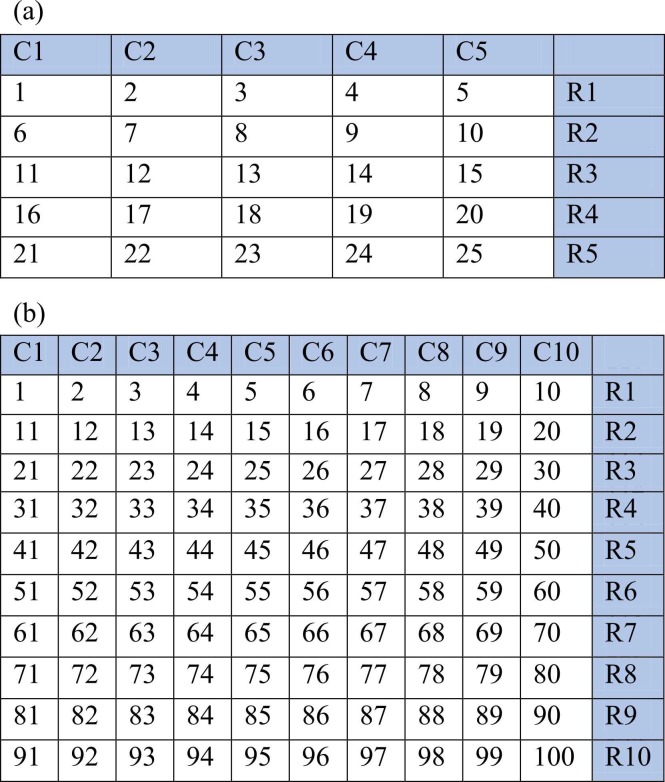
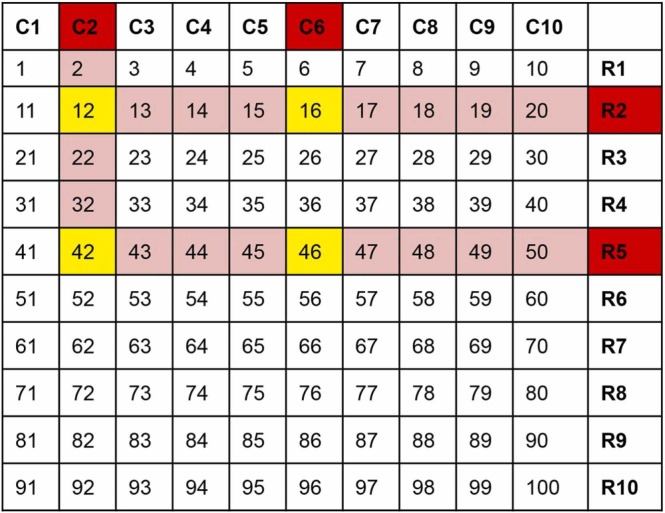
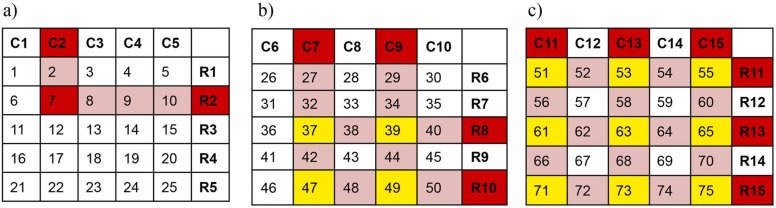
In the on-going COVID-19 pandemic, pooled testing of samples by RT-PCR has been recommended at certain scenarios to increase labs' testing capacity and reduce cost of testing. This paper describes the evaluation of bi-directional matrix pooling strategies with clinical samples in a 5 × 5 and 10 × 10 matrix. Nasopharyngeal swab samples in viral transport medium (VTM) previously tested (positive or negative) by real time RT-PCR for SARS-CoV-2 were used for these experiments. Ten sets of 5 × 5 (250 samples) and ten sets of 10 × 10 (1000 samples) pooling of samples in both directions was done with known positive samples introduced at random positions. Extracted nucleic acid was tested for SARS-CoV-2 E-gene by RT-PCR. Sensitivity or concordance and feasibility of matrix pooling were assessed in comparison to direct RT-PCR testing. In comparison to direct testing, the overall concordance was 86.6% for 5 × 5 pooling, 73.3% for 10 × 10 with 200 µL extraction volume and 86.6% for 10 × 10 with 400 µL extraction volume. Bi-directional matrix pooling can be adopted with advantage over conventional direct or pool testing for COVID-19 by RT-PCR under the following conditions: i) sample positivity rate of ≤ 5%, ii) matrix pool size of 8-10 samples, iii) use of min. 40 µL VTM from each sample and iv) utilization of automated liquid handling equipment, if available, for sample addition to avoid human errors.
在持续的 COVID-19 大流行中,建议在某些情况下通过 RT-PCR 对样本进行混合检测,以增加实验室的检测能力并降低检测成本。本文描述了在 5×5 和 10×10 矩阵中用临床样本评估双向矩阵混合策略。该实验使用了先前通过实时 RT-PCR 检测为 SARS-CoV-2 阳性或阴性的病毒转运培养基(VTM)中的鼻咽拭子样本。对两种方向的 5×5(250 个样本)和 10×10(1000 个样本)共 10 组样本进行了混合,阳性样本随机分布于其中。提取的核酸通过 RT-PCR 检测 SARS-CoV-2 E 基因。通过与直接 RT-PCR 检测比较,评估了矩阵混合的敏感性或一致性和可行性。与直接检测相比,5×5 混合检测的总体一致性为 86.6%,200µL 提取体积的 10×10 混合检测的总体一致性为 73.3%,400µL 提取体积的 10×10 混合检测的总体一致性为 86.6%。在以下情况下,双向矩阵混合可以优于常规的直接或混合 RT-PCR 检测用于 COVID-19:i)样本阳性率≤5%,ii)矩阵混合大小为 8-10 个样本,iii)每个样本使用至少 40µL 的 VTM,iv)如果有自动化液体处理设备,则可用于样本添加,以避免人为错误。