Heidelberg Institute of Global Health, Heidelberg University, Im Neuenheimer Feld 324, 69120, Heidelberg, Germany.
Bull World Health Organ. 2020 Sep 1;98(9):590-598. doi: 10.2471/BLT.20.257188. Epub 2020 Jul 6.
To evaluate two pooled-sample analysis strategies (a routine high-throughput approach and a novel context-sensitive approach) for mass testing during the coronavirus disease 2019 (COVID-19) pandemic, with an emphasis on the number of tests required to screen a population.
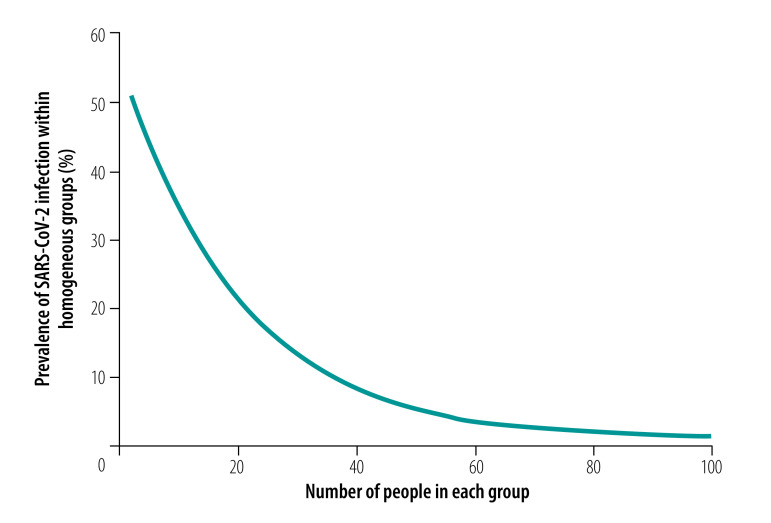
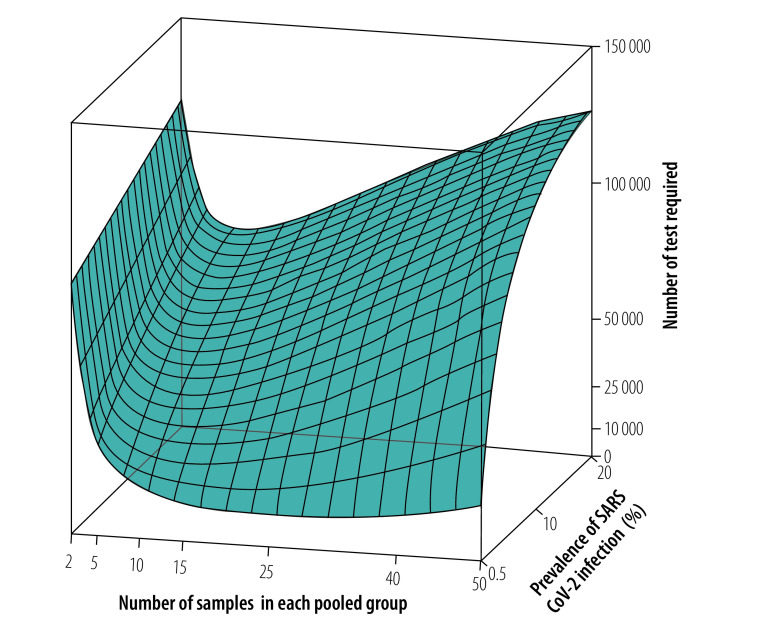
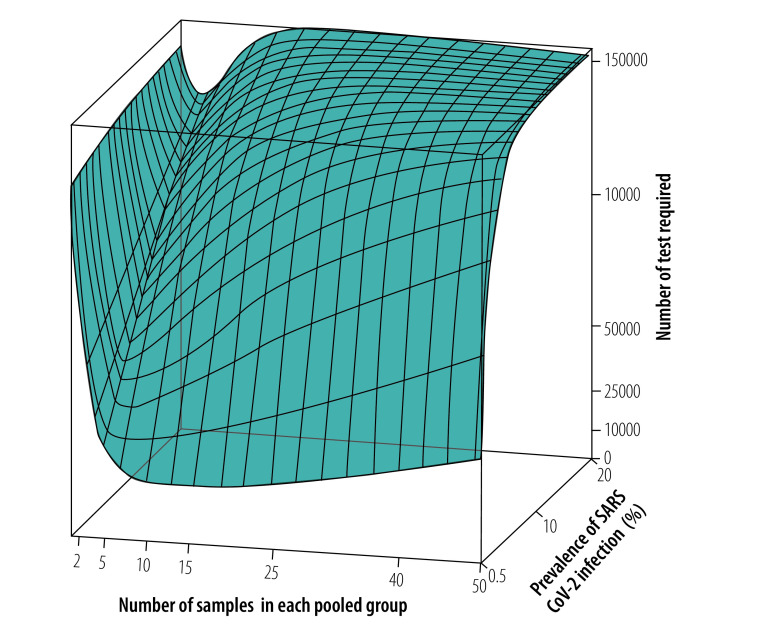
We used Monte Carlo simulations to compare the two testing strategies for different infection prevalences and pooled group sizes. With the routine high-throughput approach, heterogeneous sample pools are formed randomly for polymerase chain reaction (PCR) analysis. With the novel context-sensitive approach, PCR analysis is performed on pooled samples from homogeneous groups of similar people that have been purposively formed in the field. In both approaches, all samples contributing to pools that tested positive are subsequently analysed individually.
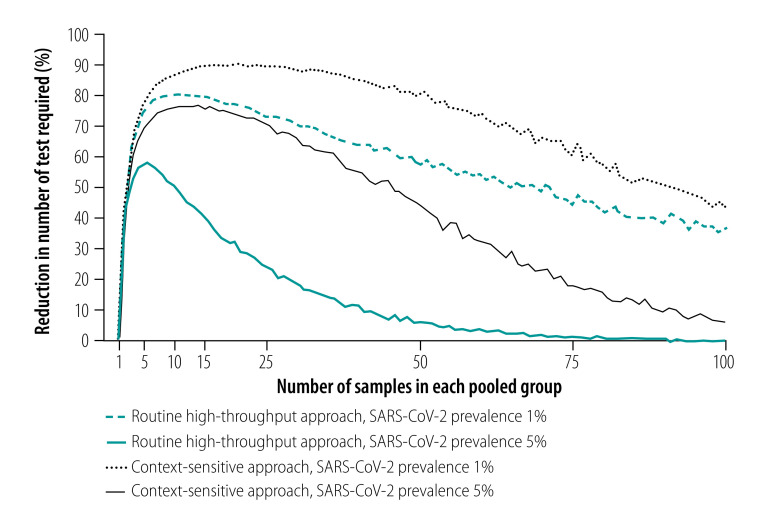
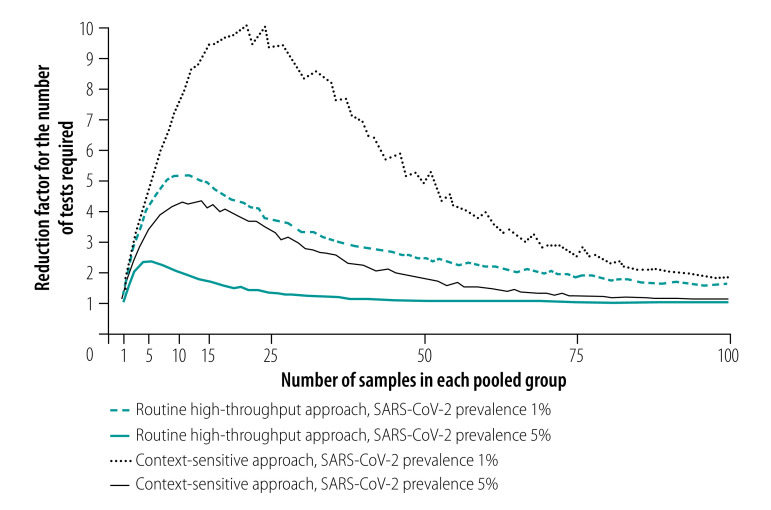
Both pooled-sample strategies would save substantial resources compared to individual analysis during surge testing and enhanced epidemic surveillance. The context-sensitive approach offers the greatest savings: for instance, 58-89% fewer tests would be required for a pooled group size of 3 to 25 samples in a population of 150 000 with an infection prevalence of 1% or 5%. Correspondingly, the routine high-throughput strategy would require 24-80% fewer tests than individual testing.
Pooled-sample PCR screening could save resources during COVID-19 mass testing. In particular, the novel context-sensitive approach, which uses pooled samples from homogeneous population groups, could substantially reduce the number of tests required to screen a population. Pooled-sample approaches could help countries sustain population screening over extended periods of time and thereby help contain foreseeable second-wave outbreaks.
评估两种合并样本分析策略(常规高通量方法和新型敏感上下文方法)在 2019 年冠状病毒病(COVID-19)大流行期间进行大规模检测的效果,重点是筛查人群所需的检测次数。
我们使用蒙特卡罗模拟比较了两种不同感染率和合并组大小的检测策略。在常规高通量方法中,随机形成异质样本池进行聚合酶链反应(PCR)分析。在新型敏感上下文方法中,对在现场有意形成的同质人群的合并样本进行 PCR 分析。在这两种方法中,所有对呈阳性的池作出贡献的样本随后都进行单独分析。
与个体分析相比,在激增检测和强化流行监测期间,这两种合并样本策略都将节省大量资源。敏感上下文方法提供了最大的节省:例如,在感染率为 1%或 5%的 15 万人口中,合并组大小为 3 至 25 个样本时,敏感上下文方法所需的测试次数比常规高通量策略分别减少 58-89%,而常规高通量策略则分别减少 24-80%。
合并样本 PCR 筛查可在 COVID-19 大规模检测中节省资源。特别是使用同质人群的合并样本的新型敏感上下文方法,可以大大减少筛查人群所需的检测次数。合并样本方法可以帮助各国在较长时间内维持人群筛查,从而有助于遏制可预见的第二波疫情爆发。