Department of Clinical Neuroscience, Karolinska Institutet, Stockholm, Sweden.
Center for Cognitive and Computational Neurosceince (CCNP), Karolinska Institutet, Stockholm, Sweden.
Sci Rep. 2022 Mar 17;12(1):4646. doi: 10.1038/s41598-022-08569-3.
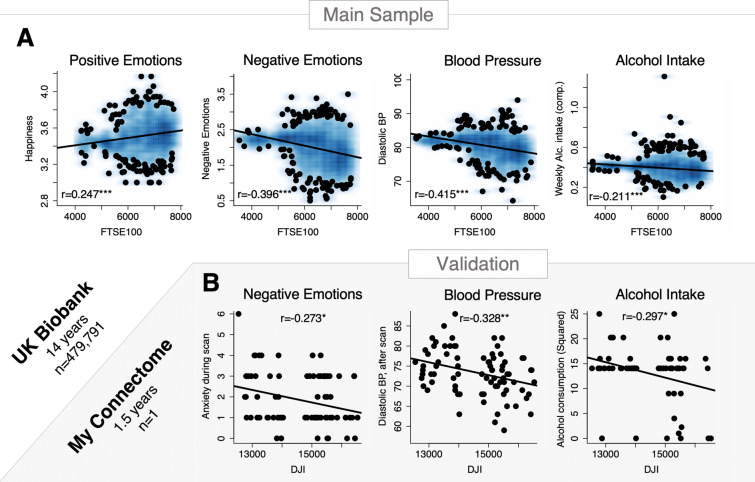
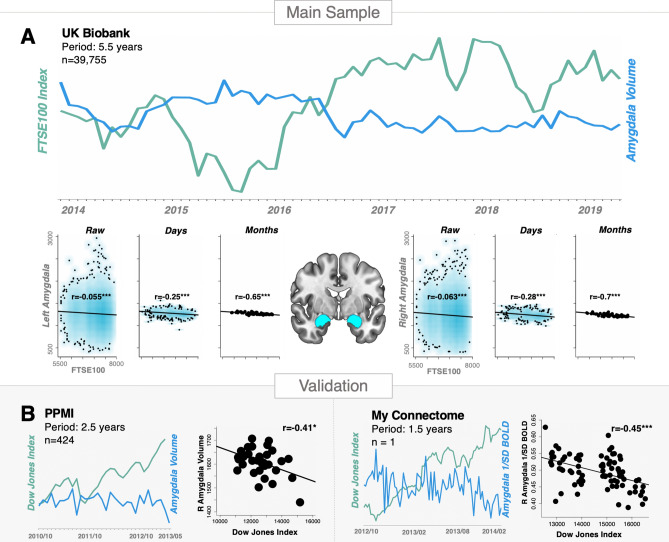
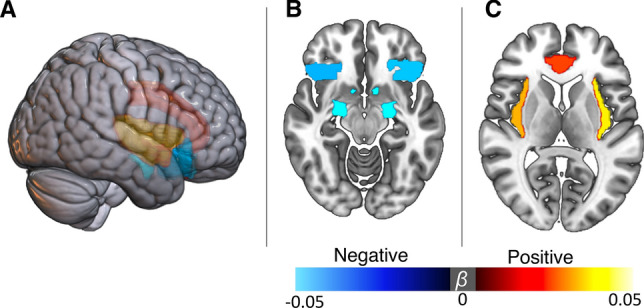
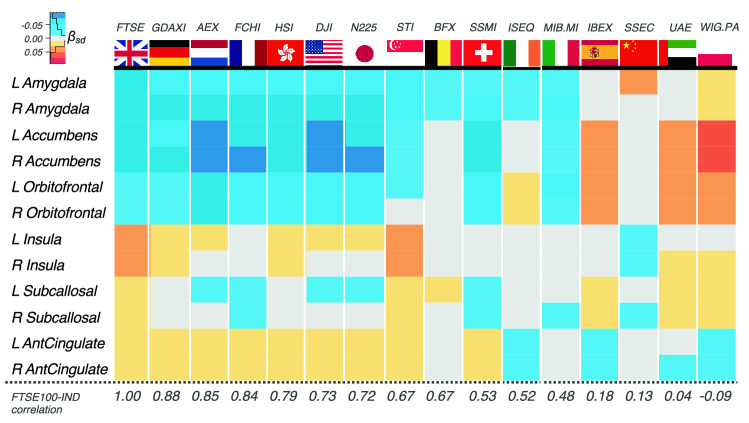
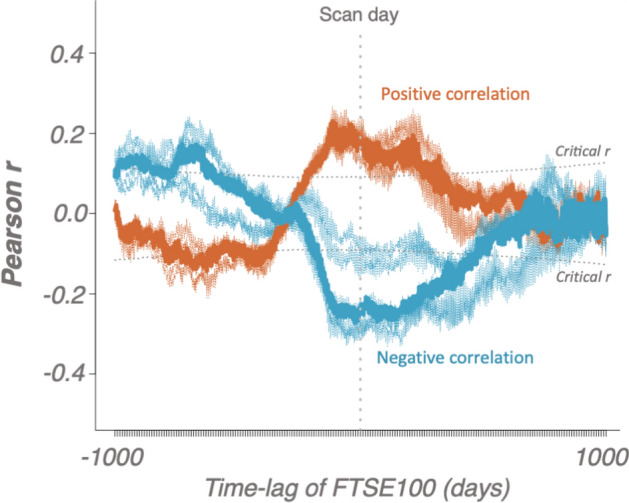
The stock market is a bellwether of socio-economic changes that may directly affect individual well-being. Using large-scale UK-biobank data generated over 14 years, we applied specification curve analysis to rigorously identify significant associations between the local stock market index (FTSE100) and 479,791 UK residents' mood, as well as their alcohol intake and blood pressure adjusting the results for a large number of potential confounders, including age, sex, linear and non-linear effects of time, research site, other stock market indexes. Furthermore, we found similar associations between FTSE100 and volumetric measures of affective brain regions in a subsample (n = 39,755; measurements performed over 5.5 years), which were particularly strong around phase transitions characterized by maximum volatility in the market. The main findings did not depend on applied effect-size estimation criteria (linear methods or mutual information criterion) and were replicated in two independent US-based studies (Parkinson's Progression Markers Initiative; n = 424; performed over 2.5 years and MyConnectome; n = 1; 81 measurements over 1.5 years). Our results suggest that phase transitions in the society, indexed by stock market, exhibit close relationships with human mood, health and the affective brain from an individual to population level.
股票市场是社会经济变化的晴雨表,这些变化可能直接影响个人的幸福感。我们使用英国生物银行在 14 年期间产生的大规模数据,应用规范曲线分析严格确定当地股票市场指数(富时 100 指数)与 479791 名英国居民的情绪以及他们的饮酒量和血压之间的显著关联,同时调整了大量潜在混杂因素的结果,包括年龄、性别、时间的线性和非线性效应、研究地点、其他股票市场指数。此外,我们在一个亚样本(n=39755;测量时间为 5.5 年)中发现了富时 100 指数与情感大脑区域体积测量值之间的类似关联,这些关联在市场波动最大的相变附近尤为强烈。主要发现不依赖于应用的效应大小估计标准(线性方法或互信息标准),并在两项独立的基于美国的研究中得到了复制(帕金森病进展标志物倡议;n=424;测量时间为 2.5 年;MyConnectome;n=1;测量时间为 1.5 年)。我们的研究结果表明,以股票市场为指标的社会相变与个体到群体层面的人类情绪、健康和情感大脑密切相关。