Wellcome Centre for Integrative Neuroimaging, FMRIB, Nuffield Department of Clinical Neurosciences, University of Oxford, UK.
Wellcome Centre for Integrative Neuroimaging, FMRIB, Nuffield Department of Clinical Neurosciences, University of Oxford, UK.
Neuroimage. 2021 Jan 1;224:117002. doi: 10.1016/j.neuroimage.2020.117002. Epub 2020 Jun 2.
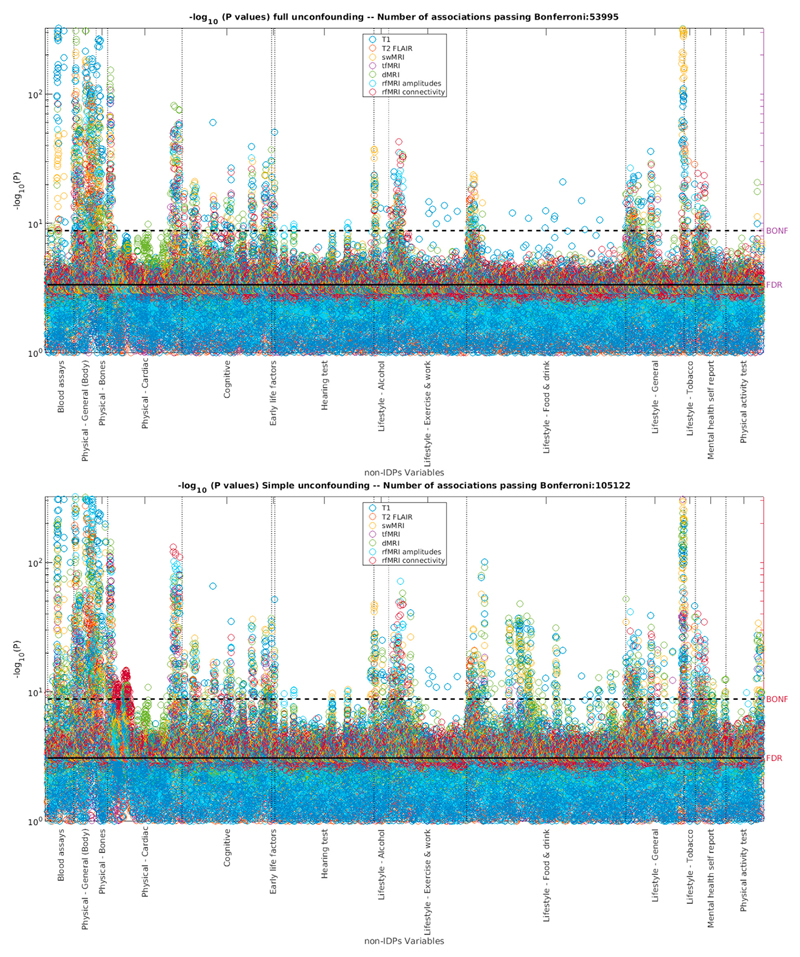
Dealing with confounds is an essential step in large cohort studies to address problems such as unexplained variance and spurious correlations. UK Biobank is a powerful resource for studying associations between imaging and non-imaging measures such as lifestyle factors and health outcomes, in part because of the large subject numbers. However, the resulting high statistical power also raises the sensitivity to confound effects, which therefore have to be carefully considered. In this work we describe a set of possible confounds (including non-linear effects and interactions that researchers may wish to consider for their studies using such data). We include descriptions of how we can estimate the confounds, and study the extent to which each of these confounds affects the data, and the spurious correlations that may arise if they are not controlled. Finally, we discuss several issues that future studies should consider when dealing with confounds.
处理混杂因素是大型队列研究中的一个重要步骤,旨在解决无法解释的方差和虚假相关等问题。英国生物银行是研究成像和非成像测量(如生活方式因素和健康结果)之间关联的强大资源,部分原因是其拥有大量的研究对象。然而,由此产生的高统计功效也提高了对混杂因素效应的敏感性,因此必须仔细考虑。在这项工作中,我们描述了一组可能的混杂因素(包括非线性效应和交互作用,研究人员可能希望在使用此类数据进行研究时考虑这些因素)。我们还介绍了如何估计这些混杂因素的方法,并研究了这些混杂因素对数据的影响程度,以及如果不加以控制可能会产生的虚假相关。最后,我们讨论了未来研究在处理混杂因素时应考虑的几个问题。