Department of Agricultural, Food and Nutritional Science, University of Alberta, Edmonton, AB, T6G 2P5, Canada.
College of Animal Science and Technology, Southwest University, Chongqing, 402460, China.
Sci Rep. 2022 Mar 17;12(1):4612. doi: 10.1038/s41598-022-08572-8.
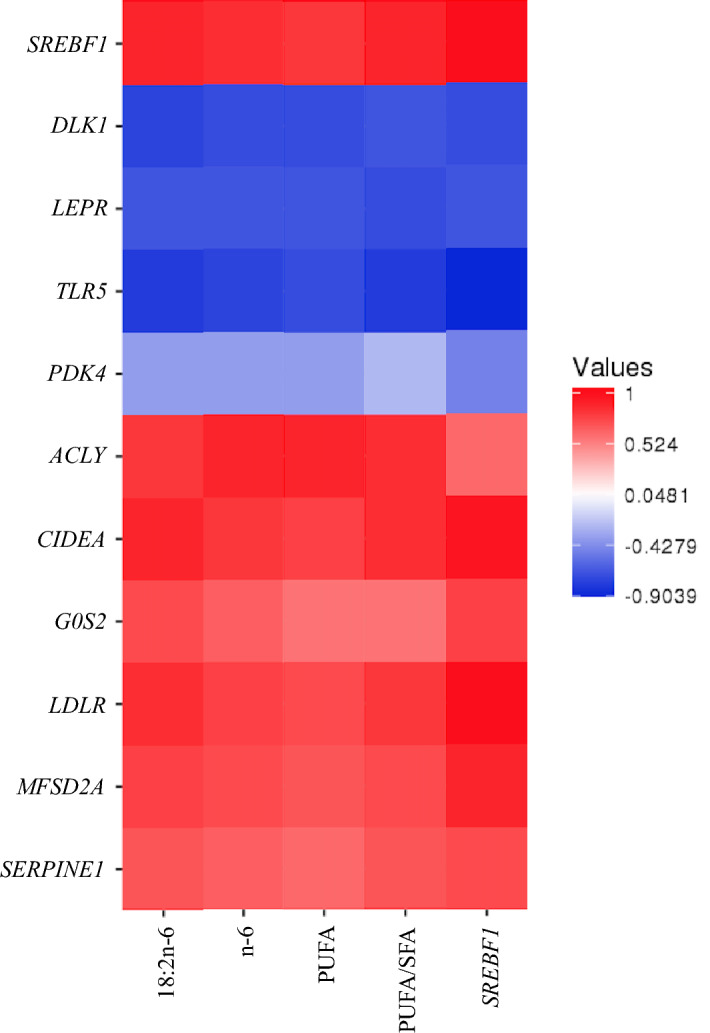
The current study aimed to determine whether breed and feed efficiency affect the molecular mechanisms regulating beneficial and non-beneficial fatty acid profiles in subcutaneous adipose tissue of beef steers. Fatty acid profiling and RNA-Seq based transcriptome analysis were performed on subcutaneous adipose tissues collected from beef steers with three divergent breeds (Angus, ANG, n = 47; Charolais, CHAR, n = 48; Kinsella Composite, KC, n = 48) and different residual feed intake (RFI, a measure of feed efficiency). The comparison of fatty acid profiles showed that KC had higher beneficial FAs compared to the other two breeds. Distinct FA profiles between H-RFIfat and L-RFIfat steers was more obvious for KC steers, where H-RFIfat steers tended to have higher proportion of healthy FAs and lower proportion of the unhealthy FAs. A higher number of differentially expressed (DE) genes were observed for KC steers, whereas ANG and CHAR steers had a lower number of DE genes between H- and L-RFIfat steers. The association analyses of the gene expressions and FA profiles showed that 10 FA metabolism-associated genes together with the one upstream regulator (SREBF1) were associated with the proportion of C18:2n-6, total n-6, PUFA and PUFA/SFA for KC steers but not the other two breeds. Subcutaneous adipose tissue FA profiles and healthy FA index differed in cattle with divergent feed efficiency and such variation was unique for the three examined cattle breeds. Key FA metabolism-associated genes together with SREBF1 which is the upstream regulator of a set of genes involved in lipid metabolism may be of importance for genetic selection of meat with higher healthy FA index in beef cattle.
本研究旨在确定品种和饲料效率是否影响调节牛肉育肥牛皮下脂肪组织中有益和无益脂肪酸谱的分子机制。对具有三种不同品种(安格斯牛,ANG,n=47;夏洛莱牛,CHAR,n=48;金赛拉复合品种,KC,n=48)和不同剩余采食量(RFI,衡量饲料效率的指标)的牛肉育肥牛的皮下脂肪组织进行了脂肪酸谱分析和基于 RNA-Seq 的转录组分析。脂肪酸谱比较表明,KC 比其他两个品种具有更高的有益 FA。H-RFIfat 和 L-RFIfat 育肥牛之间的 FA 谱差异在 KC 育肥牛中更为明显,其中 H-RFIfat 育肥牛的健康 FA 比例较高,不健康 FA 比例较低。KC 育肥牛观察到更多差异表达(DE)基因,而 ANG 和 CHAR 育肥牛之间 H-和 L-RFIfat 育肥牛之间的 DE 基因数量较少。基因表达和 FA 谱的关联分析表明,10 个与 FA 代谢相关的基因以及一个上游调节因子(SREBF1)与 KC 育肥牛的 C18:2n-6、总 n-6、PUFA 和 PUFA/SFA 比例相关,但与其他两个品种无关。具有不同饲料效率的牛的皮下脂肪组织 FA 谱和健康 FA 指数存在差异,这种差异对三种检查的牛品种是独特的。关键的 FA 代谢相关基因以及 SREBF1(参与脂质代谢的一组基因的上游调节因子)可能对牛肉中具有更高健康 FA 指数的肉的遗传选择很重要。