Department of Pharmacology, School of Pharmacy, College of Medicine and Health Science, University of Gondar, Gondar, Ethiopia.
Department of Pharmaceutics and Social Pharmacy, School of Pharmacy, University of Gondar College of Medicine and Health Sciences, Gondar, Ethiopia.
PLoS One. 2022 Mar 18;17(3):e0264617. doi: 10.1371/journal.pone.0264617. eCollection 2022.
Coronavirus disease 2019 has had a global effect on people's lifestyles. Many people have developed irregular eating patterns and become physically inactive, which leads to an aggravation of lifestyle-related diseases and unhealthier lifestyles; these, subsequently raise the severity of coronavirus disease 2019. This study aimed to assess lifestyle changes during coronavirus disease 2019 pandemic in Gondar town, North West, Ethiopia.
Community-based cross-sectional study design was conducted among households at Gondar town from June to August 2021. The study participants were selected by a systematic random sampling technique from proportionally allocated kebeles. Data were collected using face-to-face interview techniques and were entered and analyzed by using a statistical package for the social sciences version 24; P-values < 0.05 were considered as statistically significant.
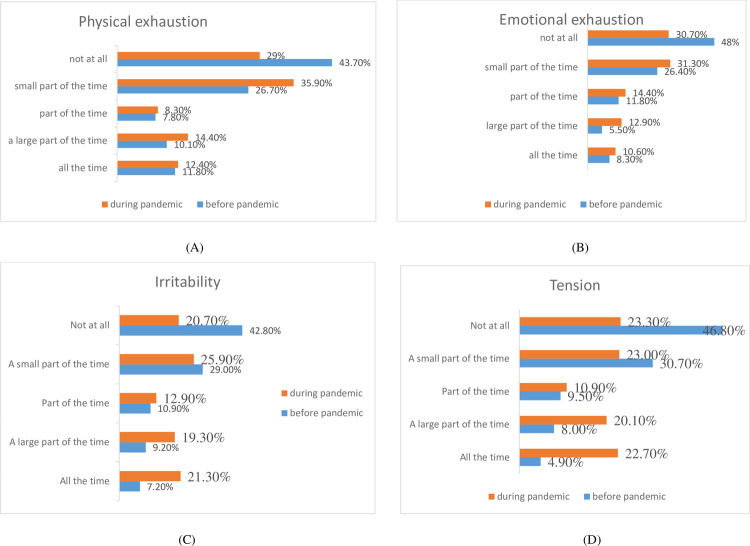
Overall, 348 study participants were included in the study. Among those respondents, 52.3% (182) were female study participants and the mean age of the respondents was 30.95±14.4. In this study, there was a significant decrement in non-homemade food from 20.4% to 13.4% at (P = <0.001). Concerning water intake, 11.5% (40) of respondents consumed ≥8 cups/day before the coronavirus disease 2019 pandemic, and the percentage increased to 14.7% (51) during the coronavirus disease 2019 pandemic (p = 0.01). Of the participants, 46% participants were reported never engaging in any physical activity before the coronavirus pandemic, and the percentage decreased to 29.9% during the pandemic (P = 0.002). The respondents also exhibited increment tension in large from 4.9% to 22.7% before and during the coronavirus disease 2019 pandemic, respectively. Furthermore, about 6.3% of the study participants slept badly before the coronavirus disease 2019 pandemics and the effects of sleeping badly and restlessly increased to 25.9% during the coronavirus disease 2019 pandemic (P = <0.001).
The current study demonstrates that there is a noticeable alteration in food consumption, food choices, regular mealtime, sleeping habits, mental exhaustion, and practice of physical activity.
2019 年冠状病毒病对人们的生活方式产生了全球性影响。许多人养成了不规律的饮食习惯,身体活动减少,这导致了与生活方式相关的疾病恶化和生活方式更不健康;这反过来又增加了 2019 年冠状病毒病的严重程度。本研究旨在评估 2019 年冠状病毒病大流行期间在埃塞俄比亚西北部贡德尔镇的生活方式变化。
2021 年 6 月至 8 月,在贡德尔镇进行了基于社区的横断面研究设计。研究参与者通过系统随机抽样技术从按比例分配的 kebeles 中选出。使用面对面访谈技术收集数据,并使用社会科学统计软件包 24 进行输入和分析;P 值<0.05 被认为具有统计学意义。
总体而言,本研究纳入了 348 名研究参与者。在这些受访者中,52.3%(182 人)是女性研究参与者,受访者的平均年龄为 30.95±14.4。在这项研究中,非自制食品的比例从 20.4%显著下降到 13.4%(P<0.001)。关于水的摄入量,在 2019 年冠状病毒病大流行之前,有 11.5%(40 人)的受访者每天摄入≥8 杯水,而在 2019 年冠状病毒病大流行期间,这一比例增加到 14.7%(51 人)(p=0.01)。在参与者中,46%的参与者在冠状病毒大流行前从未进行过任何体育活动,而在大流行期间这一比例下降到 29.9%(P=0.002)。受访者在大流行前后的紧张程度也分别从 4.9%增加到 22.7%。此外,大约 6.3%的研究参与者在 2019 年冠状病毒病大流行前睡眠质量差,而在 2019 年冠状病毒病大流行期间,睡眠质量差和不安的影响增加到 25.9%(P<0.001)。
本研究表明,在食物消耗、食物选择、规律进餐时间、睡眠习惯、精神疲惫和体育锻炼方面都发生了明显的变化。