Department of Psychiatry, Wollo University, College of Medicine and Health Sciences, Dessie, Ethiopia.
PLoS One. 2020 Dec 30;15(12):e0244530. doi: 10.1371/journal.pone.0244530. eCollection 2020.
People with disabilities face multiple barriers that prevent them from accessing care and essential information related to the COVID-19 pandemic that poses additional stress and psychopathology. Therefore, the investigation of psychopathologies during the COVID-19 outbreak and emergency response is critical.
A cross-sectional survey was implemented from July 15/2020 to July 30/2020. The PHQ-9, GAD-7 scale, insomnia severity index-7, and brief resilient coping scale were administered to participants. The collected data was then entered into Epi-data version 3.1 and exported to SPSS-20 for analysis. Descriptive statistical procedures were employed to describe the various psychopathologies. A binary logistic regression method was used to identify the related factors for the psychopathologies. Furthermore, an odds ratio with its 95%CI was driven to show association strength, and a P-value <0.05 was declared as statistically significant.
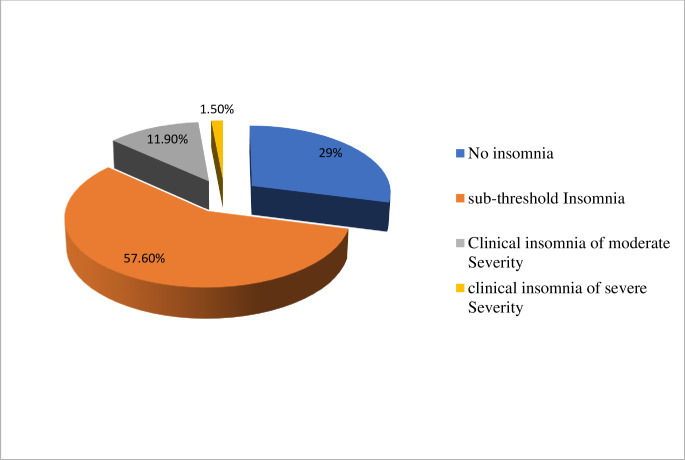
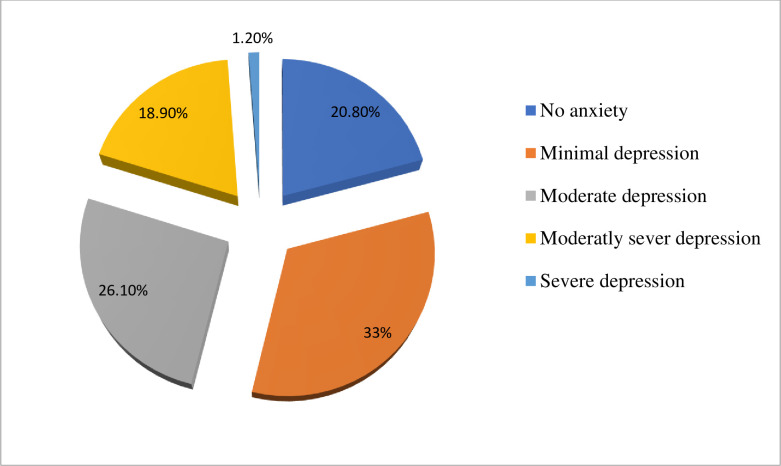
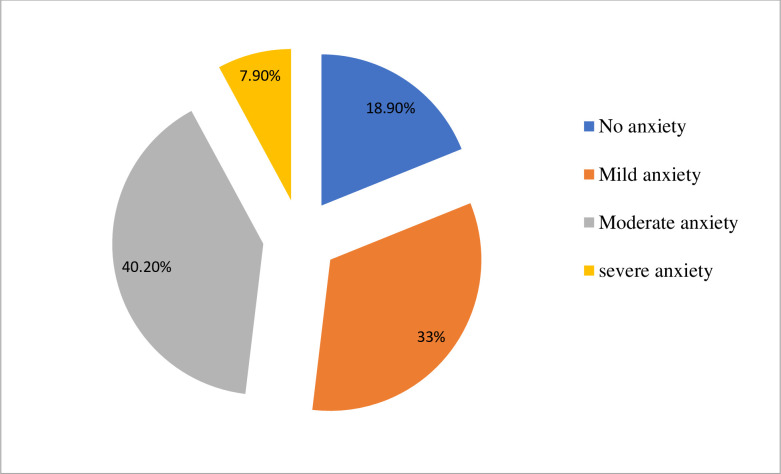
A significant proportion of individuals living with disability had psychopathologies; 46.2% for depression symptoms, 48.1% for generalized anxiety disorder symptoms, and 71% for insomnia symptoms. Nearly 45.7% of participants were low resilient copers to their psychopathology. Depression was significantly higher in divorced/widowed/separated (AOR = 3.4, 95% CI: 1.28-8.92, P-value = 0.006), non-educated (AOR = 2.12, 95% CI: 1.12, 5.90, P-value = 0.001), and unemployed (AOR = 2.1, 95% CI: 1.32, 5.11, P-value = 0.005) as well as a daily laborer (AOR = 2.4, 95% CI: 1.20, 4.89, P-value = 0.014) subjects. Generalized anxiety disorder was also significantly higher in young age (<40 years) (AOR = 1.7, 95% CI: 1.32, 2.98, P-value = 0.02), single (AOR = 2.3, 95% CI: 1.24, 5.3, P-value = 0.011), widowed/divorced/separated (AOR = 1.5, 95% CI: 1.12, 2.78, P-value = 0.032), preparatory school completed (AOR = 3.00, 95% CI: 1.59, 5.46, P-value = 0.001), daily laborer (AOR = 2.7, 95% CI: 1.21, 5.23, P-value = 0.003), and unemployed (AOR = 2.5, 95% CI: 1.17, 4.78, P-value = 0.005) participants. Moreover, insomnia was significantly higher in single (AOR = 1.5, 95% CI: 1.12, 3.09, P-value = 0.027), divorced/widowed/separated(AOR = 6.2, 95% CI: 1.08, 11.29, P-value = 0.032), unemployed (AOR = 3.00, 95% CI: 1.22, 7.03, P-value = 0.001), blind (AOR = 2.8, 95% CI: 1.42, 6.35, P-value = 0.001), and deaf (AOR = 10.2, 95% CI: 4.52, 35.33, P-value = 0.002) participants.
Depression, anxiety, and insomnia were highly prevalent among individuals with a disability during the COVID-19 period. Multiple sociodemographic and disability-related factors were associated with this high psychopathology. Attention has to be given by the government and other stakeholders to intervene in psychopathology and its associated factors.
残疾人面临多种障碍,使他们无法获得与 COVID-19 大流行相关的护理和基本信息,这给他们带来了额外的压力和精神病理学问题。因此,调查 COVID-19 爆发和应急期间的精神病理学问题至关重要。
本研究采用横断面调查,于 2020 年 7 月 15 日至 7 月 30 日实施。使用 PHQ-9、GAD-7 量表、失眠严重程度指数-7 和简要应对韧性量表对参与者进行评估。收集的数据随后输入 Epi-data 版本 3.1 并导出到 SPSS-20 进行分析。采用描述性统计程序描述各种精神病理学问题。采用二元逻辑回归方法确定精神病理学相关因素。此外,还计算了比值比及其 95%CI 以显示关联强度,P 值<0.05 表示具有统计学意义。
相当比例的残疾个体存在精神病理学问题;抑郁症状的发生率为 46.2%,广泛性焦虑障碍症状的发生率为 48.1%,失眠症状的发生率为 71%。近 45.7%的参与者对其精神病理学问题的应对能力较低。离婚/丧偶/分居(优势比 [OR] = 3.4,95%置信区间 [CI]:1.28-8.92,P 值 = 0.006)、未受教育(OR = 2.12,95%CI:1.12,5.90,P 值 = 0.001)和失业(OR = 2.1,95%CI:1.32,5.11,P 值 = 0.005)以及体力劳动者(OR = 2.4,95%CI:1.20,4.89,P 值 = 0.014)的个体中抑郁程度显著升高。年轻(<40 岁)(OR = 1.7,95%CI:1.32,2.98,P 值 = 0.02)、单身(OR = 2.3,95%CI:1.24,5.3,P 值 = 0.011)、离婚/丧偶/分居(OR = 1.5,95%CI:1.12,2.78,P 值 = 0.032)、完成预科学校(OR = 3.00,95%CI:1.59,5.46,P 值 = 0.001)、体力劳动者(OR = 2.7,95%CI:1.21,5.23,P 值 = 0.003)和失业(OR = 2.5,95%CI:1.17,4.78,P 值 = 0.005)的个体中广泛性焦虑障碍显著升高。此外,单身(OR = 1.5,95%CI:1.12,3.09,P 值 = 0.027)、离婚/丧偶/分居(OR = 6.2,95%CI:1.08,11.29,P 值 = 0.032)、失业(OR = 3.00,95%CI:1.22,7.03,P 值 = 0.001)、盲(OR = 2.8,95%CI:1.42,6.35,P 值 = 0.001)和聋(OR = 10.2,95%CI:4.52,35.33,P 值 = 0.002)的个体中失眠显著升高。
COVID-19 期间,残疾个体中抑郁、焦虑和失眠的发生率较高。多种社会人口学和残疾相关因素与这种高精神病理学问题相关。政府和其他利益相关者应关注这一问题,并采取干预措施应对精神病理学问题及其相关因素。