Rojo Federico, Conde Esther, Torres Héctor, Cabezón-Gutiérrez Luis, Bautista Dolores, Ramos Inmaculada, Carcedo David, Arrabal Natalia, García J Francisco, Galán Raquel, Nadal Ernest
Hospital Universitario Fundación Jiménez Diaz - CIBERONC, Madrid, Spain.
Hospital Universiario 12 de Octubre-CIBERONC, Madrid, Spain.
BMC Cancer. 2022 Mar 19;22(1):292. doi: 10.1186/s12885-022-09397-4.
Detection of the ROS1 rearrangement is mandatory in patients with advanced or metastatic non-small cell lung cancer (NSCLC) to allow targeted therapy with specific inhibitors. However, in Spanish clinical practice ROS1 determination is not yet fully widespread. The aim of this study is to determine the clinical and economic impact of sequentially testing ROS1 in addition to EGFR and ALK in Spain.
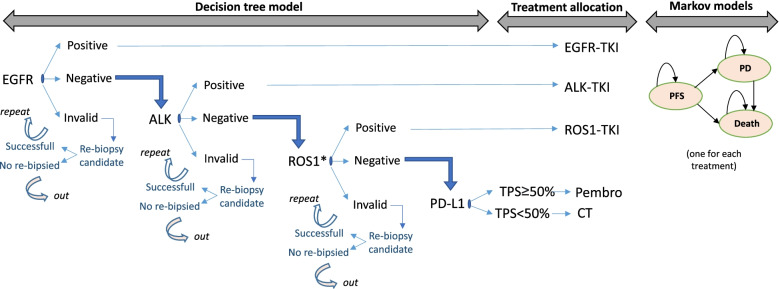
A joint model (decision-tree and Markov model) was developed to determine the cost-effectiveness of testing ROS1 strategy versus a no-ROS1 testing strategy in Spain. Distribution of ROS1 techniques, rates of testing, positivity, and invalidity of biomarkers included in the analysis (EGFR, ALK, ROS1 and PD-L1) were based on expert opinion and Lungpath real-world database. Treatment allocation depending on the molecular testing results was defined by expert opinion. For each treatment, a 3-states Markov model was developed, where progression-free survival (PFS) and overall survival (OS) curves were parameterized using exponential extrapolations to model transition of patients among health states. Only medical direct costs were included (€ 2021). A lifetime horizon was considered and a discount rate of 3% was applied for both costs and effects. Both deterministic and probabilistic sensitivity analyses were performed to address uncertainty.
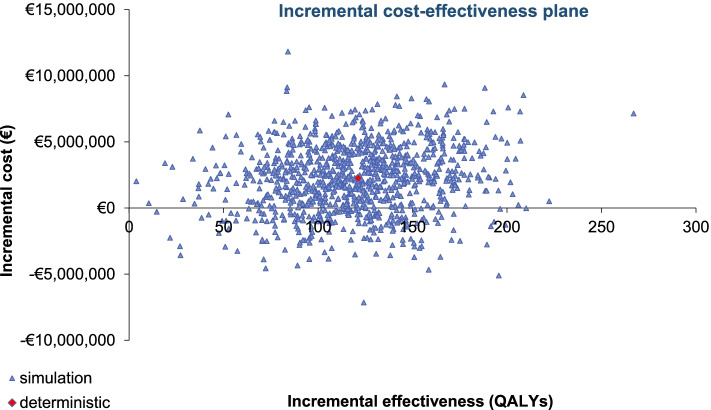
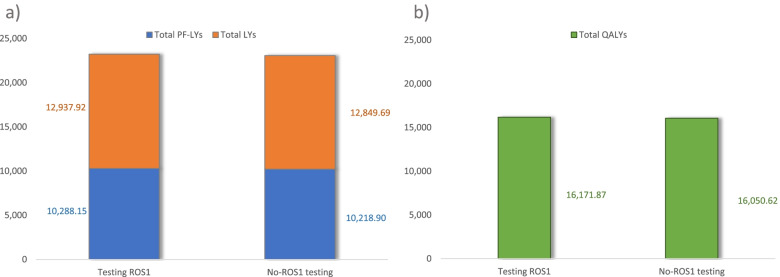
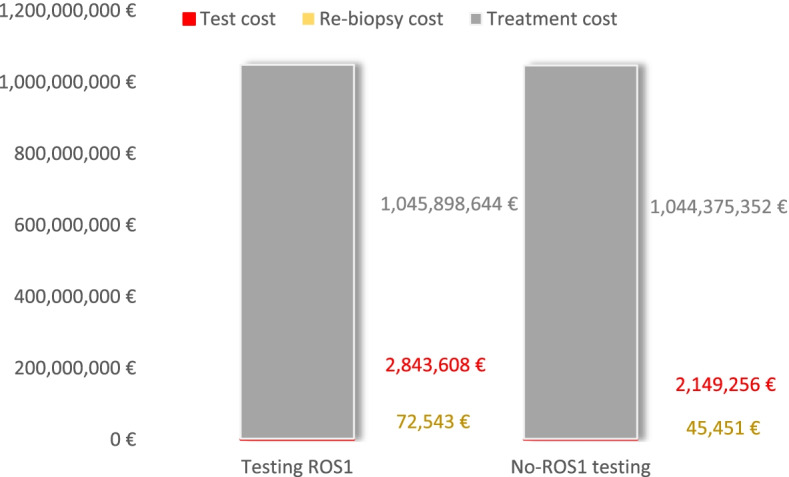
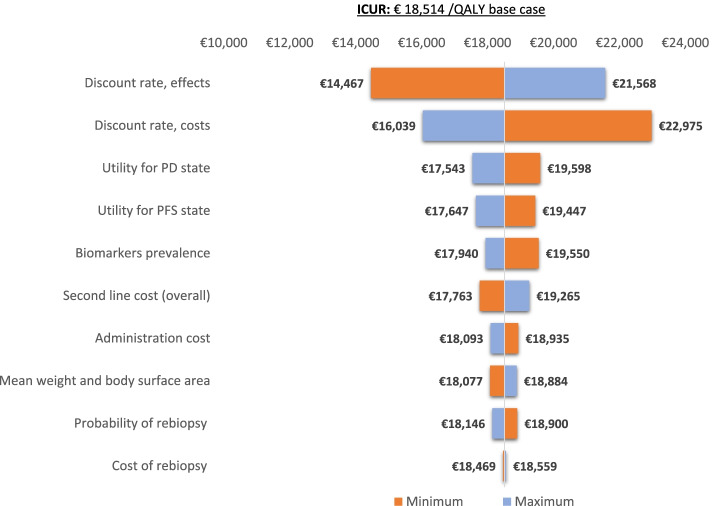
A target population of 8755 patients with advanced NSCLC (non-squamous or never smokers squamous) entered the model. Over a lifetime horizon, the ROS1 testing scenario produced additional 157.5 life years and 121.3 quality-adjusted life years (QALYs) compared with no-ROS1 testing scenario. Total direct costs were increased up to € 2,244,737 for ROS1 testing scenario. The incremental cost-utility ratio (ICUR) was 18,514 €/QALY. Robustness of the base-case results were confirmed by the sensitivity analysis.
Our study shows that ROS1 testing in addition to EGFR and ALK is a cost-effective strategy compared to no-ROS1 testing, and it generates more than 120 QALYs in Spain over a lifetime horizon. Despite the low prevalence of ROS1 rearrangements in NSCLC patients, the clinical and economic consequences of ROS1 testing should encourage centers to test all advanced or metastatic NSCLC (non-squamous and never-smoker squamous) patients.
对于晚期或转移性非小细胞肺癌(NSCLC)患者,检测ROS1重排对于采用特定抑制剂进行靶向治疗至关重要。然而,在西班牙的临床实践中,ROS1检测尚未完全普及。本研究的目的是确定在西班牙除了检测EGFR和ALK外,序贯检测ROS1的临床和经济影响。
开发了一个联合模型(决策树和马尔可夫模型)来确定在西班牙检测ROS1策略与不检测ROS1策略的成本效益。ROS1检测技术的分布、检测率、阳性率以及分析中包含的生物标志物(EGFR、ALK、ROS1和PD-L1)的无效率基于专家意见和Lungpath真实世界数据库。根据分子检测结果的治疗分配由专家意见确定。对于每种治疗,开发了一个三状态马尔可夫模型,其中无进展生存期(PFS)和总生存期(OS)曲线使用指数外推法进行参数化,以模拟患者在健康状态之间的转换。仅纳入医疗直接成本(2021欧元)。考虑终身时间范围,成本和效果均应用3%的贴现率。进行了确定性和概率敏感性分析以应对不确定性。
8755例晚期NSCLC患者(非鳞状或从不吸烟的鳞状细胞癌患者)进入模型。在终身时间范围内,与不检测ROS1的情况相比,检测ROS1的情况产生了额外的157.5个生命年和121.3个质量调整生命年(QALY)。检测ROS1的情况下,总直接成本增加至2244737欧元。增量成本效用比(ICUR)为18514欧元/QALY。敏感性分析证实了基础病例结果的稳健性。
我们的研究表明,与不检测ROS1相比,除检测EGFR和ALK外还检测ROS1是一种具有成本效益的策略,并且在西班牙的终身时间范围内可产生超过120个QALY。尽管NSCLC患者中ROS1重排的患病率较低,但ROS1检测的临床和经济后果应促使各中心对所有晚期或转移性NSCLC(非鳞状和从不吸烟的鳞状细胞癌)患者进行检测。