East Cheshire NHS Trust, Macclesfield, UK.
Department of Nephrology and Transplantation, University Hospitals Birmingham, Edgbaston, Birmingham, B15 2WB, UK.
BMC Nephrol. 2022 Mar 19;23(1):113. doi: 10.1186/s12882-022-02742-6.
The interplay between ethnicity and socioeconomic deprivation for living-donor kidney transplantation (LDKT) opportunities is unclear.
Data for 2040 consecutive kidney-alone transplant recipients receiving an allograft between 1st January 2007 and 30th June 2020 at a single center were retrospectively analyzed. The associations between the proportions of transplants that were LDKT (versus deceased donation) and both ethnicity and socioeconomic deprivation were assessed, with the latter quantified by the Index of Multiple Deprivation (IMD) quintile.
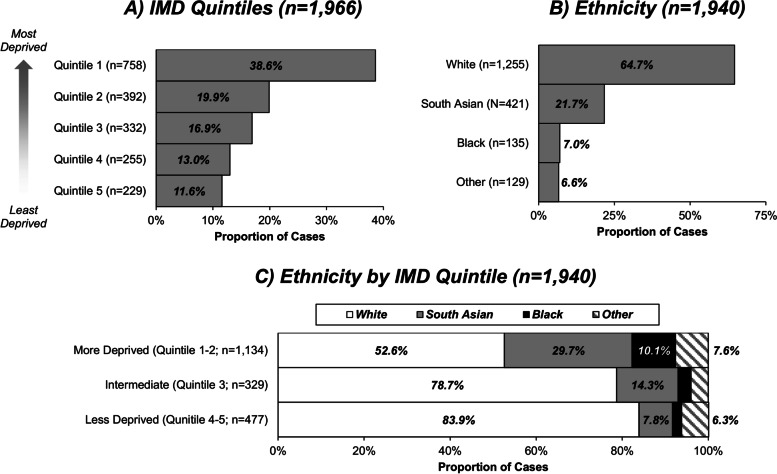
The cohort comprised recipients of White (64.7%), South Asian (21.7%), Black (7.0%) and other (6.6%) ethnic groups. Recipients tended to be from socioeconomically deprived areas, with the most deprived quintile being the most frequently observed (quintile 1: 38.6% of patients); non-White recipients were significantly more likely to live in socioeconomically deprived areas (p < 0.001). Overall, 36.5% of transplants were LDKT, with this proportion declining progressively with socioeconomic deprivation, from 50.4 to 27.6% in the least versus most deprived IMD quintile (p < 0.001). A significant difference across recipient ethnicities was also observed, with the proportion of LDKTs ranging from 43.2% in White recipients to 17.8% in Black recipients (p < 0.001). Both socioeconomic deprivation (p < 0.001) and ethnicity (p = 0.005) remained significant predictors of LDKT on multivariable analysis, with a significant interaction between these factors also being observed (p < 0.001). Further assessment of this interaction effect found that, whilst there was a marked difference in the proportions of transplants that were LDKT between White versus non-White recipients in the most socioeconomically deprived groups (39.5% versus 19.3%), no such difference was seen in the least deprived recipients (48.5% versus 51.9%).
Whilst both socioeconomic deprivation and non-White ethnicity are independent predictors for lower proportions of LDKTs, the significant interaction between the two factors should be appreciated.
在活体供肾移植(LDKT)机会方面,种族和社会经济剥夺之间的相互作用尚不清楚。
回顾性分析了 2040 例于 2007 年 1 月 1 日至 2020 年 6 月 30 日在单中心接受同种异体肾移植的患者的数据。评估了移植中 LDKT(与已故供体捐献相比)的比例与种族和社会经济剥夺之间的关系,后者用多个剥夺指数(IMD)五分位数来量化。
队列包括白人(64.7%)、南亚裔(21.7%)、黑人(7.0%)和其他(6.6%)种族的患者。患者往往来自社会经济贫困地区,最贫困的五分位数最为常见(五分位数 1:38.6%的患者);非白人患者更有可能生活在社会经济贫困地区(p<0.001)。总体而言,36.5%的移植是 LDKT,随着社会经济剥夺程度的增加,这一比例逐渐下降,从 IMD 五分位数最低组的 50.4%降至最高组的 27.6%(p<0.001)。在不同种族的患者中也观察到显著差异,LDKT 的比例从白人患者的 43.2%到黑人患者的 17.8%不等(p<0.001)。多变量分析显示,社会经济剥夺(p<0.001)和种族(p=0.005)仍然是 LDKT 的显著预测因素,同时也观察到这两个因素之间存在显著的相互作用(p<0.001)。进一步评估这种相互作用的影响发现,虽然在最贫困的社会经济群体中,白种人与非白种人患者之间的 LDKT 移植比例存在显著差异(39.5%比 19.3%),但在最不贫困的患者中没有观察到这种差异(48.5%比 51.9%)。
虽然社会经济剥夺和非白人种族都是 LDKT 比例较低的独立预测因素,但应注意这两个因素之间的显著相互作用。