Cancer Epidemiology Division, Cancer Council Victoria, Melbourne, Australia.
Department of Physiotherapy, The University of Melbourne, Melbourne, Australia.
Int J Behav Nutr Phys Act. 2022 Mar 19;19(1):30. doi: 10.1186/s12966-022-01273-5.
Higher levels of time spent sitting (sedentary behavior) contribute to adverse health outcomes, including earlier death. This effect may be modified by other lifestyle factors. We examined the association of television viewing (TV), a common leisure-time sedentary behavior, with all-cause mortality, and whether this is modified by body mass index (BMI), physical activity, smoking, alcohol intake, soft drink consumption, or diet-associated inflammation.
Using data from participants in the Melbourne Collaborative Cohort Study, flexible parametric survival models assessed the time-dependent association of self-reported TV time (three categories: < 2 h/day, 2-3 h/day, > 3 h/day) with all-cause mortality. Interaction terms were fitted to test whether there was effect modification of TV time by the other risk factors.
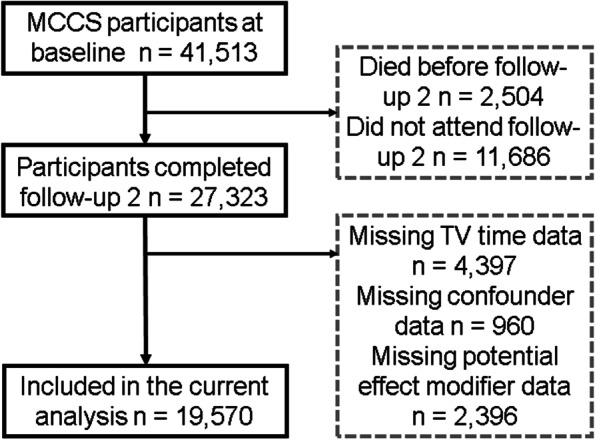
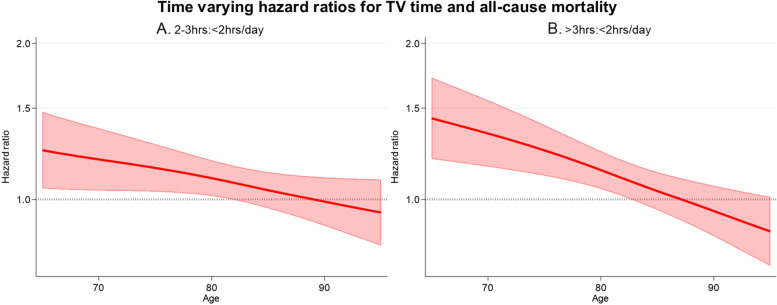
From 19,570 participants, 4,417 deaths were reported over a median follow up of 14.5 years. More TV time was associated with earlier mortality; however, this relationship diminished with increasing age. The hazard ratio (HR) and 95% confidence interval (95% CI) for > 3 h/day compared with < 2 h/day of TV time was 1.34 (1.16, 1.55) at 70 years, 1.14 (1.04, 1.23) at 80 years, and 0.95 (0.84, 1.06) at 90 years. The TV time/mortality relationship was more evident in participants who were physically inactive (compared with active; p for interaction < 0.01) or had a higher dietary inflammatory index score (compared with a lower score; p for interaction = 0.03). No interactions were detected between TV time and BMI, smoking, alcohol intake, nor soft-drink consumption (all p for interaction > 0.16).
The relationship between TV time and all-cause mortality may change with age. It may also be more pronounced in those who are otherwise inactive or who have a pro-inflammatory diet.
久坐(久坐行为)时间的增加与不良健康结果有关,包括早逝。这种影响可能会受到其他生活方式因素的影响。我们研究了看电视(一种常见的休闲久坐行为)与全因死亡率的关系,以及这是否受到体重指数(BMI)、体力活动、吸烟、饮酒、软饮料摄入或与饮食相关的炎症的影响。
利用墨尔本协作队列研究参与者的数据,灵活参数生存模型评估了自我报告的电视时间(分为三个类别:每天<2 小时、每天 2-3 小时、每天>3 小时)与全因死亡率的时间依赖性关联。拟合交互项以检验电视时间是否受到其他危险因素的影响。
在 19570 名参与者中,中位随访 14.5 年后报告了 4417 例死亡。看电视时间越多,死亡风险越高;然而,这种关系随着年龄的增长而减弱。与每天<2 小时的电视时间相比,每天>3 小时的电视时间的危险比(HR)和 95%置信区间(95%CI)为 1.34(1.16,1.55)在 70 岁时,1.14(1.04,1.23)在 80 岁时,0.95(0.84,1.06)在 90 岁时。在体力活动较少的参与者(与体力活动者相比;交互作用的 p 值<0.01)或饮食炎症指数评分较高的参与者(与评分较低的参与者相比;交互作用的 p 值=0.03)中,电视时间与死亡率的关系更为明显。在电视时间与 BMI、吸烟、饮酒或软饮料摄入之间没有检测到交互作用(所有交互作用的 p 值>0.16)。
看电视时间与全因死亡率之间的关系可能会随着年龄的增长而变化。对于那些不活跃或饮食中含有促炎物质的人来说,这种关系可能更为明显。