Department of Endocrinology and Metabolism, Guangzhou Red Cross Hospital, Jinan University, Guangzhou, China.
Institute of Disease-Oriented Nutritional Research, Guangzhou Red Cross Hospital, Jinan University, Guangzhou, China.
Int J Behav Nutr Phys Act. 2023 Jul 6;20(1):81. doi: 10.1186/s12966-023-01488-0.
Sedentary behavior is prevalent among people with diabetes and is associated with unfavorable cardiometabolic health. However, there is limited evidence regarding the impact of replacing sedentary time (ST) with physical activity on mortality in people with prediabetes and diabetes. We prospectively examined the association between accelerometer-measured ST and mortality among people with prediabetes and diabetes after adjusting for demographic characteristics, lifestyle factors, and moderate- to vigorous-intensity PA (MVPA). We further determined the effect of replacing ST with equal time of different types of physical activities on all-cause mortality.
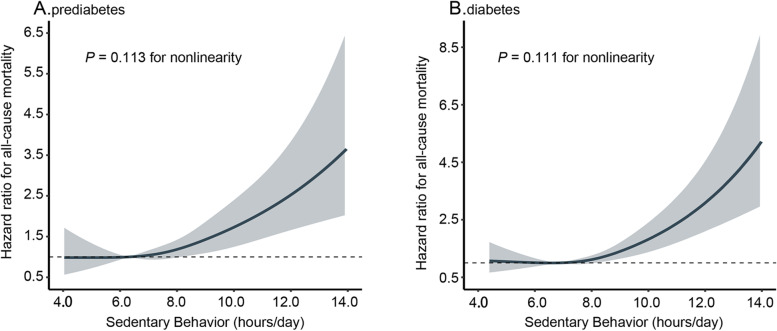
We included 1242 adults with prediabetes and 1037 with diabetes from the National Health and Nutrition Examination Survey. Restricted cubic splines were fitted to determine the dose-response association between ST and overall mortality. Isotemporal substitution modeling was used to explore the hazard ratio (HR) effects of ST replacement.
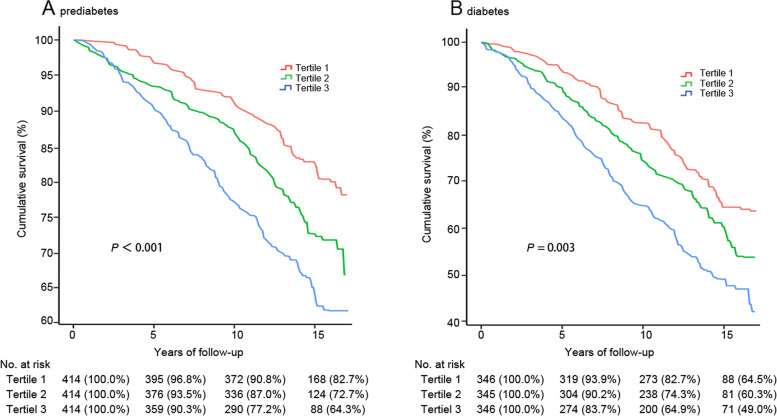
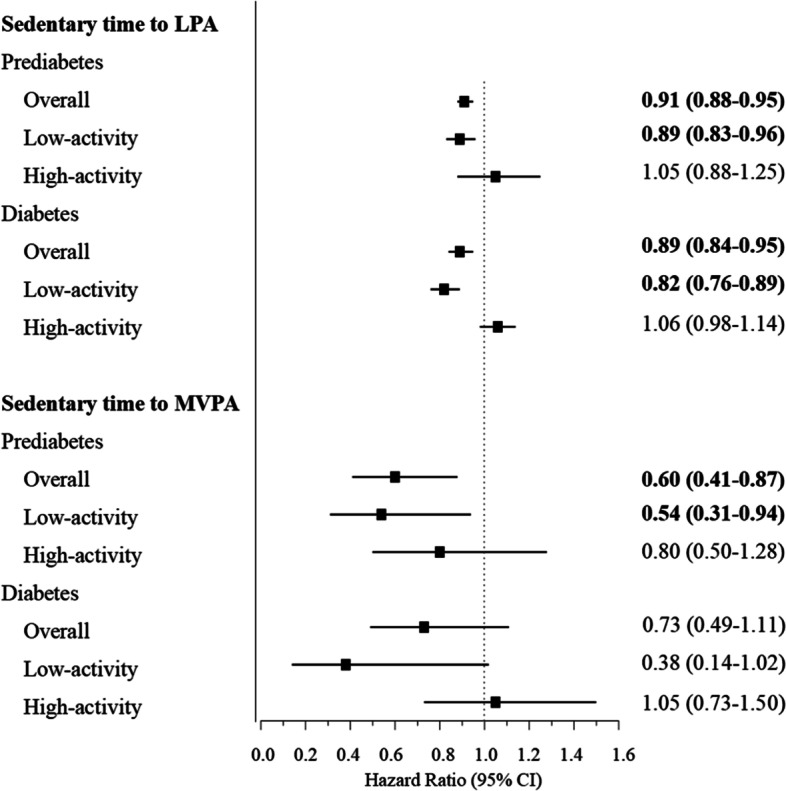
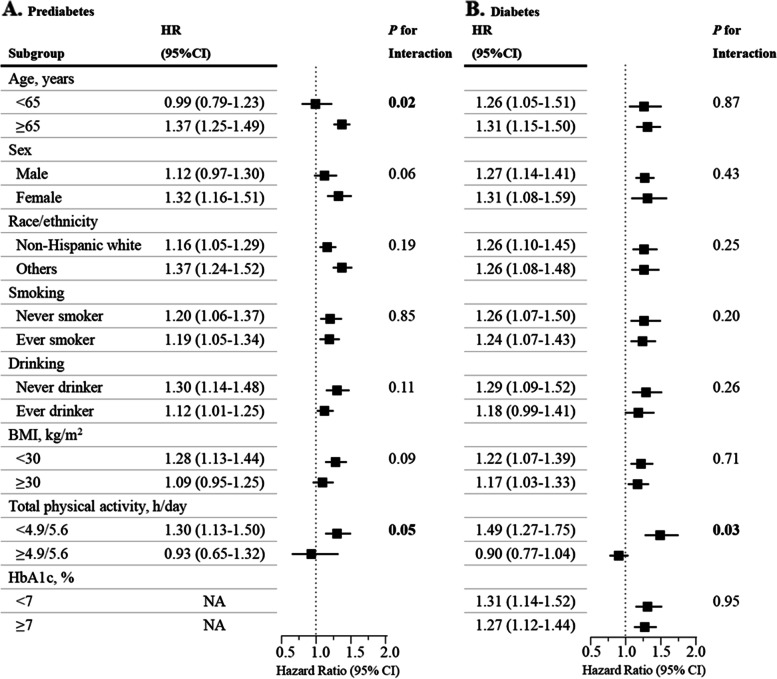
During a median follow-up of 14.1 years, 424 adults with prediabetes and 493 with diabetes died. Compared with the lowest tertile of ST, the multivariable-adjusted HRs for all-cause mortality in the highest tertile were 1.76 (95% confidence interval [CI] 1.19, 2.60) for participants with prediabetes and 1.76 (1.17, 2.65) for those with diabetes. Additionally, a linear association between ST and all-cause mortality was observed in adults with prediabetes and diabetes, with HRs for each 60 min/day increment in ST of 1.19 (1.10, 1.30) and 1.25 (1.12, 1.40), respectively. Isotemporal substitution results indicated that individuals with prediabetes whose ST was replaced by 30 min of light-intensity physical activity (LPA) and MVPA had 9% and 40% lower all-cause mortality, respectively. In people with diabetes, replacing sedentary behavior with an equivalent time of LPA and MVPA was also associated with mortality risk reduction (HR 0.89; 95% CI 0.84, 0.95 for LPA; HR 0.73; 95% CI 0.49, 1.11 for MVPA).
Higher ST was associated in a dose-response manner with an increased risk of premature mortality among adults with prediabetes and diabetes. Statistically replacing ST with LPA was potentially beneficial for health in this high-risk population.
久坐行为在糖尿病患者中很普遍,与不良的心血管代谢健康有关。然而,关于用体力活动替代久坐时间(ST)对糖尿病前期和糖尿病患者的死亡率的影响,证据有限。我们前瞻性地研究了在调整人口统计学特征、生活方式因素和中等到剧烈强度的体力活动(MVPA)后,加速度计测量的 ST 与糖尿病前期和糖尿病患者的死亡率之间的关系。我们进一步确定了用不同类型的体力活动等量替代 ST 对全因死亡率的影响。
我们纳入了来自全国健康和营养调查的 1242 名糖尿病前期患者和 1037 名糖尿病患者。使用限制性三次样条拟合来确定 ST 与总体死亡率之间的剂量反应关系。等时替代模型用于探讨 ST 替代的危害比(HR)效应。
在中位随访 14.1 年期间,424 名糖尿病前期患者和 493 名糖尿病患者死亡。与 ST 最低三分位相比,糖尿病前期患者最高三分位的全因死亡率的多变量调整 HR 为 1.76(95%置信区间 [CI] 1.19,2.60),糖尿病患者的 HR 为 1.76(1.17,2.65)。此外,在糖尿病前期和糖尿病患者中,ST 与全因死亡率之间存在线性关联,ST 每增加 60 分钟/天,HR 分别为 1.19(1.10,1.30)和 1.25(1.12,1.40)。等时替代结果表明,糖尿病前期患者将其 ST 替换为 30 分钟的低强度体力活动(LPA)和 MVPA,其全因死亡率分别降低 9%和 40%。对于糖尿病患者,用同等时间的 LPA 和 MVPA 替代久坐行为也与降低死亡风险相关(LPA 的 HR 为 0.89;95%CI 0.84,0.95;MVPA 的 HR 为 0.73;95%CI 0.49,1.11)。
较高的 ST 与糖尿病前期和糖尿病患者过早死亡的风险呈剂量反应关系。统计学上用 LPA 替代 ST 对该高危人群的健康可能有益。