Department of Epidemiology, College of Public Health, Zhengzhou University, Zhengzhou 450001, China.
Suzhou Institute of Systems Medicine, Chinese Academy of Medical Sciences, Suzhou 215123, China.
Viruses. 2021 Oct 14;13(10):2060. doi: 10.3390/v13102060.
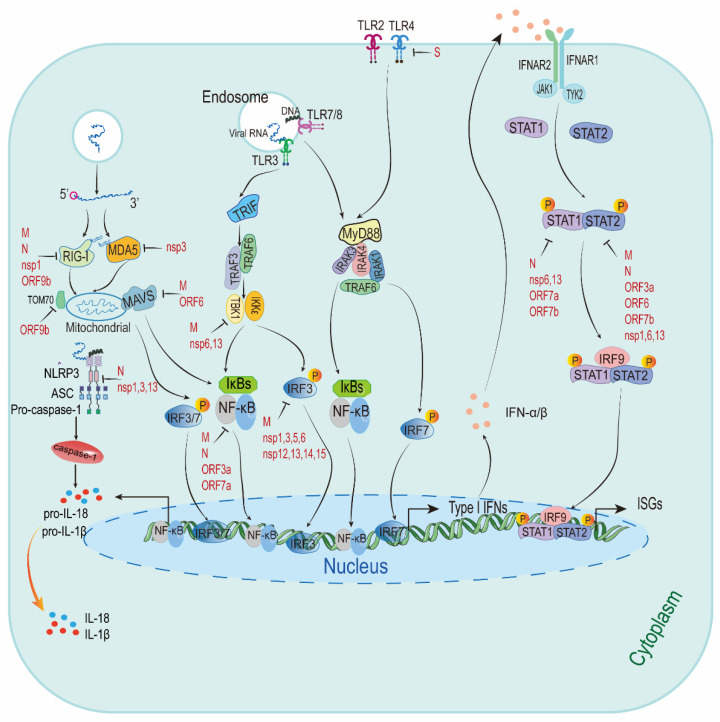
The severe acute respiratory syndrome coronavirus 2 (SARS-CoV-2) is a member of the family, which is responsible for the COVID-19 pandemic followed by unprecedented global societal and economic disruptive impact. The innate immune system is the body's first line of defense against invading pathogens and is induced by a variety of cellular receptors that sense viral components. However, various strategies are exploited by SARS-CoV-2 to disrupt the antiviral innate immune responses. Innate immune dysfunction is characterized by the weak generation of type I interferons (IFNs) and the hypersecretion of pro-inflammatory cytokines, leading to mortality and organ injury in patients with COVID-19. This review summarizes the existing understanding of the mutual effects between SARS-CoV-2 and the type I IFN (IFN-α/β) responses, emphasizing the relationship between host innate immune signaling and viral proteases with an insight on tackling potential therapeutic targets.
严重急性呼吸综合征冠状病毒 2(SARS-CoV-2)是冠状病毒科的一个成员,它引发了 COVID-19 大流行,随后对全球社会和经济造成了前所未有的破坏影响。先天免疫系统是人体抵御入侵病原体的第一道防线,它由多种细胞受体感应病毒成分而被诱导。然而,SARS-CoV-2 利用各种策略来破坏抗病毒的先天免疫反应。先天免疫功能障碍的特征是Ⅰ型干扰素(IFN)的生成较弱和促炎细胞因子的过度分泌,导致 COVID-19 患者的死亡率和器官损伤。这篇综述总结了目前对 SARS-CoV-2 与Ⅰ型 IFN(IFN-α/β)反应之间相互作用的理解,强调了宿主先天免疫信号与病毒蛋白酶之间的关系,并深入探讨了潜在的治疗靶点。