Al Hayek Ayman A, Sobki Samia H, Al-Saeed Abdulghani H, Alzahrani Wael M, Al Dawish Mohamed A
Department of Endocrinology and Diabetes, Diabetes Treatment Center, Prince Sultan Military Medical City, P.O. Box 7897, Riyadh, 11159, Saudi Arabia.
Department of Central Military Laboratory and Blood Bank, Prince Sultan Military Medical City, Riyadh, Saudi Arabia.
Diabetes Ther. 2022 May;13(5):953-967. doi: 10.1007/s13300-022-01240-0. Epub 2022 Mar 20.
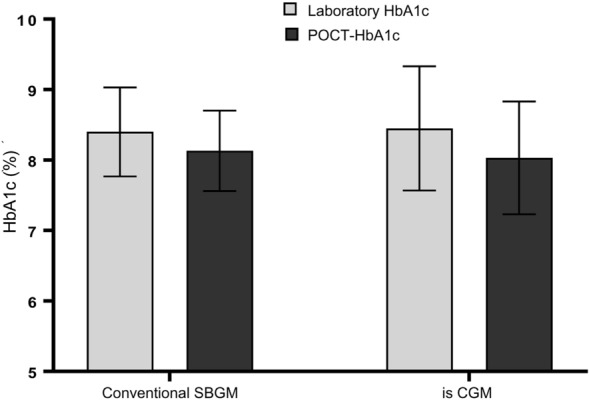
Hemoglobin A1C (HbA1c) is an important marker for diabetes care management. With the increasing use of new technologies such as continuous glucose monitoring (CGM) and point-of-care testing (POCT), patients and their physicians have been able to monitor and continuously check their blood glucose levels in an efficient and timely manner. This study aimed to investigate the level of agreement between the standard laboratory test for HbA1c (Lab-HbA1c) with point-of-care testing (POCT-HbA1c) and glucose monitoring index (GMI) derived by intermittently scanned CGM (isCGM) or estimated average glucose (eAG) derived by conventional self-monitored blood glucose (SMBG) devices.
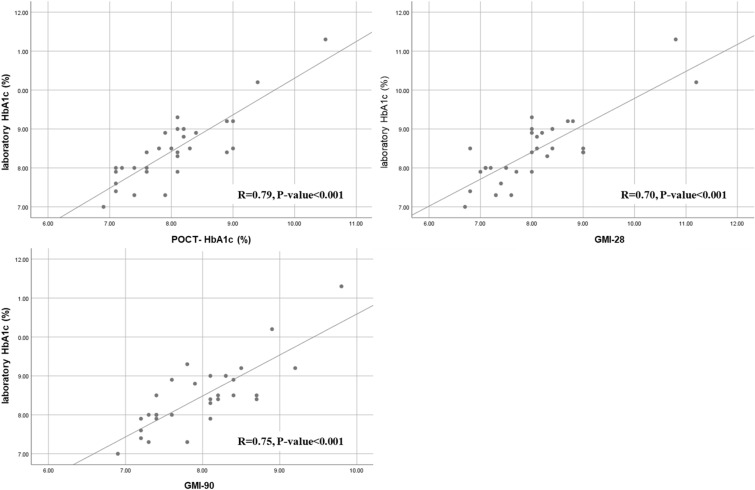
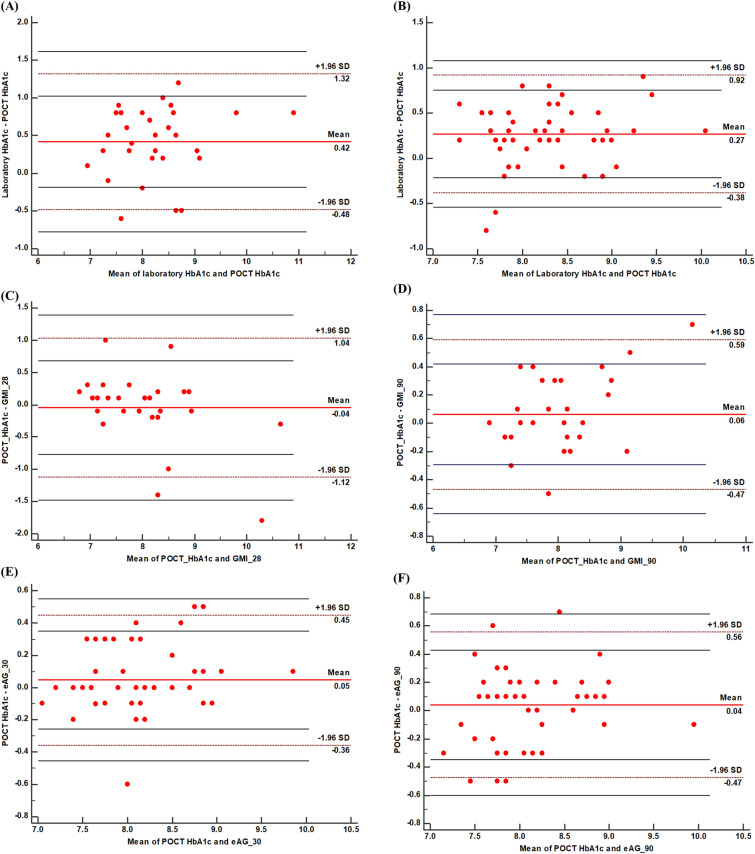
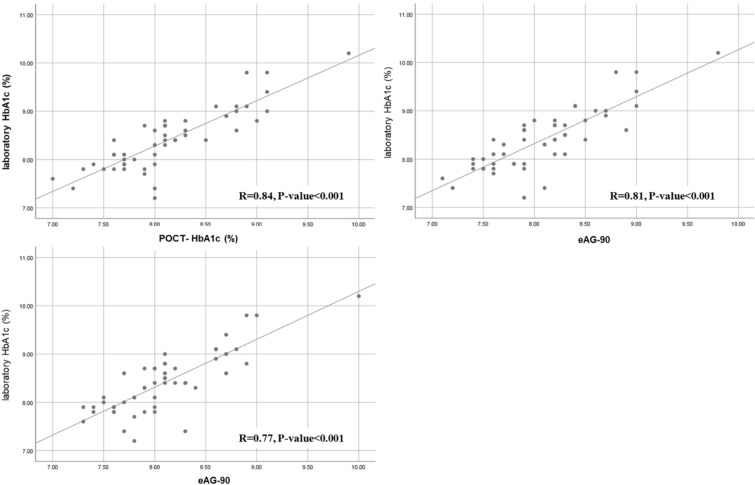
A cross-sectional study was conducted at the Diabetes Treatment Center, Prince Sultan Military Medical City, Saudi Arabia, between May and December 2020 with 81 patients with diabetes who used the isCGM system (n = 30) or conventional finger-pricking SMBG system (n = 51). At the same visit, venous and capillary blood samples were taken for routine HbA1c analysis by the standard laboratory and POCT methods, respectively. Also, for isCGM users, the GMI data for 28 days (GMI-28) and 90 days (GMI-90) were obtained, while for SMBG users, eAG data for 30 days (eAG-30) and 90 days (eAG-90) were calculated. The limits of agreement in different HbA1c measurements were evaluated using a Bland-Altman analysis. Pearson correlation and multivariate linear regression analyses were also performed.
Based on the Bland-Altman analysis, HbA1c levels for 96.7% and 96.1% of the patients analyzed by the POCT and the standard laboratory methods were within the range of the 95% limit of agreement in both isCGM and conventional SMBG users, respectively. About 93.3% of the GMI measurements were within the 95% limit of agreement. Also, about 94.12% of the eAG-30 and 90.2% of the eAG-90 measurements were within the 95% limit of agreement. Moreover, the correlation analysis revealed a statistically significant positive correlation and linear regression among Lab-HbA1c, POCT-HbA1c, GMI, and eAG in both conventional SMBG and isCGM users (all p < 0.001). These positive results persisted significantly after adjusting for different factors (all p < 0.001).
GMI derived by isCGM or eAG derived by conventional SMBG systems, as well as the POCT-HbA1c measurements, showed a high level of agreement; therefore, we recommend them as potential methods for diabetes monitoring, especially when a rapid result is needed or with patients with uncontrolled diabetes or on intensive insulin therapy.
糖化血红蛋白(HbA1c)是糖尿病护理管理的重要指标。随着持续葡萄糖监测(CGM)和即时检验(POCT)等新技术的使用日益增加,患者及其医生能够高效、及时地监测和持续检查血糖水平。本研究旨在调查糖化血红蛋白的标准实验室检测(实验室-HbA1c)与即时检验(POCT-HbA1c)以及通过间歇性扫描CGM得出的葡萄糖监测指数(GMI)或通过传统自我血糖监测(SMBG)设备得出的估计平均血糖(eAG)之间的一致性水平。
2020年5月至12月在沙特阿拉伯苏丹王子军事医疗城糖尿病治疗中心进行了一项横断面研究,研究对象为81例使用CGM系统(n = 30)或传统指尖采血SMBG系统(n = 51)的糖尿病患者。在同一次就诊时,分别采集静脉血和毛细血管血样本,通过标准实验室方法和POCT方法进行常规HbA1c分析。此外,对于使用CGM的患者,获取了28天(GMI-28)和90天(GMI-90)的GMI数据,而对于使用SMBG的患者,计算了30天(eAG-30)和90天(eAG-90)的eAG数据。使用Bland-Altman分析评估不同HbA1c测量值的一致性界限。还进行了Pearson相关性分析和多元线性回归分析。
基于Bland-Altman分析,POCT和标准实验室方法分析的患者中,分别有96.7%和96.1%的HbA1c水平在CGM和传统SMBG使用者的95%一致性界限范围内。约93.3%的GMI测量值在95%一致性界限范围内。此外,约94.12%的eAG-30和90.2%的eAG-90测量值在95%一致性界限范围内。此外,相关性分析显示,在传统SMBG和CGM使用者中,实验室-HbA1c、POCT-HbA1c、GMI和eAG之间存在统计学上显著的正相关和线性回归(所有p < 0.001)。在调整不同因素后,这些阳性结果仍然显著(所有p < 0.001)。
通过CGM得出的GMI或通过传统SMBG系统得出的eAG,以及POCT-HbA1c测量值,显示出高度一致性;因此,我们推荐它们作为糖尿病监测的潜在方法,特别是在需要快速结果时,或对于血糖控制不佳的患者或接受强化胰岛素治疗的患者。