Jeon Sae-Rom, Kang Jung Won, Ang Lin, Lee Hye Won, Lee Myeong Soo, Kim Tae-Hun
Department of Clinical Korean Medicine, Graduate School, Kyung Hee University, Seoul, Republic of Korea.
Department of Acupuncture and Moxibustion, College of Korean Medicine, Kyung Hee University, Seoul, Republic of Korea.
Integr Med Res. 2022 Sep;11(3):100842. doi: 10.1016/j.imr.2022.100842. Epub 2022 Mar 13.
Since the beginning of the Coronavirus disease 2019 (COVID-19) pandemic, various complementary and alternative medicines (CAMs) have been used in clinical practice. In this overview, we summarized the evidence for CAM interventions in the treatment of COVID-19 patients.
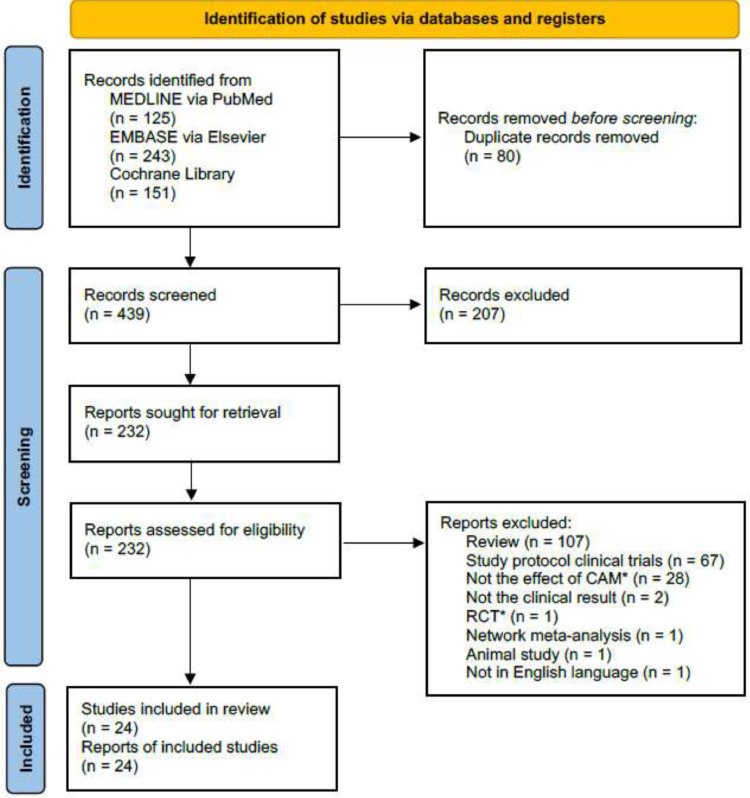
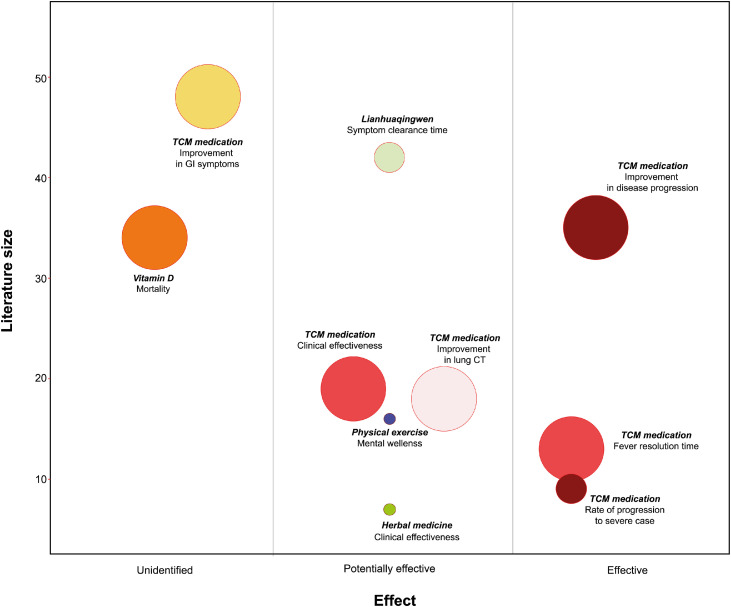
For this overview, PubMed, Embase and Cochrane Library were searched from inception to October 2021. Systematic reviews (SRs) on the effectiveness and safety of CAM interventions for COVID-19 patients were located, and the MeaSurement Tool to Assess Systematic Reviews 2 (AMSTAR 2) was used to evaluate the reporting quality of the included SRs. Keywords including COVID-19 and CAM interventions were used for locating SRs. For evidence mapping, we created a two-dimensional bubble plot that included the width and strength of the evidence for each CAM intervention and specific outcome.
In this overview, we identified 24 SRs (21 for Traditional Chinese Medicine (TCM) medications, two for vitamin D and one for home-based activity). From the included SRs, TCM herbal medications were reported to show good results in decreasing the rate of disease progression (relative risk (RR) 0.30, 95% confidence intervals (CI) [0.20, 0.44]), time to the resolution of fever (standard mean difference (SMD) -0.98, 95% CI [-1.78, -0.17]) and rate of progression to severe COVID-19 cases (RR 0.34, 95% CI [0.18, 0.65]), but the evidence for other interventions did not show effectiveness with certainty. Gastric disturbance was a major adverse event of TCM medications.
There is evidence that TCM medications are effective in the symptom management of COVID-19 patients. However, evidence for the effectiveness of most CAM interventions still needs evaluation.
自2019年冠状病毒病(COVID-19)大流行开始以来,各种补充和替代医学(CAM)已在临床实践中使用。在本综述中,我们总结了CAM干预措施治疗COVID-19患者的证据。
对于本综述,从创刊至2021年10月检索了PubMed、Embase和Cochrane图书馆。查找了关于CAM干预措施对COVID-19患者有效性和安全性的系统评价(SR),并使用评估系统评价的测量工具2(AMSTAR 2)来评估纳入SR的报告质量。使用包括COVID-19和CAM干预措施在内的关键词来查找SR。为了进行证据映射,我们创建了一个二维气泡图,其中包括每种CAM干预措施和特定结果的证据宽度和强度。
在本综述中,我们确定了24项SR(21项针对中药,2项针对维生素D,1项针对居家活动)。从纳入的SR中,据报道中药在降低疾病进展率(相对风险(RR)0.30,95%置信区间(CI)[0.20,0.44])、发热消退时间(标准平均差(SMD)-0.98,95%CI[-1.78,-0.17])和进展为重症COVID-19病例的发生率(RR 0.34,95%CI[0.18,0.65])方面显示出良好效果,但其他干预措施的证据并未明确显示出有效性。胃部不适是中药的主要不良事件。
有证据表明中药在COVID-19患者的症状管理中有效。然而,大多数CAM干预措施有效性的证据仍需评估。